
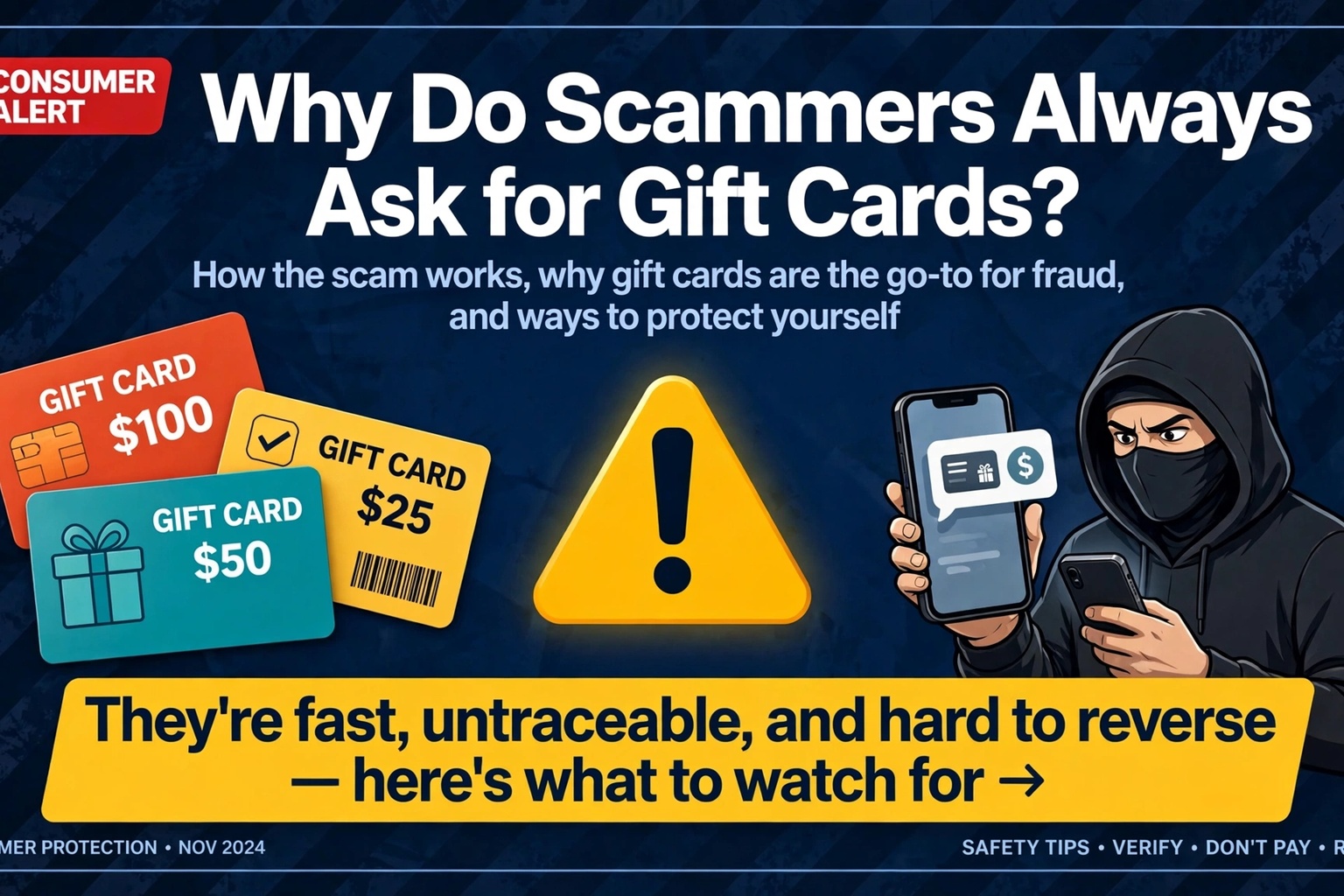
‘Can you grab some Apple gift cards and send me the codes? It’s the only way I can pay the hospital from here.’ If you’ve dated online long enough, you’ve seen some version of this sentence. The gift card request is so characteristic of romance scams that federal agencies list it alongside wire transfers and crypto as a hallmark of fraud. But why gift cards? What’s so special about a rectangle of plastic from a drugstore?
The answer is simple: gift cards are cash with no take-backs.
The mechanics of the gift card drain
The FTC spells it out in its romance scam guidance: scammers tell victims to put money on gift cards — Amazon, Google Play, iTunes, Steam — and hand over the PIN codes. The moment you read those codes aloud or photograph the back of the card, the value is gone. The scammer drains the balance online within minutes, often reselling the codes at a discount on secondary markets. There’s no bank to call, no fraud department to reverse it, no ‘pending transaction’ to cancel.
That’s the entire appeal. The FTC’s framing is that scammers want your money ‘in a way that makes it hard for you to get it back.’ Gift cards are the purest version: instant, anonymous, irreversible.
Why it works psychologically
Gift cards feel small. Nobody feels like they’re wiring their life savings when they’re buying a $200 card at checkout — so victims buy five, then ten, then twenty, each purchase feeling manageable while the total climbs into the thousands. The denomination disguises the scale.
They also feel legitimate. Gift cards are sold everywhere, associated with birthdays and holidays, and buying one doesn’t trigger the internal alarm that ‘wire $5,000 to Nigeria’ would. Scammers exploit that normalcy — the request sounds like an errand, not a heist.
The rule that kills this scam
No legitimate person — no soldier, no surgeon, no oil rig engineer, no customs official — needs you to pay their emergency with iTunes gift cards. Ever. Real hospitals take credit cards. Real lawyers take checks. Real emergencies don’t run on Steam wallet codes.
The FTC’s broader data underscores why this matters at scale: reported losses to scams originating on social media are eight times higher than in 2020, and romance scams alone accounted for $298 million in reported social-media-originated losses in 2025. The gift card is one of the main pipes carrying that money out.
So if a sweetheart you haven’t met in person asks for gift cards, you don’t have a partner with an unusual payment problem. You have a scammer following a script — and the FTC’s advice is absolute: never send money or gifts to someone you haven’t met in person, stop communicating immediately, and report it at ReportFraud.ftc.gov.
The gift card demand has a sibling worth recognizing: the crypto wallet address. Both serve the identical function — moving your money into a channel with no reversals — and scammers switch between them based on what the victim finds less suspicious. An older victim might balk at ‘send Bitcoin to this address’ but comply with ‘grab some gift cards’; a younger one might reverse those reactions. The FTC lists wire transfers, gift cards, money transfer apps, and cryptocurrency together for a reason: they’re a menu of irreversible options, and the scammer will order whichever you’ll serve. The defense doesn’t require understanding blockchain or MoneyGram’s fee structure. It requires recognizing the pattern: a sweetheart you haven’t met in person, giving you payment instructions, on a deadline. That pattern is the whole scam — and the FTC’s answer to it is one sentence long.
Disclosure: The stories on Love Lies Abroad are based on publicly reported accounts. We are not stating these as facts — this is what was reported. If you are featured in a story and believe it is inaccurate, contact us and we will review it, correct it, or take it down.
Submit a correction, documentation, context, or a response for private editorial review. Contact the editorial desk.
Join the conversation
Load Facebook comments to read and reply using your Facebook account.