
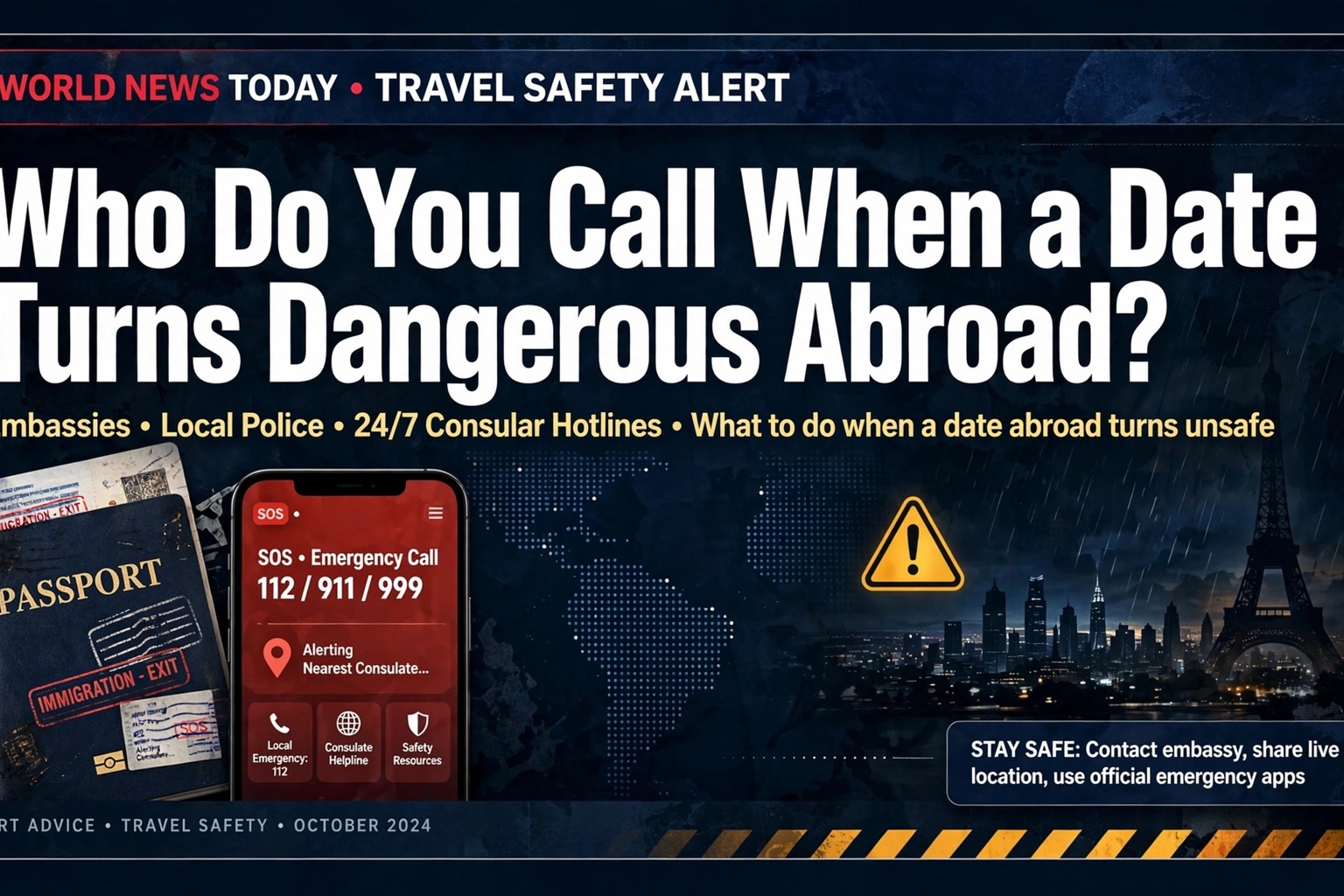
It is 11 p.m. in a city you do not know. The date has turned threatening — the charm is gone, his hand is on your arm, and the exit suddenly feels very far away. Who do you call?
If you are reading this for the first time right now, it is already late. Save these numbers before you fly. Every one of them works whether or not you speak the language.
The Numbers That Work Everywhere
112 — the international emergency number. It works across the European Union, and on most mobile networks worldwide it will connect you to local emergency services even without a SIM card or local plan. Program it now.
The local emergency number — 911 (U.S., much of Latin America), 999 (UK and many former British territories), 000 (Australia), 110/119 (Japan, China, parts of Asia). Look yours up for your specific destination before departure and save it under “Emergency” in your phone.
Your embassy or consulate. The U.S. State Department’s emergency line for citizens abroad is reachable 24/7, and every embassy lists a duty number for after-hours crises. Save the one nearest your destination. If you enrolled in STEP before traveling, they already know you are in the country.
Your travel insurance 24-hour line. Not the sales number — the emergency assistance line on the back of your policy. They coordinate medical evacuation, emergency transport, and hospital admission.
What to Say When You Call
Language barrier? Use the emergency phrases from our phrase guide, but know this: dispatchers worldwide are trained for the word “help” and your location. If you can say nothing else, say your location — hotel name, street, landmark — and stay on the line. An open line with a location is enough to dispatch help.
If Calling Is Not Safe
Sometimes the danger is in the room and a phone call would escalate it. That is what the duress word is for: one normal-sounding message to your check-in contact that means “call for help now.” Agree it in advance. Examples travelers use: asking about a fake appointment, mentioning a relative who does not exist, a specific emoji that never appears in normal chat.
Also know: in many countries you can text emergency services or use a safety app to silently alert contacts with your live location. Set that up before you need it.
The 60-Second Drill
Right now, wherever you are: open your phone, create a contact called “Emergency Abroad,” and put the destination’s emergency number, the embassy number, and your insurance line in it. Sixty seconds. Then tell your check-in contact you did it.
The women who get help fast are not the ones who stay calmest. They are the ones who prepared the call before they ever needed to make it.
After the Call: What Happens Next
Knowing the number is half the battle. The other half is knowing what to expect: emergency dispatchers will ask for your location first, then the nature of the emergency. Give the location even if you are unsure — a hotel name, a street, a landmark, “near the big mosque” — and stay on the line. If you are moved, keep narrating: street names, shop signs, anything visible. Dispatchers can work with fragments; they cannot work with silence.
And if the threat is a person you came with — someone who followed you, someone whose behavior turned — you do not need to explain the relationship. “I need help. I am at [location]. Please send police.” That sentence has no wrong version. Say it in any language, in any order, and help comes.
Sources
- Wikipedia — Emergency telephone number
- UK Foreign, Commonwealth & Development Office — Travel Advice
- Wikipedia — Smart Traveler Enrollment Program
Disclosure: The stories on Love Lies Abroad are based on publicly reported accounts. We are not stating these as facts — this is what was reported. If you are featured in a story and believe it is inaccurate, contact us and we will review it, correct it, or take it down.
Submit a correction, documentation, context, or a response for private editorial review. Contact the editorial desk.
Join the conversation
Load Facebook comments to read and reply using your Facebook account.