
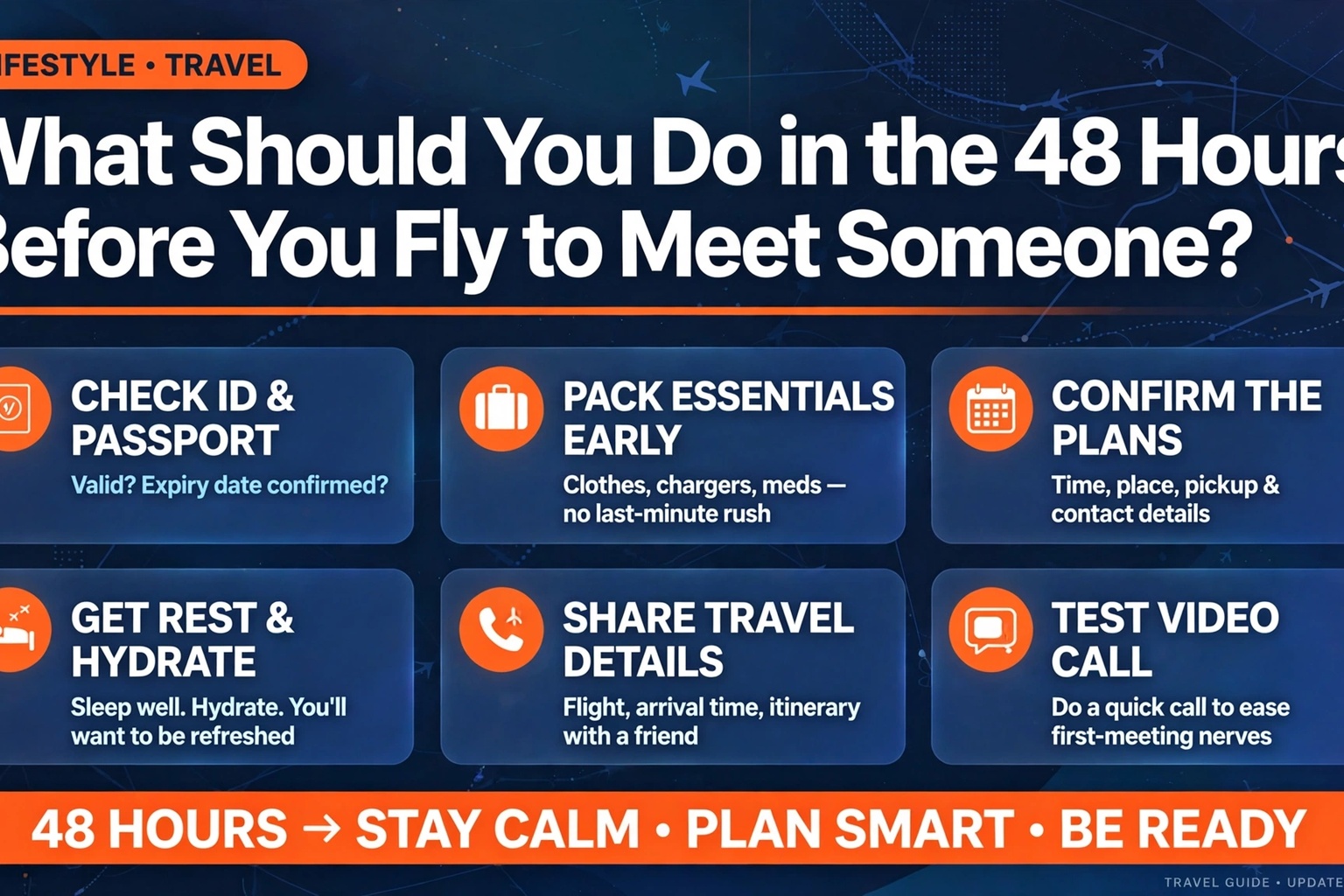
You booked the flight. You told yourself it would be fine. Now you have 48 hours, a suitcase, and a person waiting on the other side of the world who you have never stood in the same room with. This is the window where smart travelers separate from lucky ones.
Everything below takes less than two days and costs almost nothing. Skip any of it and you are gambling. Do all of it and you land with a safety net already in place.
24 Hours Out: Paper Trail
1. Register with your embassy. U.S. citizens can enroll in the State Department’s Smart Traveler Enrollment Program (STEP) — a free service that sends embassy alerts and helps officials reach you in an emergency. It takes minutes at the official STEP site.
2. Photograph every document. Passport photo page, visa, travel insurance, flight confirmations, hotel booking. Store copies in your email and a cloud folder someone at home can access.
3. Write down the address where you are staying — the real one, not “his place.” If you do not have a hotel booked, book one now. Never fly to another country with no independent place to sleep.
4. Save emergency numbers in your phone — the local equivalent of 911 for your destination, plus the nearest U.S. embassy or consulate number, plus your travel insurance 24-hour line.
5. Tell two people your full itinerary. Flight numbers, dates, where you are staying, who you are meeting, their full name and phone number. Not one person — two, so a single missed call does not become a single point of failure.
12 Hours Out: The Check-In Contract
6. Set a check-in schedule. Agree on specific times you will message home — morning and night at minimum. Decide in advance what happens if you miss one: how long before your contact starts calling, and who they call next.
7. Agree on a duress word. A normal-sounding word or phrase that means “I am not okay, get help.” It must be something you would never say casually.
8. Turn on location sharing with your check-in contact for the full trip. Not just “find my friends” — continuous sharing they can see without asking you.
9. Charge everything and pack a power bank. A dead phone abroad is not an inconvenience. It is the loss of your map, your translator, your lifeline, and your proof of where you are.
10. Screenshot offline maps of the area around your hotel and the airport. If your data plan fails on arrival, you still know where you are going.
At the Gate: Final Gut Check
11. Confirm your return flight is booked and paid. Not “we’ll figure it out.” A confirmed seat home, on a date you chose, that nobody else controls.
12. Carry emergency cash in two places — some on you, some in your luggage. Enough for a taxi to the embassy and one night in a hotel, minimum.
13. Ask yourself the hard question: if this person turned out to be dangerous, what is my exact plan? Name the hotel, the taxi app, the embassy address. If you cannot answer, you are not ready to board.
None of this is paranoia. Every item on this list exists because someone, somewhere, needed it and did not have it. The women who come home safe are rarely the lucky ones — they are the prepared ones.
Sources
- Wikipedia — Smart Traveler Enrollment Program
- UK Foreign, Commonwealth & Development Office — Travel Advice
- Wikipedia — Emergency telephone number
Disclosure: The stories on Love Lies Abroad are based on publicly reported accounts. We are not stating these as facts — this is what was reported. If you are featured in a story and believe it is inaccurate, contact us and we will review it, correct it, or take it down.
Submit a correction, documentation, context, or a response for private editorial review. Contact the editorial desk.
Join the conversation
Load Facebook comments to read and reply using your Facebook account.