
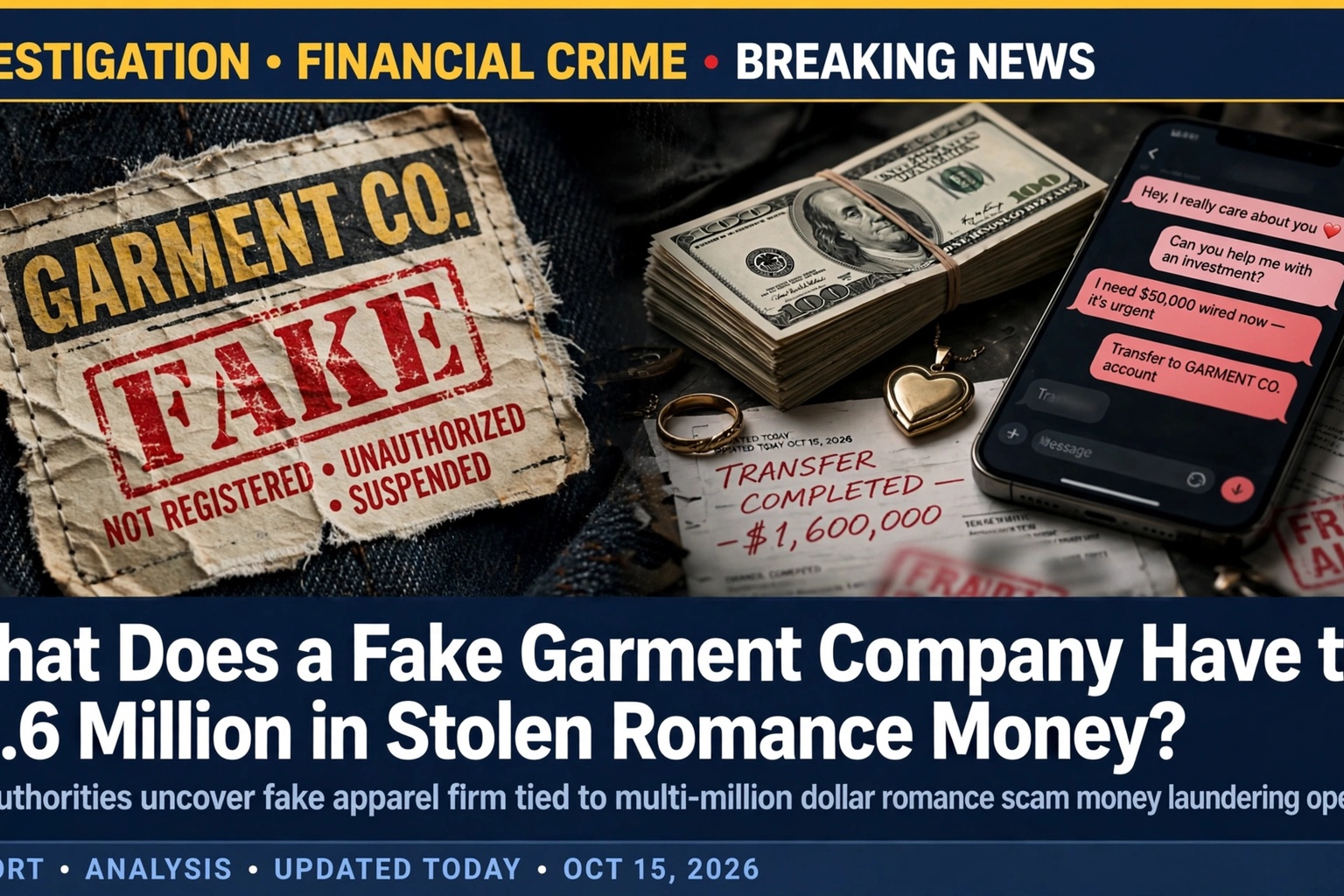
Nana Takyiwa Adonu, 43, of Odenton, Maryland, told the FBI she ran a legitimate business. Han-Dak LLC, she said, was a garment production company making clothing in China. When federal agents came asking questions about the millions flowing through its accounts, she produced invoices, customer lists, and vendor lists to prove it.
None of it was real.
According to the U.S. Attorney’s Office for the Southern District of Iowa, Han-Dak LLC existed for one purpose: to receive money from romance scam victims. Adonu received more than $1.6 million from people who believed they were sending funds to romantic partners they had met on dating sites and social media — partners who told them the money would help the couple finally unite. Instead, victims drained retirement accounts, sold homes and vehicles, returned to work after retiring, and borrowed from friends and family.
One victim lived in the Southern District of Iowa. He sent more than $55,000. His case became the thread prosecutors pulled to unravel the whole operation.
What elevated Adonu’s case from fraud to something prosecutors treated with special seriousness was the cover-up. After the FBI confronted her, she didn’t just deny the scheme — she manufactured an entire paper reality. In response to a federal grand jury subpoena, she produced false invoices and fabricated customer and vendor lists, attempting to launder the investigation itself. That obstruction, layered on top of the money laundering, helped drive the sentence: 70 months in federal prison, handed down on July 22, 2026.
The financial reckoning was precise. Adonu was ordered to pay $1,655,640.76 in restitution — nearly down to the cent. After prison, she faces three years of supervised release.
Her co-defendant, Naabanyin Aniagyei-Cobbold, 30, of Connecticut, received an even stiffer sentence: 108 months. He operated a parallel shell company, Alpha Distributions LLC, and recruited and coached at least one other person in building sham entities, websites, and bank accounts to receive victim funds. In a detail prosecutors made sure the court saw, Aniagyei-Cobbold had created and starred in a music video titled “S.C.A.M.,” posing beside a car with the word spelled out on the hood in hundred-dollar bills, rapping about receiving “scam money” and “laundering it up.”
The Iowa cases are a reminder of how romance fraud has industrialized. The scammers who write the love letters are rarely the ones who collect the money. Between them sits a layer of American-based money movers — people like Adonu — who open LLCs, rent mailboxes, and give stolen money a clean address. Taking them out doesn’t end the scams. But it does make them more expensive to run.
Sources: U.S. Department of Justice — Maryland Woman and Ghanaian National Sentenced to 70 Months (2026); U.S. Department of Justice — Connecticut Man Sentenced to Nine Years (2026)
Disclosure: The stories on Love Lies Abroad are based on publicly reported accounts. We are not stating these as facts — this is what was reported. If you are featured in a story and believe it is inaccurate, contact us and we will review it, correct it, or take it down.
Submit a correction, documentation, context, or a response for private editorial review. Contact the editorial desk.
Join the conversation
Load Facebook comments to read and reply using your Facebook account.