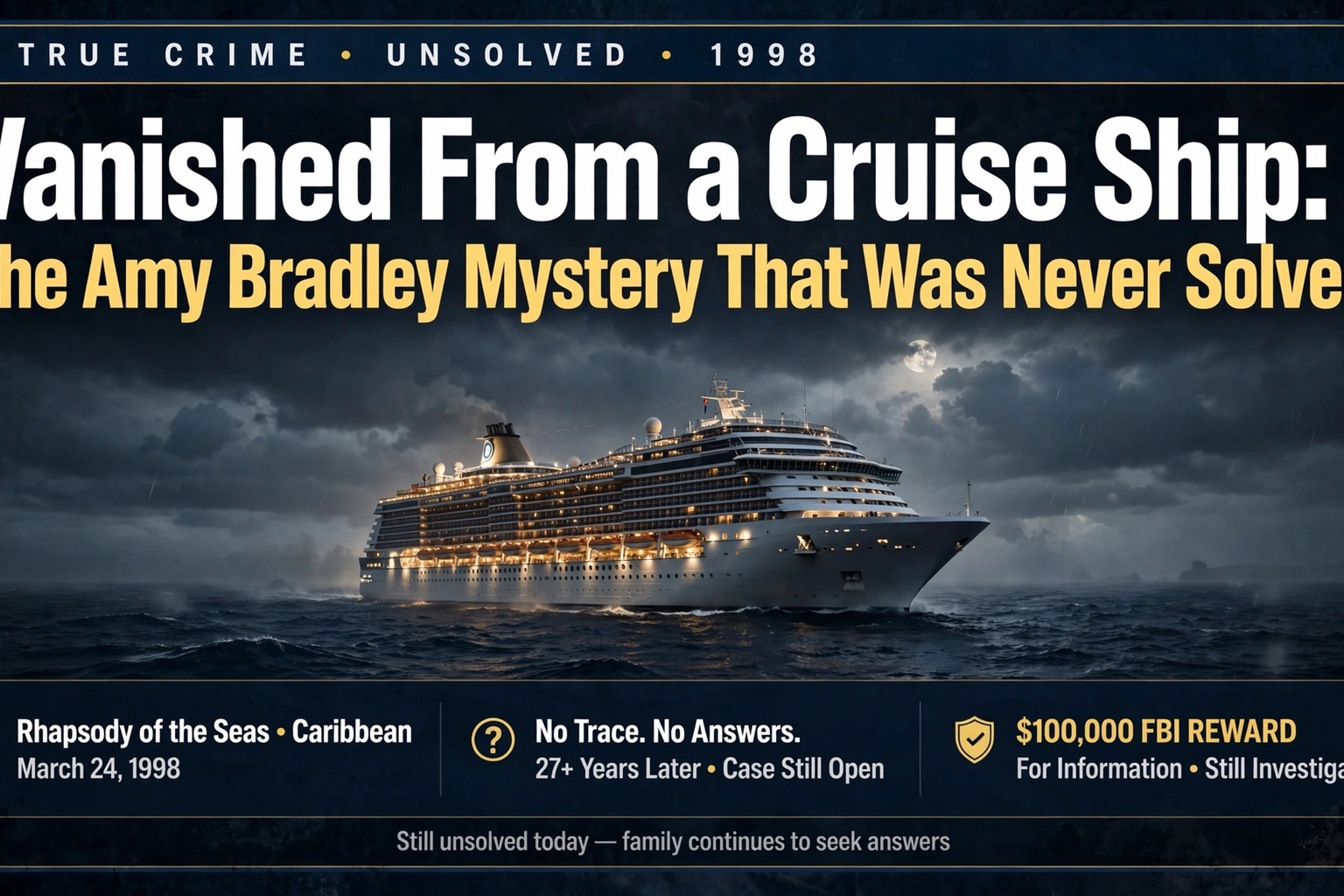
Amy Lynn Bradley was 23 years old, a recent college graduate from Virginia, when she boarded Royal Caribbean’s Rhapsody of the Seas with her family in March 1998. It was supposed to be a carefree Caribbean cruise. She never came home.
According to the FBI, the ship departed San Juan, Puerto Rico, on March 21, 1998, stopped in Aruba, and was sailing toward Curacao when Amy disappeared in the early morning hours of March 24. Her father, Ron Bradley, last saw her sleeping on their cabin’s balcony around 5:30 a.m. When he checked again roughly half an hour later, she was gone. The balcony door stood open. There was no sign of a struggle, no splash, no scream heard by any of the ship’s 2,000 passengers.
What followed became one of the most criticized responses in cruise ship history. The ship’s crew did not announce her disappearance until nearly 7:50 a.m., by which point most passengers had already disembarked at Curacao. Investigators and advocates have long argued that the delay destroyed any chance of securing the ship or identifying who might have seen her in those critical hours.
Searches of the vessel and the surrounding waters found nothing. In the years since, reported sightings of Amy have surfaced across the Caribbean, including on Curacao itself, but none has ever been confirmed. Her family has pursued every lead, and the FBI still lists her as missing, offering a reward for information leading to her recovery and to whoever was responsible for her disappearance.
The case helped fuel demands for reform in how cruise lines handle disappearances at sea. It took more than a decade, but the Cruise Vessel Safety and Security Act of 2010 eventually required ships to report missing persons to the FBI and the Coast Guard, preserve surveillance footage, and maintain crime logs. Advocates say those reforms exist in large part because of families like the Bradleys, who refused to let the industry look away.
More than a quarter century later, the central questions remain unanswered. Did Amy fall overboard? Was she taken off the ship in Curacao? Was she abducted by someone she met on board? Her family has never stopped believing she may still be alive. The FBI has never closed the case. And the 30-minute window between a father’s two glances at a balcony remains one of the most haunting unsolved disappearances in American true crime.
In 2005, the case took a startling turn when someone emailed Amy’s family photographs from a Caribbean escort website. The FBI investigated the images, but the woman pictured was never confirmed to be Amy Bradley. The possibility that she had been trafficked rather than lost at sea electrified the case and convinced her family she might still be alive. Reported sightings continued for years, including accounts from Curacao and Barbados, but none was ever confirmed.
Decades later, the case found a new audience. In 2025, Netflix released the docuseries Amy Bradley Is Missing, revisiting the timeline and the theories, and hundreds of new tips poured in. Investigators described three of the new leads as very significant. Amy was legally declared dead in 2010, yet she remains on the FBI’s active missing persons list, and the reward still stands. Her brother Brad has said the family will never stop looking. Somewhere in the Caribbean, they believe, the answer to what happened in those 30 minutes is still out there.
Sources: Wikipedia: Disappearance of Amy Lynn Bradley; FBI: Amy Lynn Bradley
Disclosure: The stories on Love Lies Abroad are based on publicly reported accounts. We are not stating these as facts — this is what was reported. If you are featured in a story and believe it is inaccurate, contact us and we will review it, correct it, or take it down.
Submit a correction, documentation, context, or a response for private editorial review. Contact the editorial desk.
Join the conversation
Load Facebook comments to read and reply using your Facebook account.