
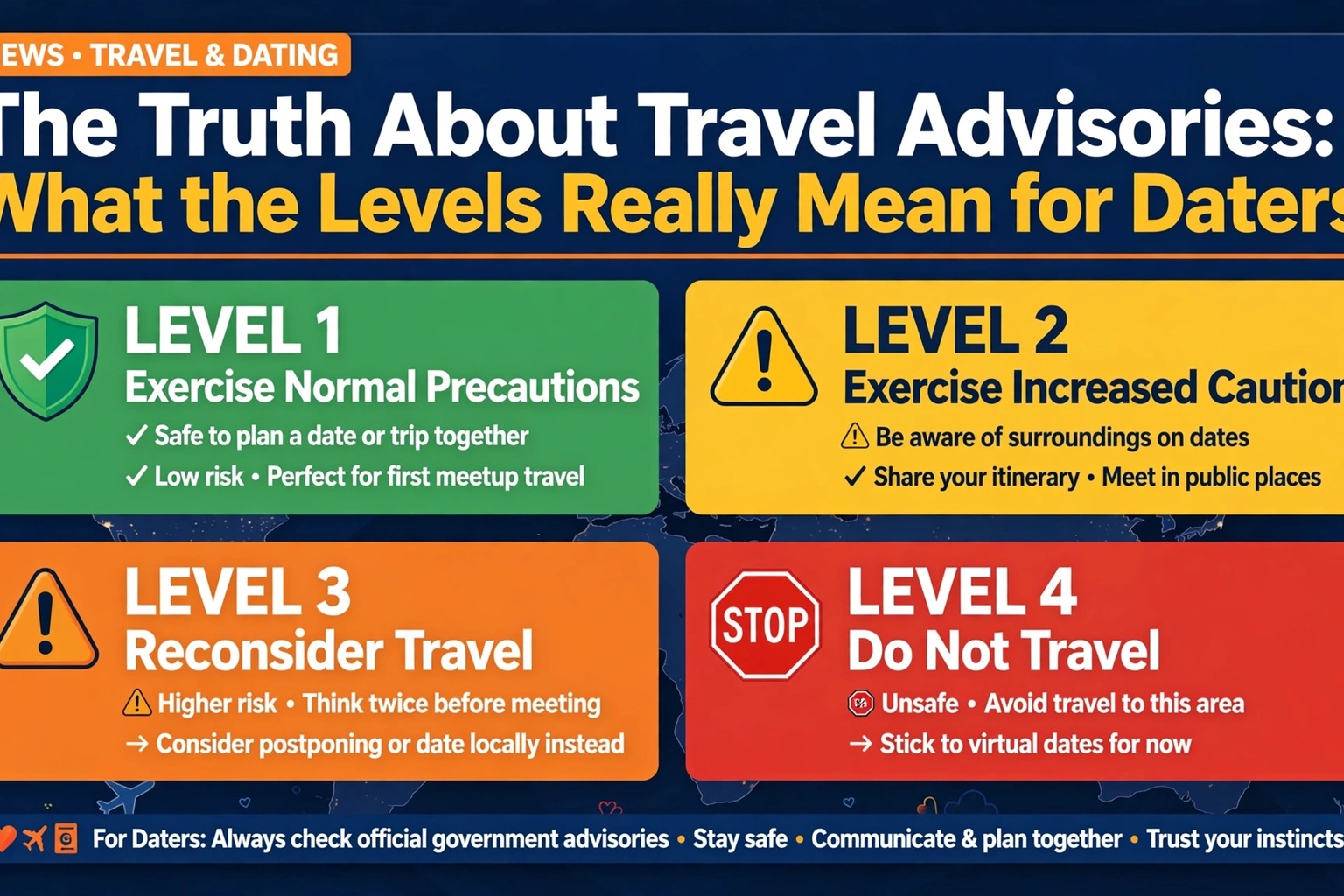
Before you book a flight to meet someone, you’ll probably hear the same advice from every corner of the internet: “check the travel advisory.” It sounds responsible. It sounds simple. But most cross-border daters have no idea what those advisories actually say — or how to use them when the question isn’t “should I visit this country” but “should I meet this person in this city on this date.”
Here’s the real story: travel advisories are one of the most misunderstood tools in a dater’s safety kit, and misunderstanding them cuts both ways. Some people treat a Level 2 advisory like a stop sign and cancel trips they’d have loved. Others wave away a Level 3 because “my date says it’s fine there.” Both mistakes come from the same place — reading the headline instead of the details.
What the levels actually mean
Governments publish travel advisories on tiered scales, and the wording matters. The U.S. State Department uses a four-level system: Level 1 means exercise normal precautions, Level 2 means exercise increased caution, Level 3 means reconsider travel, and Level 4 means do not travel. The UK’s FCDO travel advice takes a different but equally serious approach, with per-country pages covering safety and security, local laws, and entry requirements. Notice what’s missing from every system: there is no level that says “romance is safe here” or “dating is dangerous here.” Advisories assess country conditions — crime, civil unrest, terrorism, health risks — not your personal situation.
The detail pages are where the value lives. Each advisory breaks down risks by region within the country, because conditions in a capital city can differ wildly from a border province. If your date wants to meet in a region flagged for kidnapping risk while the capital is Level 2, that distinction matters more than the country’s overall color on the map.
How other governments say the same thing differently
Don’t rely on a single source. The UK Foreign, Commonwealth & Development Office publishes its own per-country advice with sections on safety, local laws, and entry requirements — and it sometimes differs from other governments’ assessments, which is useful data in itself. Canada’s travel.gc.ca portal publishes its own advisory levels with plain-language guidance. When two or three governments flag the same region for the same reason, that’s a strong signal. When they differ, read why — the reasoning teaches you more than the rating. And before any trip, run through the UK’s foreign travel checklist: insurance, documents, health prep, and a backup plan for the unexpected.
What advisories can’t tell you
This is the part nobody mentions: advisories are slow. They’re reviewed periodically, not in real time, and conditions can shift between updates. They also don’t cover the risks most specific to dating — a country’s advisory won’t warn you that meeting a stranger at their apartment is a bad idea. That’s your judgment call, and no government page makes it for you.
Use advisories the way they’re designed to be used: as a baseline for the destination, checked before you book and re-checked before you fly. Then layer your personal safety plan on top — public meetings, shared itineraries, check-in buddies, your own transport. The advisory tells you about the country. The rest is about the date. Don’t confuse the two, and don’t skip either one.
Disclosure: The stories on Love Lies Abroad are based on publicly reported accounts. We are not stating these as facts — this is what was reported. If you are featured in a story and believe it is inaccurate, contact us and we will review it, correct it, or take it down.
Submit a correction, documentation, context, or a response for private editorial review. Contact the editorial desk.
Join the conversation
Load Facebook comments to read and reply using your Facebook account.