
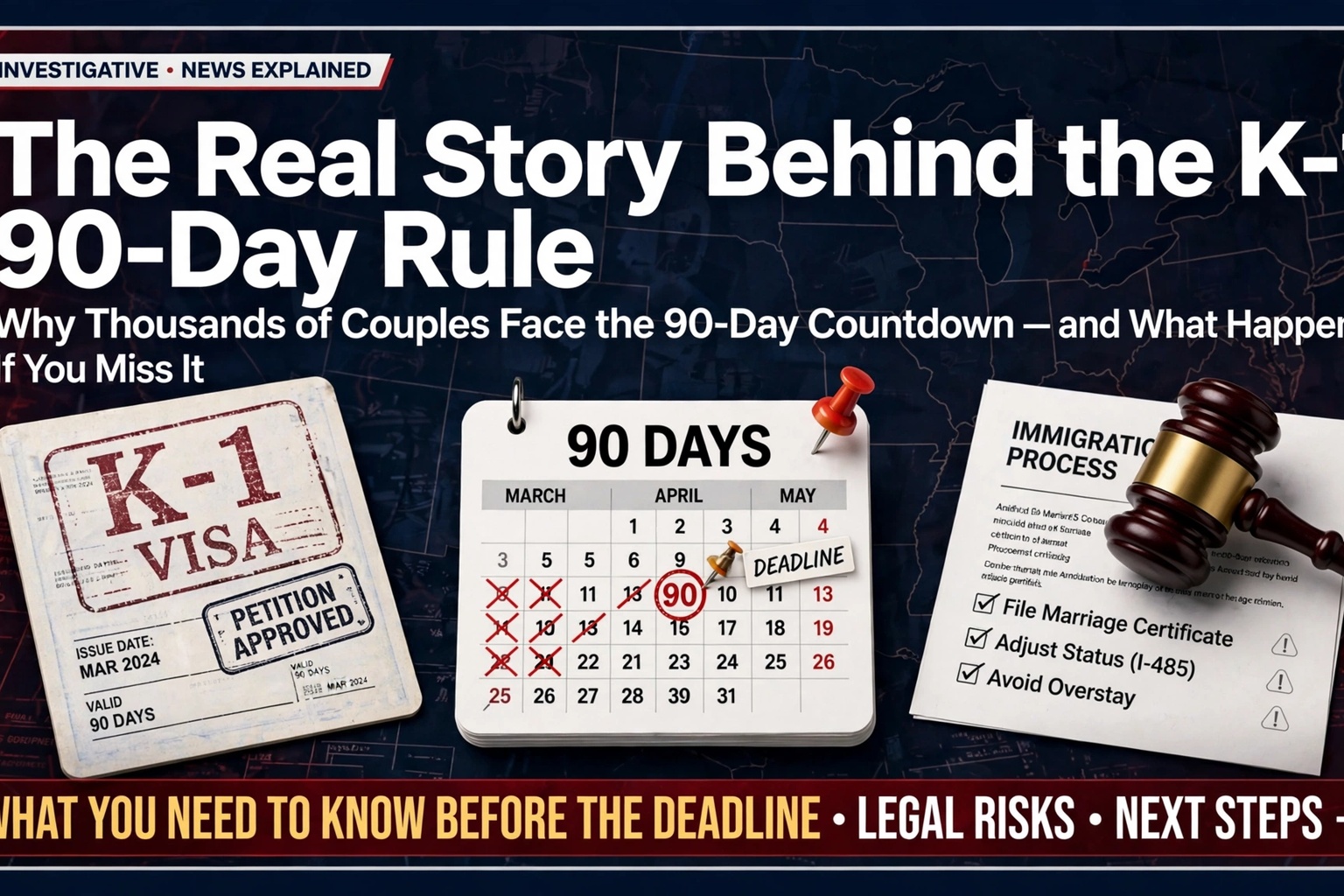
Every K-1 guide mentions the 90-day rule, but few explain why it exists, when the clock actually starts, or what happens when life gets in the way. The rule is simple to state: a person admitted to the United States on a K-1 visa must marry the U.S. citizen petitioner within 90 days of admission. The consequences of missing it are where the real story lives.
Why 90 days, and why it is strict
The K-1 category exists for one purpose: to let a foreign fiance(e) enter the United States to marry the petitioner. Congress built the 90-day window into the law so the visa could not become a back door to a long unauthorized stay. The K-1 is admitted for 90 days, period. There is no extension of K-1 status, no renewal, and no way to convert to another status from inside the country to buy time. The clock starts on the date of admission at the port of entry — not when the visa was issued, and not when the wedding invitations go out.
What counts as marrying
The marriage must be legally valid where it is performed — any U.S. state or territory works, and it does not have to be a large ceremony. A courthouse wedding on day 80 satisfies the law exactly as well as a ballroom wedding on day 30. What matters is a legal marriage to the petitioner, documented with a marriage certificate, because that certificate is the foundation of the adjustment of status filing that follows.
What the rule does not allow
A K-1 holder cannot satisfy the requirement by marrying someone other than the petitioner. The statute permits adjustment of status only based on the marriage to the petitioner who filed the I-129F. Marrying a different U.S. citizen does not cure a K-1 case; it leaves the person with no adjustment path from that admission. Similarly, the 90 days cannot be “paused” by leaving and reentering — the K-1 is a single-entry visa, and departure ends that admission.
Missing the deadline
If the marriage does not happen within 90 days, the K-1 holder falls out of status and is expected to depart. Staying accrues unlawful presence, which can trigger the three- and ten-year bars on reentry: departure after more than 180 days of unlawful presence brings a three-year bar; after a year or more, ten years. There is no waiver of the 90-day marriage requirement itself, and each month of unauthorized stay narrows whatever options remain.
The practical takeaway
Couples should land with a realistic wedding plan, not a vague intention. A marriage license appointment booked before travel, knowledge of the state’s waiting periods and ID requirements, and a backup courthouse option cost nothing and remove the most common failure mode: logistics eating the calendar. If genuine complications arise — serious illness, a family emergency — talk to an immigration attorney before day 90, not after. This article is informational only.
One more timing subtlety: the 90 days are calendar days from admission, and the admission is recorded on the I-94 arrival record. Couples should check the I-94 online after entry to confirm the admitted-until date matches their expectation — errors are rare but consequential when the entire case turns on a deadline.
Sources: https://www.uscis.gov/family/family-of-us-citizens/visas-for-fiancees-of-us-citizens https://www.uscis.gov/i-485
Disclosure: The stories on Love Lies Abroad are based on publicly reported accounts. We are not stating these as facts — this is what was reported. If you are featured in a story and believe it is inaccurate, contact us and we will review it, correct it, or take it down.
Submit a correction, documentation, context, or a response for private editorial review. Contact the editorial desk.
Join the conversation
Load Facebook comments to read and reply using your Facebook account.