
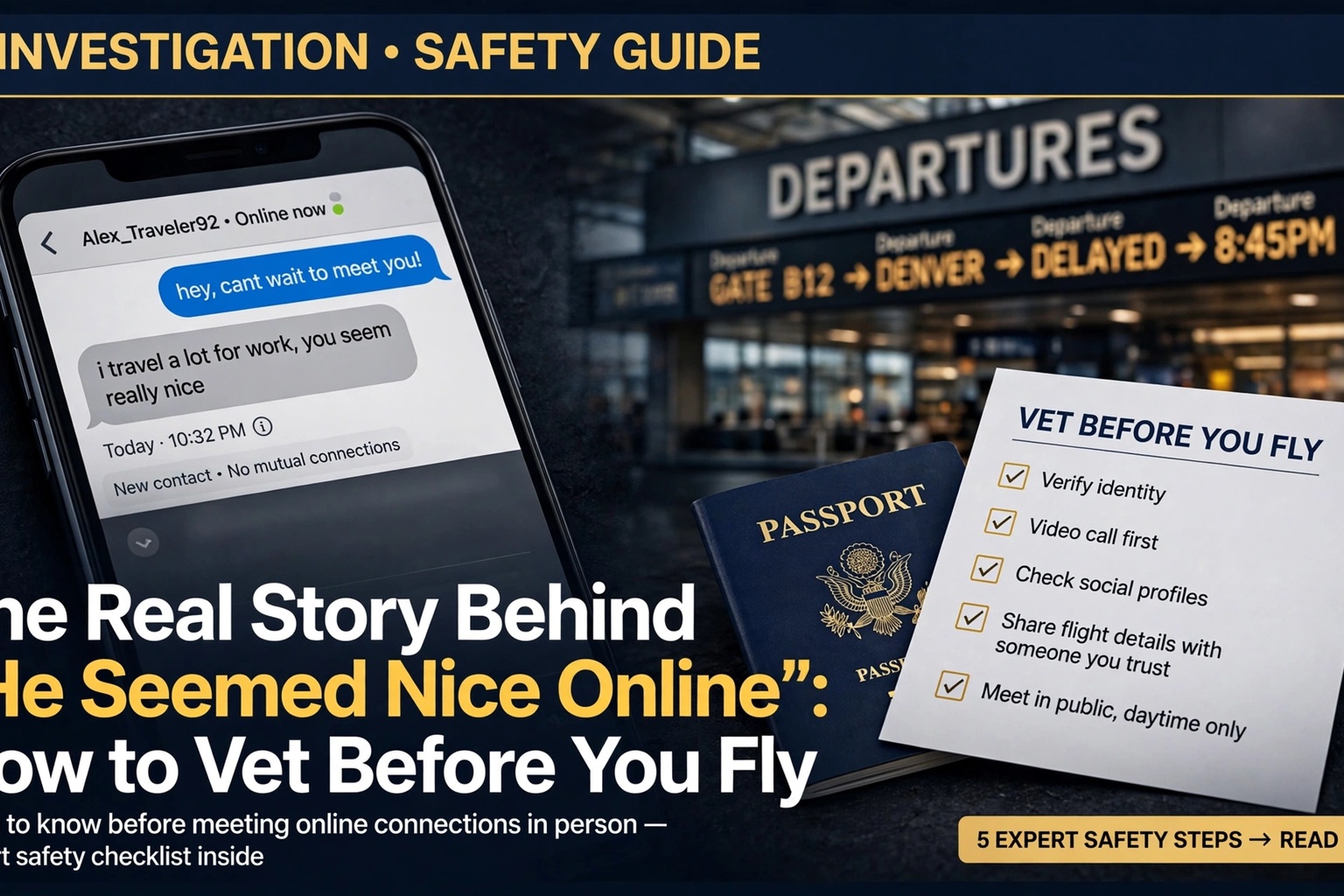
“He seemed nice online.” It is the sentence behind so many stories that ended badly — not because the women who said it were foolish, but because “seems nice” was the entire background check. Online charm is cheap. Verification is not, and it is the difference between a love story and a cautionary tale.
Before you book the flight, run the person through this vetting process. Every step is legal, free or cheap, and non-negotiable.
Identity: Prove He Exists
1. Full legal name. Not a first name and a nickname. If he will not give his full name after months of talking, stop here.
2. Live video, unscripted. Not a recorded clip — a real-time call where you ask him to do something spontaneous: show you the street outside, introduce the cat, wave at the camera. Months of “broken camera” is not shyness. It is a red flag with an excuse attached.
3. Reverse-image search his photos. Save his profile pictures and run them through a reverse image search. Stock photos, celebrity shots, or images tied to other names end the conversation immediately.
4. Social footprint with history. Real profiles have years of posts, tagged photos by other people, comments from friends, a life that predates you. A profile created three months ago with twelve photos and no tags is a costume, not a person.
Story: Check the Details
5. Verify one independent fact. His workplace, his university, his business — one thing you can confirm without him. Search it. Call it. A real life leaves traces.
6. Track consistency. Keep notes on what he tells you — job, family, city, history. Lies drift; truth stays put. Re-read your notes monthly and look for the drift.
7. Meet his people — virtually. A video call with a friend or family member of his. Not a voice in the background — a face, a name, a relationship you can see. Isolated people are either very private or very fabricated.
Behavior: Watch the Pattern
8. Test a boundary early. Say no to something small — a call time, a photo request, a plan change — and watch the reaction. Respect is instant. Pressure, guilt, or cold withdrawal is the preview of everything.
9. Refuse secrecy. If he needs the relationship hidden from everyone you trust, ask why — and do not accept “they wouldn’t understand” as an answer. Secrecy protects him, not you.
10. Never send money, move money, or carry anything. Not a loan, not a gift card, not a package, not a suitcase. Financial requests are where romance ends and fraud begins — the FTC’s romance-scam reports put victim losses in the hundreds of millions annually.
The real story behind “he seemed nice online” is always the same: the vetting never happened. Ten steps, a few evenings of effort, and you either board the plane with confidence or you do not board it at all. Both outcomes are wins.
Sources
- National Domestic Violence Hotline — Warning Signs of Abuse
- UK Foreign, Commonwealth & Development Office — Travel Advice
- BusinessGhana — Romance scam: US woman freed after year as hostage in Nigeria
Disclosure: The stories on Love Lies Abroad are based on publicly reported accounts. We are not stating these as facts — this is what was reported. If you are featured in a story and believe it is inaccurate, contact us and we will review it, correct it, or take it down.
Submit a correction, documentation, context, or a response for private editorial review. Contact the editorial desk.
Join the conversation
Load Facebook comments to read and reply using your Facebook account.