
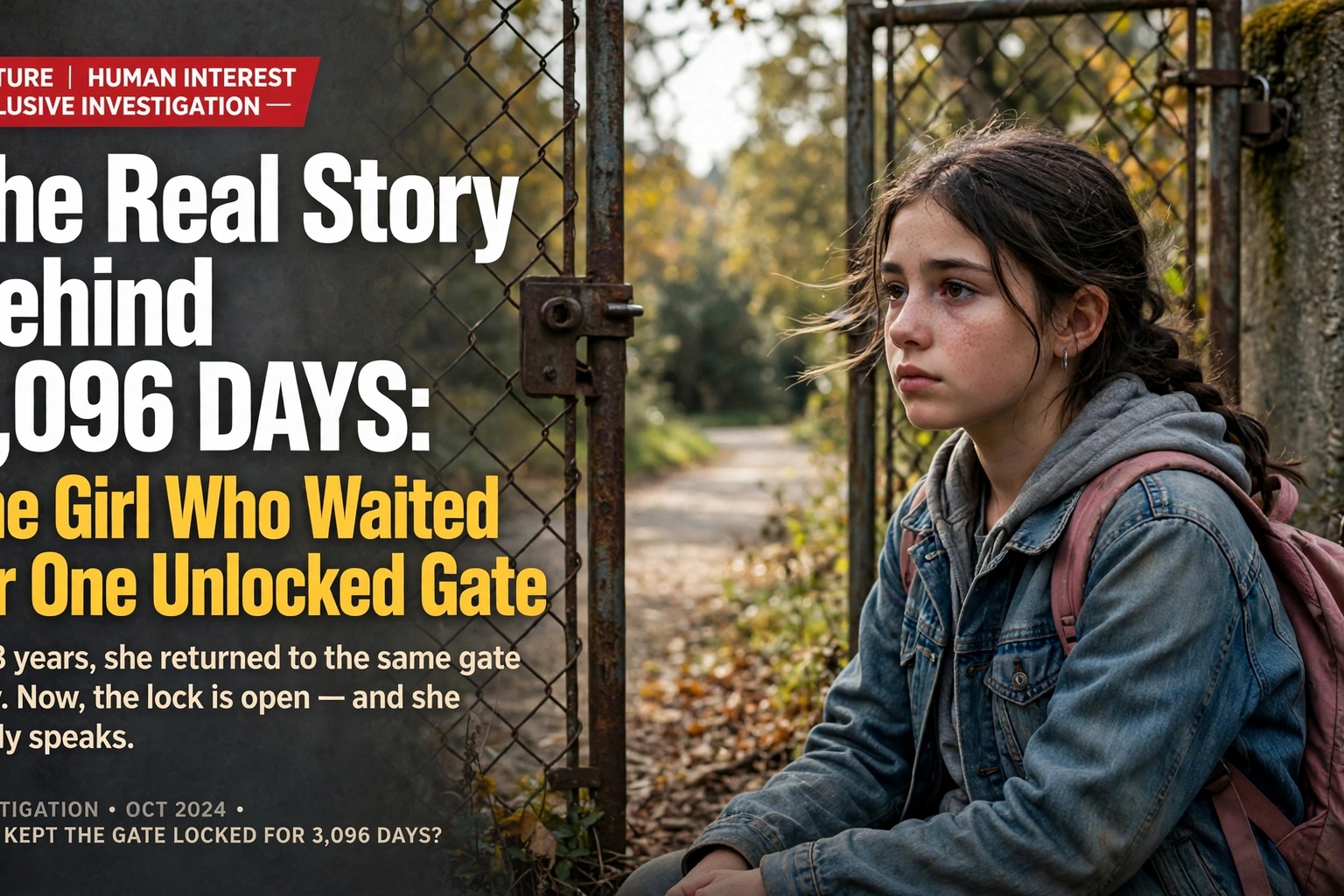
On March 2, 1998, ten-year-old Natascha Kampusch was walking to school in Vienna when Wolfgang Priklopil abducted her. What followed was 3,096 days — more than eight years — in a hidden, windowless cellar beneath his house in Strasshof, north-east of Vienna. She was 18 when she finally escaped on August 23, 2006.
This is the real story behind the number: not just the captivity, but the patience, the calculation, and the single unlocked gate.
Eight Years Underground
Kampusch was kept in a secret cellar, initially never allowed to leave it. Over the years, Priklopil gradually allowed her into the house — to clean, to cook — and eventually on tightly controlled outings, including shopping trips and even a skiing trip. She later said she tried desperately to catch the eyes of passersby, but none responded. He controlled her with threats: the doors and windows were booby-trapped, he said, and he would kill himself if she escaped.
She educated herself with books and a radio he provided. She never stopped watching for a chance.
The Escape
On the afternoon of August 23, 2006, Kampusch was in the driveway vacuuming Priklopil’s car. He received a phone call and stepped a few meters away to hear it over the vacuum’s noise — out of sight for the first time in years. She left the vacuum running, tiptoed to the gate, and found it unlocked. She ran to a neighbor’s house and told them who she was. Police were called. She was free.
Priklopil, realizing his captive was gone, threw himself under a train the same day — carrying out the threat he had used to control her for years.
After: The Second Battle
Kampusch wrote the memoir 3,096 Days (2010), later adapted into the German film 3096 (2013), and a second book, 10 Years of Freedom. She has spoken about the strange reality that the world wanted her story to be simple — pure victim, pure villain — when survival was far more complicated: she had negotiated, adapted, and waited for eight years for a few unwatched seconds.
The Lesson
Kampusch’s story is the extreme proof of a principle every traveler should internalize: captors depend on you believing escape is impossible. She survived by never accepting that — by staying alert through 3,096 days until the gate was unlocked.
Your version is smaller but the same: always know where the exits are. Always keep your phone on you. Always have a check-in contact expecting to hear from you. Never believe you have no options — there is always an embassy, a hotel lobby, a crowded street. The gate is unlocked more often than fear tells you. Be ready when it is.
Patience as a Survival Skill
What separates Kampusch’s story from most survival accounts is the timescale. She did not escape in days or weeks — she waited eight years, staying mentally intact, watching, until a few seconds of inattention created an opening. That kind of patience is almost impossible to imagine, and it carries a lesson that applies far beyond captivity: do not mistake a bad situation for a permanent one.
Travelers in frightening situations often freeze because they believe the moment defines the outcome. Kampusch’s life proves the opposite: the moment is just a moment. Keep thinking, keep watching, keep your options open — the phone in your pocket, the contact expecting your call, the embassy address in your notes — and when the gate unlocks, even for seconds, you are ready to run through it.
Sources
- All That’s Interesting — How Natascha Kampusch Survived 3096 Days
- GoodToKnow — What happened to Natascha Kampusch
Disclosure: The stories on Love Lies Abroad are based on publicly reported accounts. We are not stating these as facts — this is what was reported. If you are featured in a story and believe it is inaccurate, contact us and we will review it, correct it, or take it down.
Submit a correction, documentation, context, or a response for private editorial review. Contact the editorial desk.
Join the conversation
Load Facebook comments to read and reply using your Facebook account.