
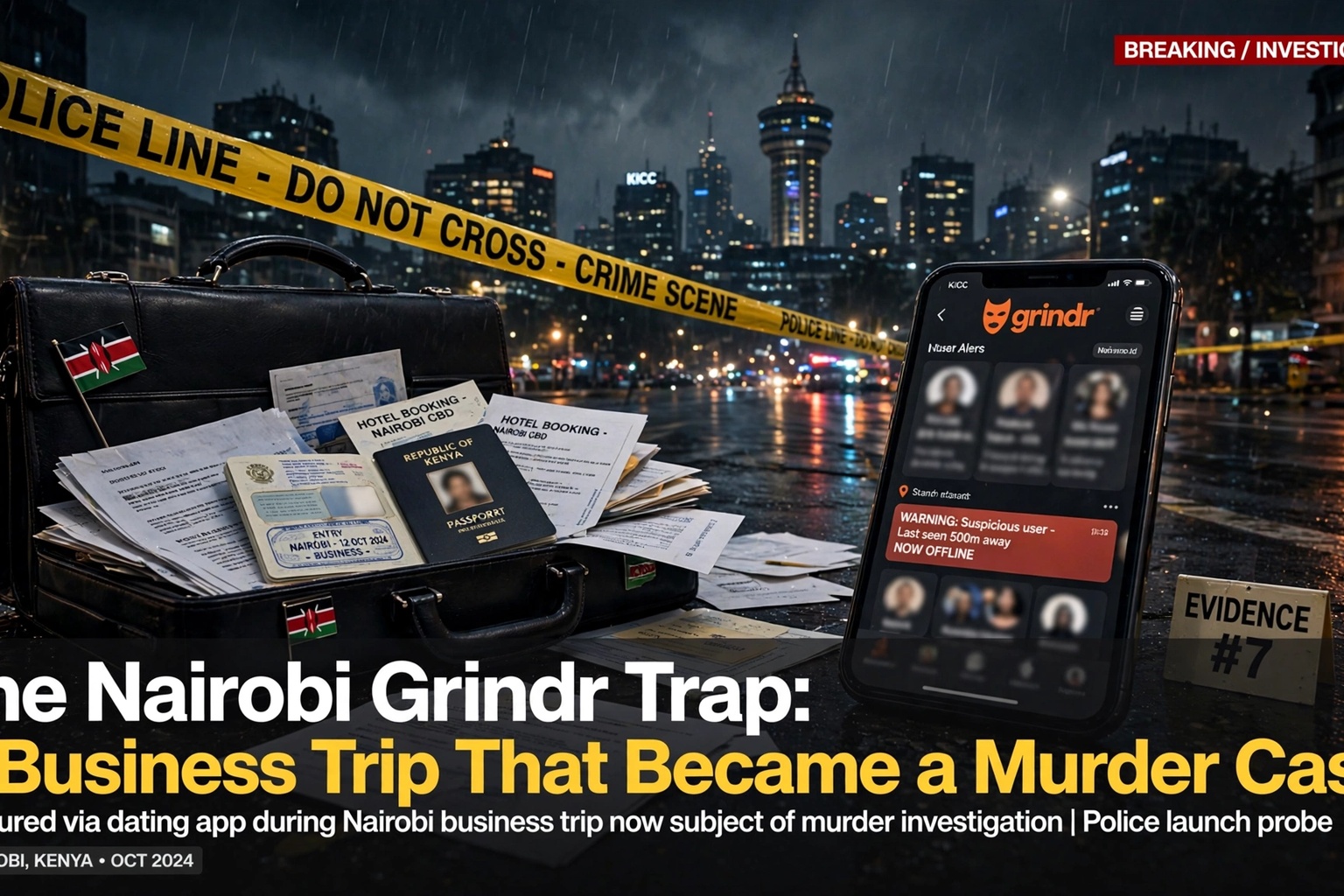
Campbell Scott landed in Nairobi on February 15, 2025, for what should have been a routine business trip. The British executive — a senior director at the credit-scoring giant FICO — was in Kenya for a conference. Days later, he was dead, and his case would expose something far bigger than one tragedy.
According to investigators, Scott was lured through a fake Grindr profile to the Pipeline area of Embakasi. What followed, police say, was a robbery that spiraled: bank withdrawals were made from his accounts in Nairobi, then Voi, then Mombasa — his captors moving with him across the country. On February 22, his body was found stuffed in a sack in Makongo Forest, in Makueni County.
Suspects have been arrested, and the case is moving toward trial. They have not been convicted, and the presumption of innocence applies — what follows is the allegation as investigators describe it, not a verdict.
But the Scott case matters beyond one victim because Kenyan authorities say it fits a pattern. A gang, police allege, has been systematically using dating apps to lure foreign nationals — promising a meeting, then kidnapping and robbing them. A Filipino man, Christopher Fadera, survived a nearly identical trap, giving investigators a living witness to the method.
This is the evolution the true-crime world has been warning about: the “lonely hearts” predator, industrialized. Not one manipulative stranger but an organized crew running dating profiles the way other gangs run phishing scams — at scale, with roles, with a pipeline (in every sense) for victims.
For anyone traveling for work or pleasure and opening a dating app in an unfamiliar city, the Nairobi cases are a cold-water warning. The profile you’re chatting with might be a person. It might be a shift worker. Verify before you meet, meet in public, and remember: in some cities, a dating app isn’t a dating app — it’s a hunting ground with a user interface.
Disclosure: The stories on Love Lies Abroad are based on publicly reported accounts. We are not stating these as facts — this is what was reported. If you are featured in a story and believe it is inaccurate, contact us and we will review it, correct it, or take it down.
Submit a correction, documentation, context, or a response for private editorial review. Contact the editorial desk.
Join the conversation
Load Facebook comments to read and reply using your Facebook account.