
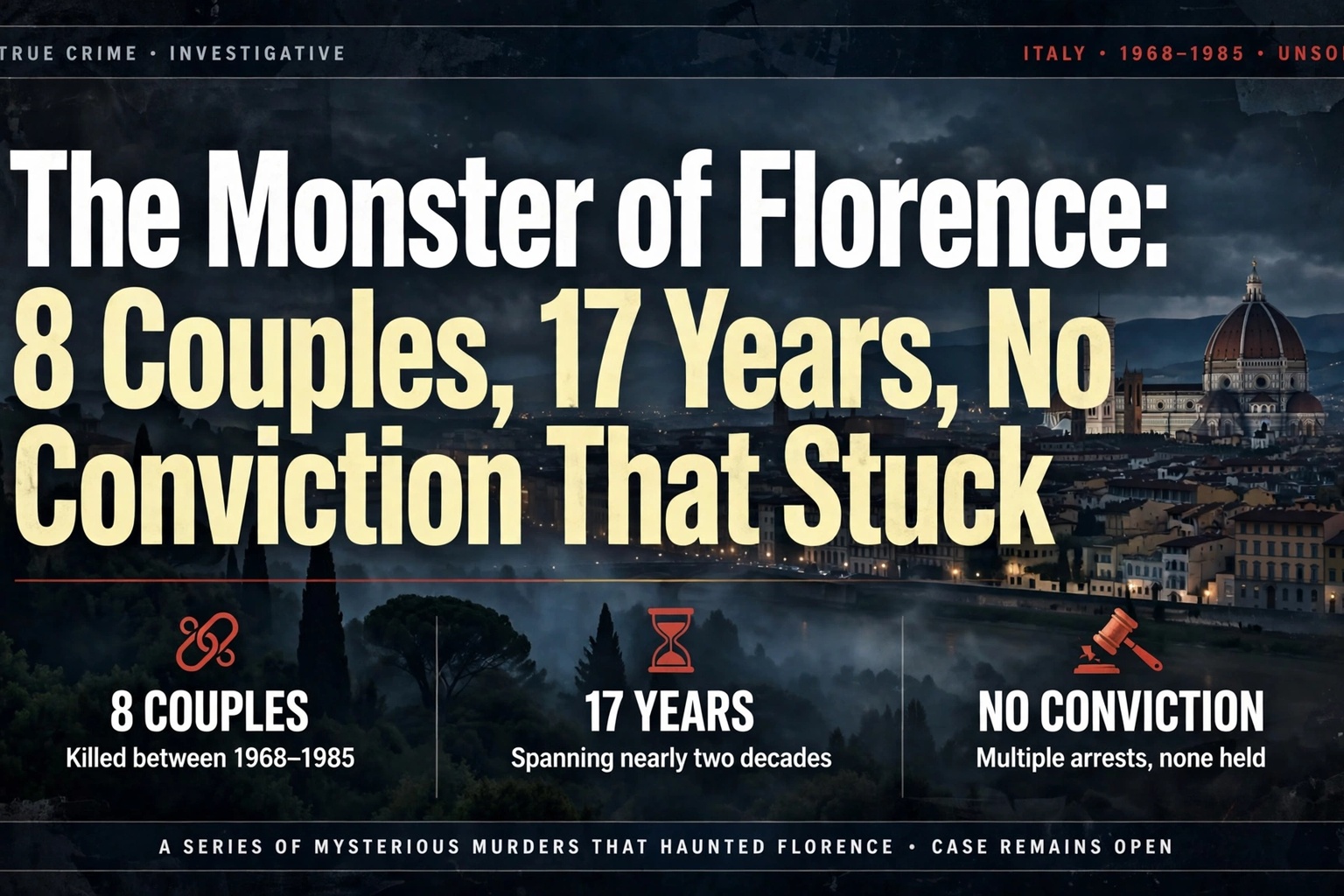
For seventeen years, couples parking on the lonely country roads around Florence, Italy, risked encountering Il Mostro — the Monster of Florence. Between 1968 and 1985, eight couples were shot dead in their cars in secluded lovers’ lanes, sixteen victims in all, killed with the same .22 caliber Beretta pistol. Several of the female victims were also stabbed and mutilated. The gun has never been found. Neither, definitively, has the killer.
The investigation became one of the most tangled in Italian criminal history. Early suspicion fell on Stefano Mele, the husband of the first female victim, who confessed and then retracted. A so-called “Sardinian trail” consumed years. In the 1990s, farmer Pietro Pacciani was convicted, then acquitted on appeal; he died in 1998 before a retrial. In 2000, Mario Vanni and Giancarlo Lotti were definitively sentenced for the later murders — verdicts that many journalists, magistrates, and investigators still dispute. The case is not officially closed, and further investigations have continued into the 2000s.
The victims came from Italy and beyond — including two young German tourists and a French couple on a camping holiday — ordinary young people whose only mistake was seeking privacy on a dark road. Their names are still recited in Italy: Barbara Locci and Antonio Lo Bianco, Stefania Pettini and Pasquale Gentilcore, and six more couples whose murders remain officially attributed but widely questioned.
Eight couples, seventeen years, one unrecovered gun, and a series of convictions that convinced almost no one. The Monster of Florence may be the most famous unsolved case in Italian history — and the mystery of who pulled the trigger endures.
The signature never varied. Couples parked on dirt roads and in wooded clearings around Florence — at Signa, Scandicci, Calenzano, Vicchio — were shot with the same .22 Beretta loaded with Winchester series-H ammunition, and the female victims were often stabbed and mutilated afterward. The first attributed double murder, in August 1968, claimed Barbara Locci and her lover Antonio Lo Bianco; Locci’s husband was initially convicted before the pattern emerged. The last, in September 1985, killed French tourists Jean Michel Kraveichvili and Nadine Mauriot at their campsite in Scopeti. In between: six more couples, including two young German tourists, all guilty of nothing but seeking privacy.
The investigation lurched through some of the most controversial chapters in Italian justice. A “Sardinian trail” consumed years and multiple wrongful detentions. Farmer Pietro Pacciani was convicted in 1994, acquitted on appeal in 1996, and died in 1998 before a retrial. In 2000, Mario Vanni and Giancarlo Lotti were definitively sentenced for the later murders — verdicts that journalists, magistrates, and even some investigators publicly reject. The Beretta was never recovered. A Netflix dramatization in October 2025 introduced the case to a new generation, but in Italy the argument is unchanged: whether the real Monster was ever caught at all.
Among the theories still debated: a lone hunter, a small group, or a killer who stopped because he died or was imprisoned for something else — the same unanswered question that shadows every long-dormant serial case.
Sources:
Disclosure: The stories on Love Lies Abroad are based on publicly reported accounts. We are not stating these as facts — this is what was reported. If you are featured in a story and believe it is inaccurate, contact us and we will review it, correct it, or take it down.
Submit a correction, documentation, context, or a response for private editorial review. Contact the editorial desk.
Join the conversation
Load Facebook comments to read and reply using your Facebook account.