
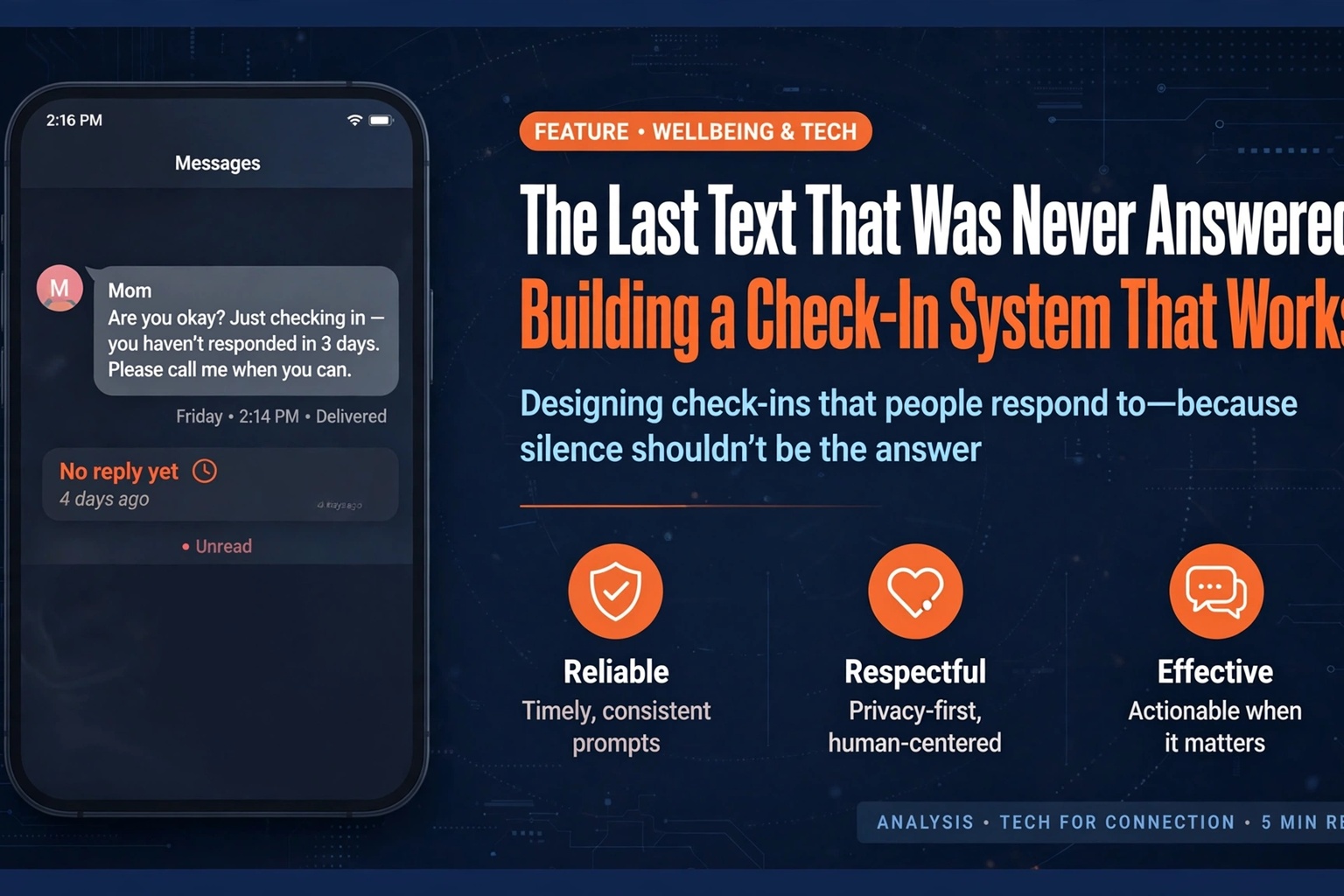
Imagine the scenario every family fears: her last message was “going to dinner, talk tomorrow.” Tomorrow comes. No message. The day after — nothing. When does worry become action, and who acts?
If you cannot answer that question right now, you do not have a check-in system. You have a habit of texting. Here is how to build the real thing before your next trip.
The Anatomy of a Check-In System
1. Pick one primary contact — and one backup. Your primary is the person most likely to notice a missed check-in within hours. The backup is who the primary calls if they cannot reach you. Write both down and make sure each knows the other exists.
2. Fix two daily check-in times. Morning and night, in your home timezone so nobody does math at midnight. “Text by 9 a.m. and 9 p.m. home time.” Vague promises — “I’ll text when I can” — are how the last text becomes the last text.
3. Define the content. Each check-in includes three things: where you are, what you are doing next, and when the next check-in is. “At the hotel, dinner with him at 7 at [restaurant], next check-in 10 p.m.” Thirty seconds to write. Priceless if you go quiet.
4. Set the escalation clock. Agree in advance: if a check-in is missed by 2 hours, the contact calls you. By 4 hours, they call your hotel. By 8 hours, they contact the embassy and local police. Write this down. In a panic, nobody thinks clearly — the plan does the thinking.
The Duress Layer
5. Create a duress word or phrase. Something ordinary that you would never say by accident: “Tell Mom the roses arrived.” One message containing it means “I am not safe — call for help, do not reply asking if I’m okay.”
6. Set up silent location sharing. Continuous location sharing with your primary contact for the entire trip — not shared on request, always on. If your phone goes dark, the last known location is still visible.
7. Keep a “dead man’s” note. Before each outing, message your contact: who you are with (full name, photo if you have one), where you are going, when you expect to be back. If the evening goes sideways, someone knows exactly where to start looking.
Test It Before You Fly
Run the system for three days at home. Miss a check-in on purpose. Time how long it takes your contact to escalate. Fix the gaps while the stakes are zero.
A check-in system is not about fear. It is about arithmetic: a predator can silence one person, but they cannot silence a schedule, a backup contact, and a live location dot — not all at once, not quietly. Make yourself loud by default, and the last text is never the last word.
What Counts as a Check-In
A common failure: the check-in becomes “hey” and “hey back” — two people performing safety theater. Real check-ins carry information. The minimum viable check-in answers three questions: where are you, what is next, when is the next one. “Hotel. Dinner at 7 at Marina Bay. Next check-in 10pm.” If your messages do not answer those three questions, tighten them up tonight. Vague check-ins are barely better than none, because they give your contact nothing to act on if you go quiet.
Sources
- Wikipedia — Smart Traveler Enrollment Program
- UK Foreign, Commonwealth & Development Office — Travel Advice
- Wikipedia — Emergency telephone number
Disclosure: The stories on Love Lies Abroad are based on publicly reported accounts. We are not stating these as facts — this is what was reported. If you are featured in a story and believe it is inaccurate, contact us and we will review it, correct it, or take it down.
Submit a correction, documentation, context, or a response for private editorial review. Contact the editorial desk.
Join the conversation
Load Facebook comments to read and reply using your Facebook account.