
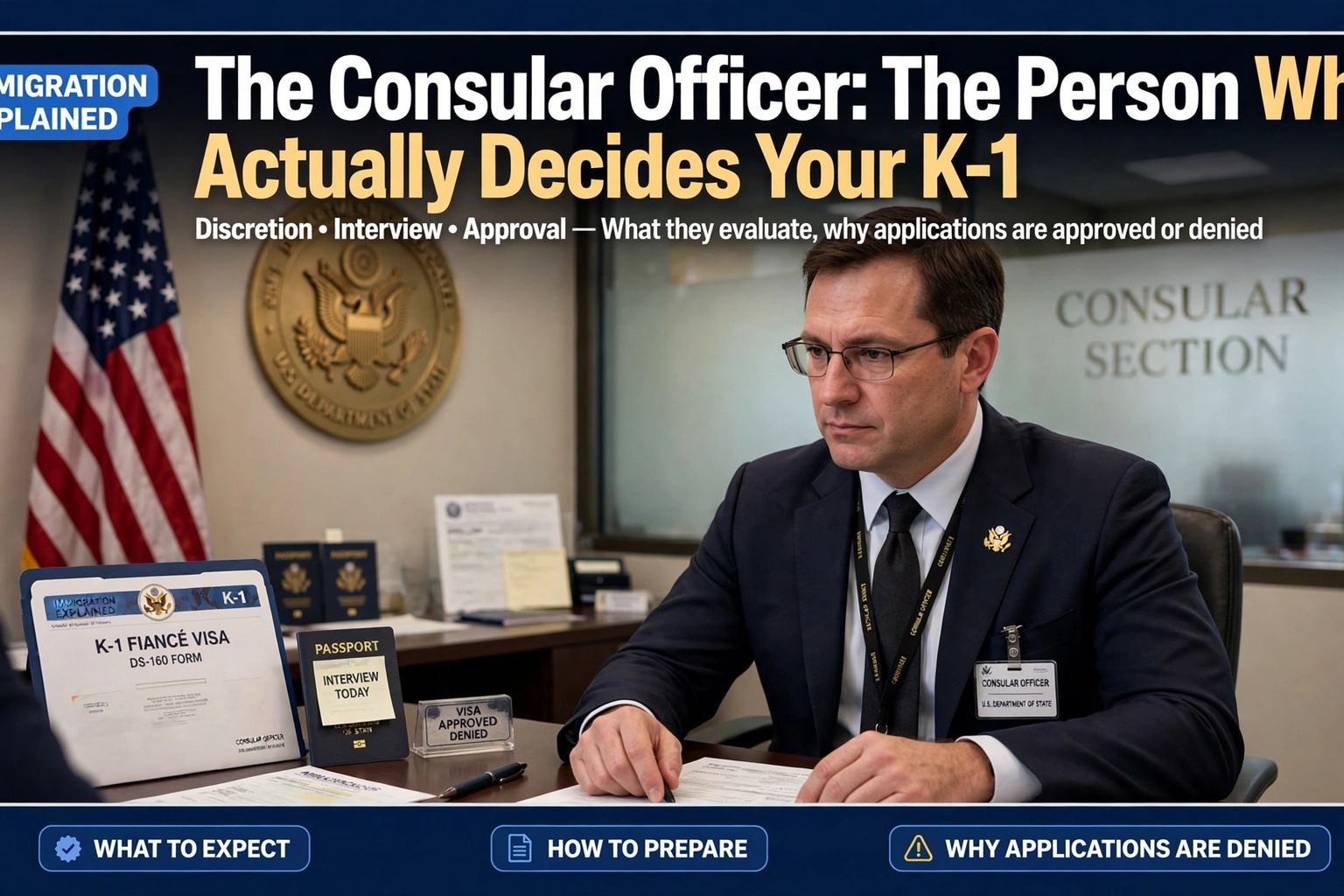
After months of USCIS processing, stacks of evidence, and a medical exam, your K-1 case lands in front of one person: the consular officer conducting the embassy interview. USCIS approval of the I-129F does not guarantee a visa — the petition establishes eligibility to apply, and the consular officer decides whether to issue. Understanding what that person is deciding, and how, is the final piece of K-1 preparation.
Two questions, one interview
The officer is resolving two issues. First, is the relationship bona fide — a real engagement between two people who intend to marry — as opposed to an arrangement for immigration purposes? This is evaluated through the petition evidence, the DS-160 answers, the documents presented at the window, and the applicant’s own testimony. Second, is the applicant admissible? Criminal history, prior immigration violations such as overstays or deportations, health-related grounds, and security check results all fall under this heading. Either question can end the case independently of the other.
How credibility is judged
Officers conduct hundreds of these interviews and develop a practiced ear for consistency. They compare the applicant’s account — how the couple met, the story of the in-person visits, how often they communicate, what the petitioner does for work, where the petitioner lives, what the wedding plan is — against the petitioner’s statements in the I-129F and the documentary record. Vague answers about basic facts read as warning signs. Confident, specific, consistent answers read as truth. This is not about performing affection or bringing gifts of extra evidence; it is about knowing your own story cold and telling it the same way every time. An honest “I don’t remember the exact date” beats a guessed date that contradicts the file.
What helps, concretely
Organized originals in a logical order, so nothing is fumbled for. Direct, honest answers without embellishment. Clear knowledge of the 90-day marriage requirement and a realistic plan for satisfying it — officers do ask about wedding plans, and “we haven’t thought about it” is a bad answer in a process built around a wedding. Financial documents that plainly meet the I-134 threshold, with the household counted correctly. None of this overcomes genuine ineligibility, but it removes every avoidable obstacle between a qualified applicant and an approval.
What the officer cannot do
The officer cannot approve a case the law makes ineligible, cannot waive requirements that have no waiver, and — under the doctrine of consular nonreviewability — their refusal is generally not appealable to any court. That finality is exactly why preparation beats damage control: the interview is the whole contest. If the case involves prior refusals, overstays, criminal history, or any fraud-adjacent facts, bring an immigration attorney into the strategy before the interview, not after the refusal slip. The cost of counsel is small next to the cost of a refusal that could have been prevented. Informational only.
Remember that the officer decides on the preponderance of the file plus the interview — no single perfect answer saves a thin file, and no single awkward moment sinks a strong one. The interview confirms what the paper already shows. Build the paper, tell the truth, and let the file do the heavy lifting.
Sources: https://www.uscis.gov/family/family-of-us-citizens/visas-for-fiancees-of-us-citizens https://www.uscis.gov/i-129f
Disclosure: The stories on Love Lies Abroad are based on publicly reported accounts. We are not stating these as facts — this is what was reported. If you are featured in a story and believe it is inaccurate, contact us and we will review it, correct it, or take it down.
Submit a correction, documentation, context, or a response for private editorial review. Contact the editorial desk.
Join the conversation
Load Facebook comments to read and reply using your Facebook account.