
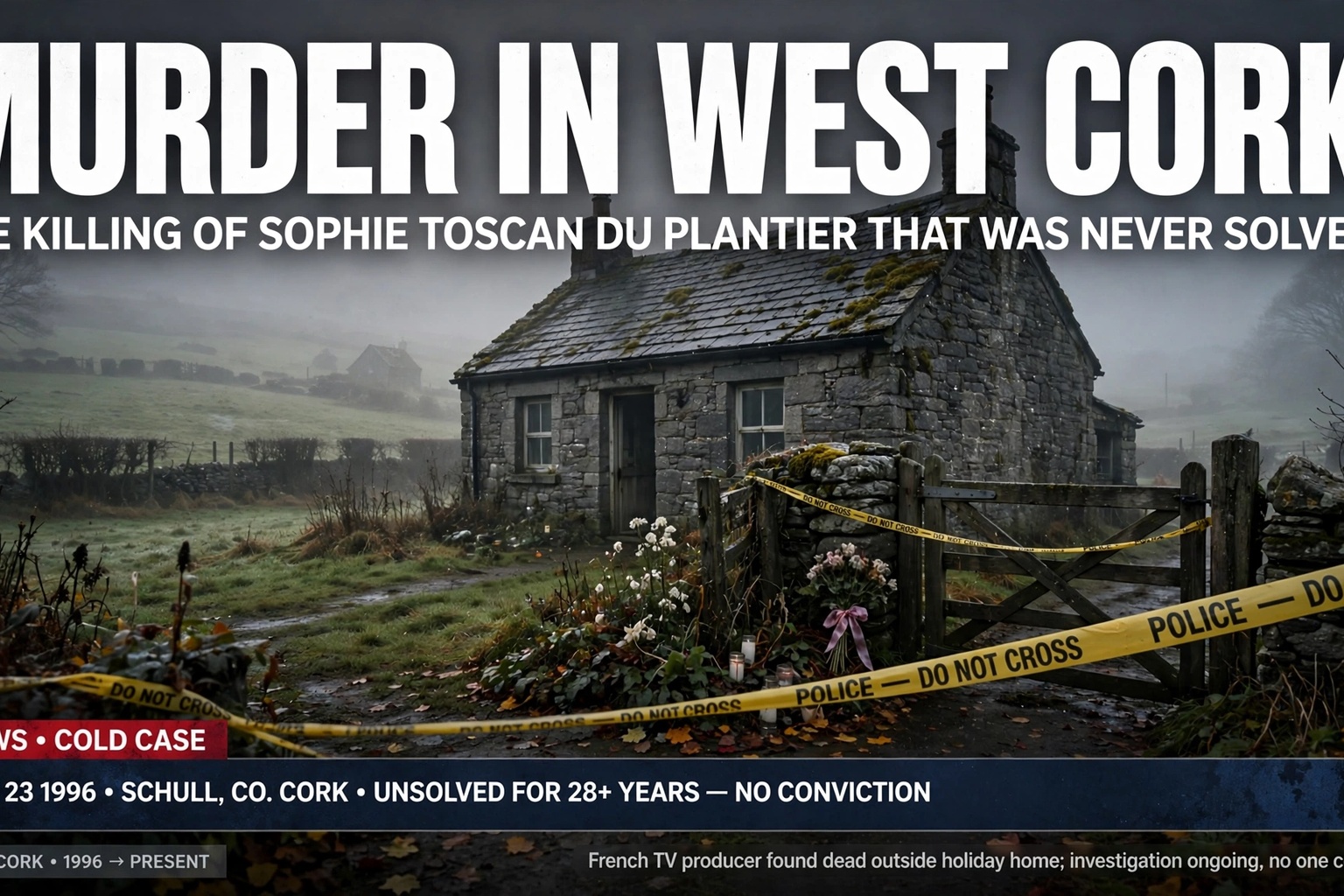
On the morning of December 23, 1996, a neighbor found the body of Sophie Toscan du Plantier outside her holiday cottage near Schull, in the wilds of West Cork, Ireland. The 39-year-old French television producer had been beaten to death in her nightclothes. She had arrived from Paris alone three days earlier, planning to return home for Christmas. Nearly three decades later, no one has been convicted of her murder in Ireland.
The investigation was troubled from the start. The state pathologist took 28 hours to reach the remote crime scene. Suspicion quickly settled on Ian Bailey, a British journalist living nearby who had been among the first on the scene and who had unexplained scratches on his face and arms. Bailey was arrested twice and released without charge; Irish prosecutors concluded there was not enough evidence to prosecute him, and he always maintained his innocence.
France saw it differently. French authorities pursued the case for years, and in 2019 a Paris court convicted Bailey in absentia and sentenced him to 25 years in prison. Ireland refused to extradite him, and the conviction changed nothing on the ground in West Cork. Bailey died in January 2024, still protesting his innocence, and with him died the prospect of ever testing the French verdict in an Irish courtroom.
The case has inspired a hit podcast, “West Cork,” and a Netflix documentary, “Sophie: A Murder in West Cork.” But beneath the media attention sits an unresolved wound: a woman beaten to death on a lonely lane two days before Christmas, a prime suspect who was never tried where the crime happened, and a murder file that remains open. The killing of Sophie Toscan du Plantier is Ireland’s most famous unsolved murder — and it may stay that way.
The details of the killing are brutal. Sophie was struck repeatedly with a concrete block, her body left by a laneway near her cottage at Toormore. The state pathologist did not reach the scene for 28 hours, and the investigation was hampered from the start by the remoteness of West Cork and the inexperience of local Gardaí with a murder of this profile. Ian Bailey, the British journalist who became the focus of suspicion, had been one of the first reporters at the scene. He had scratches on his forearms and face the morning after, an alibi that shifted, and a witness who claimed to have seen him on a bridge near the murder site that night.
France refused to let the case die. A French investigative judge pursued it for years, and in 2019 Bailey was tried in absentia in Paris, convicted, and sentenced to 25 years. Ireland’s Director of Public Prosecutions, however, had repeatedly concluded the evidence could not sustain a prosecution, and the Irish courts blocked extradition. Bailey, who always maintained his innocence and suggested he was the victim of a Garda conspiracy, died in January 2024. With the only suspect dead and two countries’ justice systems having reached opposite conclusions, the murder of Sophie Toscan du Plantier is now frozen in permanent dispute.
Sources:
- Murder of Sophie Toscan du Plantier — Wikipedia
- The True Story Behind Sophie: A Murder in West Cork — Radio Times
Disclosure: The stories on Love Lies Abroad are based on publicly reported accounts. We are not stating these as facts — this is what was reported. If you are featured in a story and believe it is inaccurate, contact us and we will review it, correct it, or take it down.
Submit a correction, documentation, context, or a response for private editorial review. Contact the editorial desk.
Join the conversation
Load Facebook comments to read and reply using your Facebook account.