
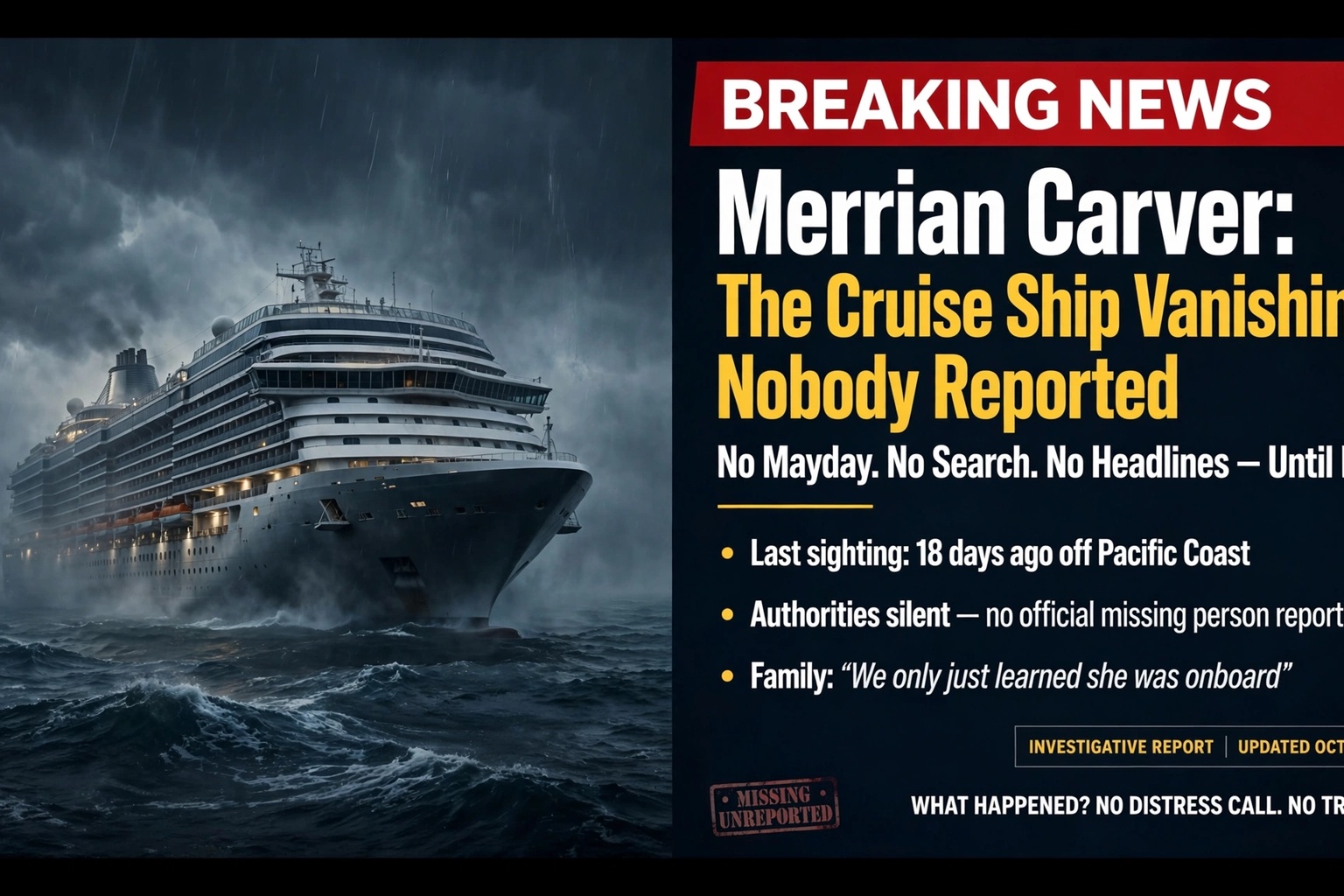
Merrian Carver boarded the Celebrity Mercury in Seattle on August 27, 2004, for a seven-day Alaska cruise. She was 40, a red-haired poet and investment banker from Boston, traveling alone. A cabin steward saw her on August 28. Nobody credible ever saw her again. And for weeks, nobody in charge of the ship told anyone she was missing.
The Mercury stopped in Juneau, Skagway, and Ketchikan, Alaska, and in Prince Rupert, British Columbia. Carver did not disembark at any of them, as far as anyone could determine. She never used her Sea Pass, the ship’s onboard credit and ID card. She never bought a drink. When the cruise ended in Vancouver on September 3, it was never established whether she got off the ship. She missed her flight home to Massachusetts. Her family, who hadn’t even known she’d taken a cruise, reported her missing on September 7 after a detective traced her credit card records.
When her father, Kendall Carver, called the cruise line, he was told his daughter had boarded but disappeared during the voyage. What he learned next was staggering: the cruise line had not reported her disappearance to anyone. Her cabin steward had reported her missing from her cabin for days during the cruise and was told by a supervisor to forget it and do his job. Her belongings, including her clothing, had been given to charity. Her purse, containing papers, computer disks, and keys, went into storage. The employee who ordered the disposal was later fired.
The FBI wasn’t notified until five weeks after she vanished, and only after her father pushed. By then, the trail was cold. No one was ever charged in connection with her disappearance. She was never found.
Kendall Carver refused to accept it. He became the founding president of the International Cruise Victims Association, testified before Congress multiple times, and spent years fighting the cruise industry’s lobbying against reform. His campaign helped produce the Cruise Vessel Safety and Security Act of 2010, which finally required ships to report missing passengers, preserve evidence, and install better safety systems.
Merrian Carver’s case is the reason those laws exist. A woman vanished from a ship carrying thousands of people, and the ship’s response was to give her clothes to charity and say nothing. Her father spent the rest of his life making sure it couldn’t happen so quietly again.
Her father, Kendall Carver, a retired New York insurance executive, turned his grief into a campaign that would outlast the cruise industry’s resistance. In 2006 he co-founded the International Cruise Victims Association, and over the next decade he testified at eight congressional hearings, pushing for transparency in crime reporting, man-overboard systems, rape protocols, and evidence preservation. The industry fought back with tens of millions of dollars in lobbying, painting him as a villain. He persisted, and in 2010 the Cruise Vessel Safety and Security Act became law.
The law required ships to report missing persons and crimes to the FBI and Coast Guard, retain surveillance footage, maintain crime logs, and improve safety systems. It was the first meaningful federal regulation of cruise ship safety, and it existed because a 40-year-old woman vanished from the Mercury and the ship’s response was to donate her belongings to charity. Her steward, Domingo Monteiro, had reported her missing for days and been told to forget it. The industry’s own regulations said a missing passenger should be reported to security. Nobody followed them until her father forced the issue.
Sources: The Charley Project; J.H. Moncrieff
Disclosure: The stories on Love Lies Abroad are based on publicly reported accounts. We are not stating these as facts — this is what was reported. If you are featured in a story and believe it is inaccurate, contact us and we will review it, correct it, or take it down.
Submit a correction, documentation, context, or a response for private editorial review. Contact the editorial desk.
Join the conversation
Load Facebook comments to read and reply using your Facebook account.