
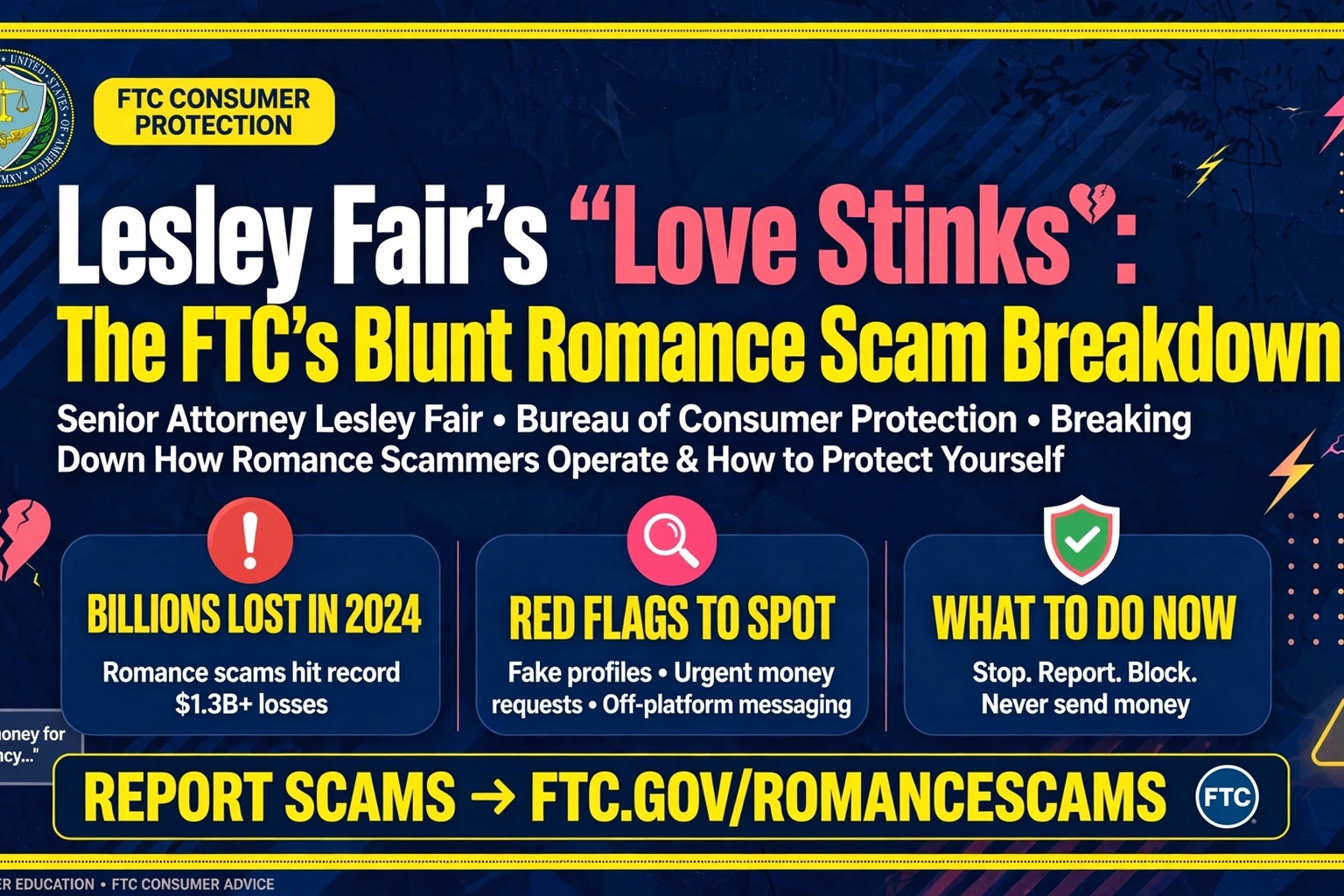
In February 2024, FTC attorney Lesley Fair published a business-guidance piece with a title that pulled no punches: ”Love Stinks’ — When a Scammer Is Involved.’ Writing for the agency’s business blog, Fair took the romance scam problem to the companies and platforms in the middle of it — and her framing is worth every dater’s attention too.
Fair’s core point: romance scams aren’t just a consumer heartbreak story. They’re a business ecosystem problem, and the businesses whose platforms host the deception have a role in stopping it. That institutional lens produces some of the bluntest federal language on the subject.
What Fair wants businesses — and you — to understand
The piece sits in the FTC’s long-running effort to drag romance fraud into the daylight. The agency’s consumer guidance, which Fair’s work complements, lays out the scammer’s standard lies: they can’t meet in person (oil rig, military, overseas work, international organization); they’ll ask for money (medical expenses, plane tickets, visa fees, getting out of trouble, crypto ‘investing’); and they’ll dictate how you pay — wire transfers, gift cards with the PIN codes, money transfer apps, cryptocurrency. As the FTC puts it, they want your money in a way that makes it hard for you to get it back.
Fair’s business-side message reinforces what the data shows: this is industrial-scale fraud. The Senate’s Romance Scam Prevention Act report, citing FTC Consumer Sentinel data, recorded over 59,000 consumers losing nearly $1.2 billion to romance scams in 2024, with a median loss of $2,000 — continuing a four-year trend of romance fraud ranking among the most popular scams among online criminals.
Why the business angle matters to daters
Here’s the part that affects your love life directly: the Senate report found that scammers deliberately move victims off dating platforms — to text or email — specifically so the platform’s fraud detection can’t see what’s happening. Platforms can and do ban scammer accounts, but the proposed Romance Scam Prevention Act would go further, requiring dating services to notify you if someone who messaged you gets banned for fraud.
Until that law exists, the notification system is you. Fair’s implied advice to the ecosystem is the same advice the FTC gives consumers: learn the lies, verify the person, and treat the rush off-platform as the warning it is.
The FTC’s consumer bottom line, which underpins everything Fair wrote: never send money or gifts to a sweetheart you haven’t met in person. Stop communicating with suspected scammers immediately. Talk to someone you trust. Reverse-image-search the photos. Search the job title plus ‘scammer.’ And report it at ReportFraud.ftc.gov — because every report is data, and data is how the FTC builds the cases Fair writes about.
Fair’s business-blog venue is itself part of the message: the FTC doesn’t see romance fraud as merely a consumer-education problem but as an ecosystem failure with institutional fixes. The proposed Romance Scam Prevention Act — requiring dating platforms to notify users when a contact is banned for fraud — is exactly the kind of structural response her work points toward. But structural fixes take years, and the scammers are working today. The consumer defenses in the FTC’s guidance haven’t changed because they haven’t needed to: the con still requires your trust and your money, in that order, and withholding either one breaks it. Never send money to a sweetheart you haven’t met in person. Verify the photos. Search the story. Tell a friend. Fair’s title was blunt for a reason — when a scammer is involved, love stinks, and the sooner you smell it, the cheaper the lesson.
Disclosure: The stories on Love Lies Abroad are based on publicly reported accounts. We are not stating these as facts — this is what was reported. If you are featured in a story and believe it is inaccurate, contact us and we will review it, correct it, or take it down.
Submit a correction, documentation, context, or a response for private editorial review. Contact the editorial desk.
Join the conversation
Load Facebook comments to read and reply using your Facebook account.