
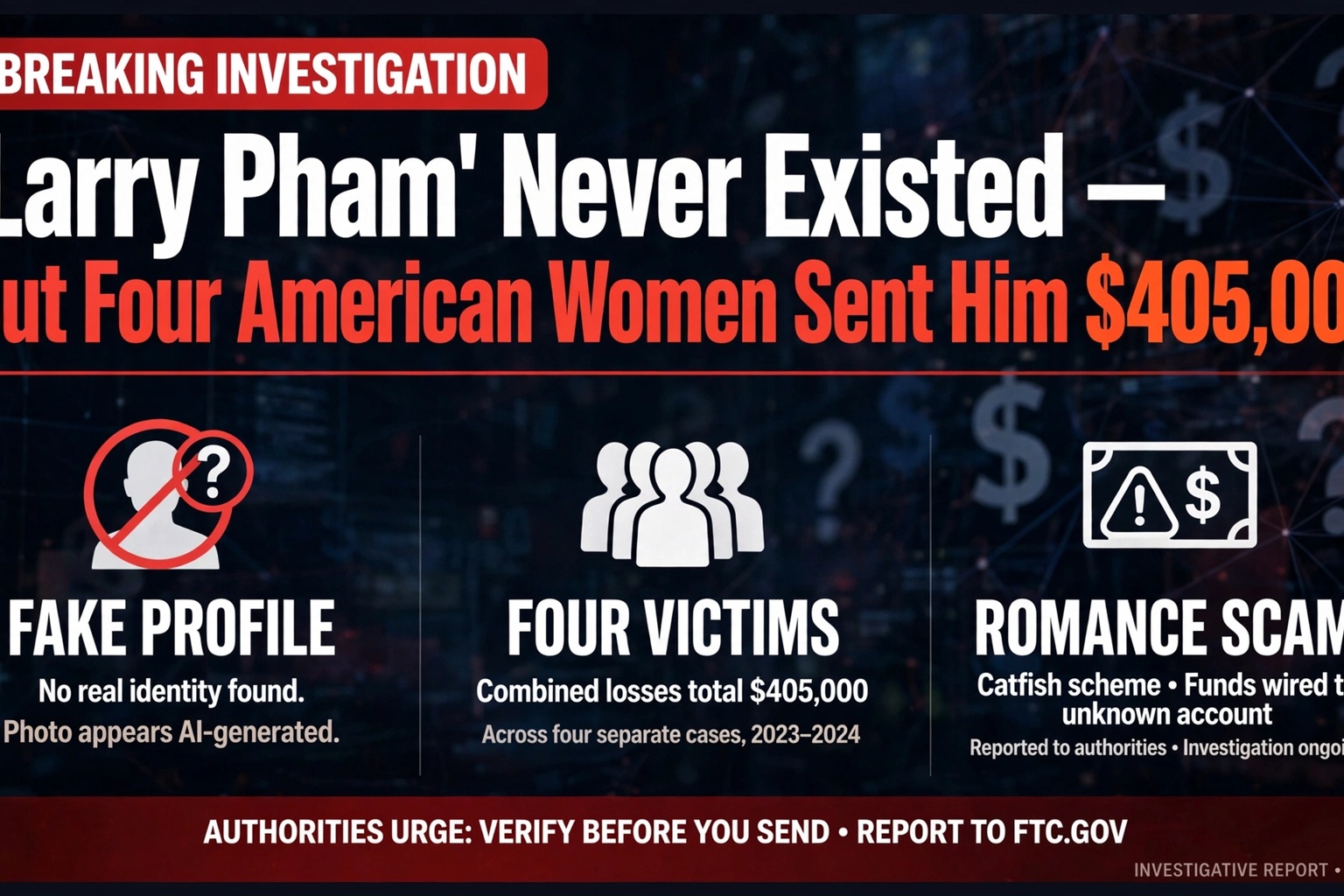
“Larry Pham” was a Canadian-born Vietnamese man — charming, attentive, and entirely fictional. Behind the persona sat Daniel Chima Inweregbu, 40, a citizen of Lagos, Nigeria, who with accomplices ran a coordinated romance-fraud network that targeted four American women and caused more than $405,000 in actual and intended losses.
In late 2025, Inweregbu was sentenced to 33 months in federal prison by U.S. District Judge Nanette Jolivette Brown in the Eastern District of Louisiana, after pleading guilty to conspiracy to commit mail fraud, wire fraud, use of an assumed name in a mail fraud scheme, and conspiracy to commit money laundering. He was also ordered to pay $166,400 in restitution and serve three years of supervised release.
The operation ran from July 2017 to December 2018. Using social media, email, and messaging platforms, the conspirators initiated contact with women identified in court records only as Victims 1 through 4, gained their trust through carefully crafted online personas, and exploited their desire for companionship. Once emotional attachment was established, the “relationships” converted to financial extraction: the women were persuaded to send money to U.S.-based bank accounts under various fraudulent pretexts. The funds were then laundered through intermediaries to obscure their origin.
What makes the Inweregbu case notable in the annals of romance-fraud enforcement is the extradition. Inweregbu was arrested while traveling from Nigeria to the United Kingdom — and was extradited from the UK to the United States in July 2025 to face the charges. The long arm of the case stretched across three countries before it closed around him.
The “Larry Pham” alias itself is a small case study in scammer tradecraft: a specific, plausible, slightly exotic identity — Canadian-born Vietnamese — designed to be memorable enough to trust and vague enough to never verify. The victims never met a Canadian. They met a network.
Thirty-three months is a modest sentence by recent federal standards for romance fraud, reflecting the guilty plea and the scale of the losses. But for the four women who sent money to a man who never existed, the sentence closes a chapter that began with a friend request and ended in a federal courtroom in New Orleans.
Sources: U.S. Department of Justice, EDLA — Nigerian Resident Sentenced to 33 Months (2025); Diaspora Digital Media — US Court Jails Lagos Internet Fraudster Over $405K Romance Scam (2025)
Disclosure: The stories on Love Lies Abroad are based on publicly reported accounts. We are not stating these as facts — this is what was reported. If you are featured in a story and believe it is inaccurate, contact us and we will review it, correct it, or take it down.
Submit a correction, documentation, context, or a response for private editorial review. Contact the editorial desk.
Join the conversation
Load Facebook comments to read and reply using your Facebook account.