
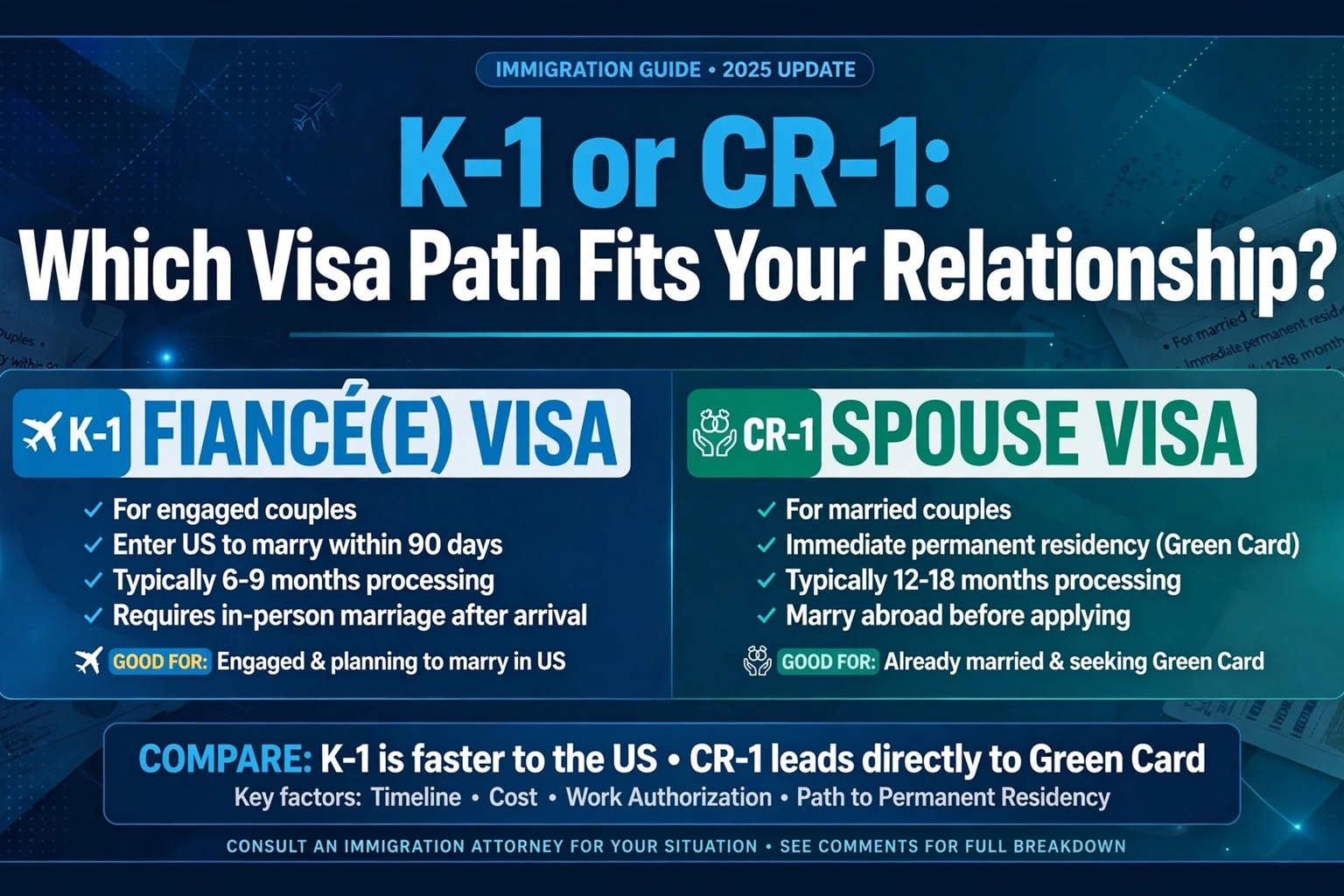
Couples where one partner is a U.S. citizen usually face a fork in the road: the K-1 fiance(e) visa or the CR-1 spousal visa. Both end at a green card. They differ in timing, cost structure, wedding logistics, and what daily life looks like between arrival and permanent residence. There is no universally right answer — but there is a right answer for your facts. Here is the honest comparison.
The K-1 route: enter first, marry, then adjust
With the K-1, the U.S. citizen files Form I-129F ($675), the fiance(e) interviews at the embassy, enters the United States, and the couple marries within 90 days. Then the foreign spouse files Form I-485 for adjustment of status — currently $1,440 for an adult — and waits months for the green card. During that wait, working requires an employment authorization document and international travel requires advance parole, each a separate application with its own fee ($260 and $630 respectively under the current schedule). Total government fees run higher because the case pays at both the nonimmigrant and immigrant stages, and the adjustment wait means a long stretch of limited work and travel.
The CR-1 route: marry first, arrive as a resident
With the CR-1, the couple marries first — abroad or during a visit to the United States — and the citizen files Form I-130, Petition for Alien Relative. The spouse then completes immigrant visa processing through the National Visa Center and the embassy interview. On admission, the spouse becomes a lawful permanent resident immediately: authorized to work from day one, free to travel internationally, with no adjustment filing and no work-permit wait. If the marriage is less than two years old at admission, the green card is conditional and the couple later files Form I-751 ($750) to remove conditions — the “CR” in CR-1 literally stands for conditional resident.
The trade-offs, plainly
The K-1 historically gets the foreign partner to the United States sooner, which matters enormously to couples who have been apart for a year of processing. The price is the back-loaded adjustment stage: months of restricted work and travel after arrival, plus higher total fees. The CR-1 usually takes longer before entry but delivers full resident status on arrival — work authorization immediate, travel free, no second USCIS adjudication. Couples who need the foreign partner earning quickly, or who travel internationally for work or family, tend to favor the CR-1 math. Couples who want to be physically together as soon as possible, and will marry in the United States anyway, often choose the K-1 despite its costs.
Factors that tilt the decision
Wedding plans matter: a couple dreaming of a wedding in the beneficiary’s home country with family present leans CR-1 naturally. Finances matter: the K-1’s two-stage fees versus the CR-1’s single immigrant process. Patience matters: the K-1 front-loads the wait before togetherness and back-loads the paperwork; the CR-1 concentrates the wait up front. And individual complications — prior immigration violations, criminal history, previous filings — can make one path materially safer than the other.
Model both timelines against your facts before filing anything, and consider an immigration attorney for the comparison when complications exist. Informational only.
Sources: https://www.uscis.gov/i-130 https://www.uscis.gov/i-485
Disclosure: The stories on Love Lies Abroad are based on publicly reported accounts. We are not stating these as facts — this is what was reported. If you are featured in a story and believe it is inaccurate, contact us and we will review it, correct it, or take it down.
Submit a correction, documentation, context, or a response for private editorial review. Contact the editorial desk.
Join the conversation
Load Facebook comments to read and reply using your Facebook account.