
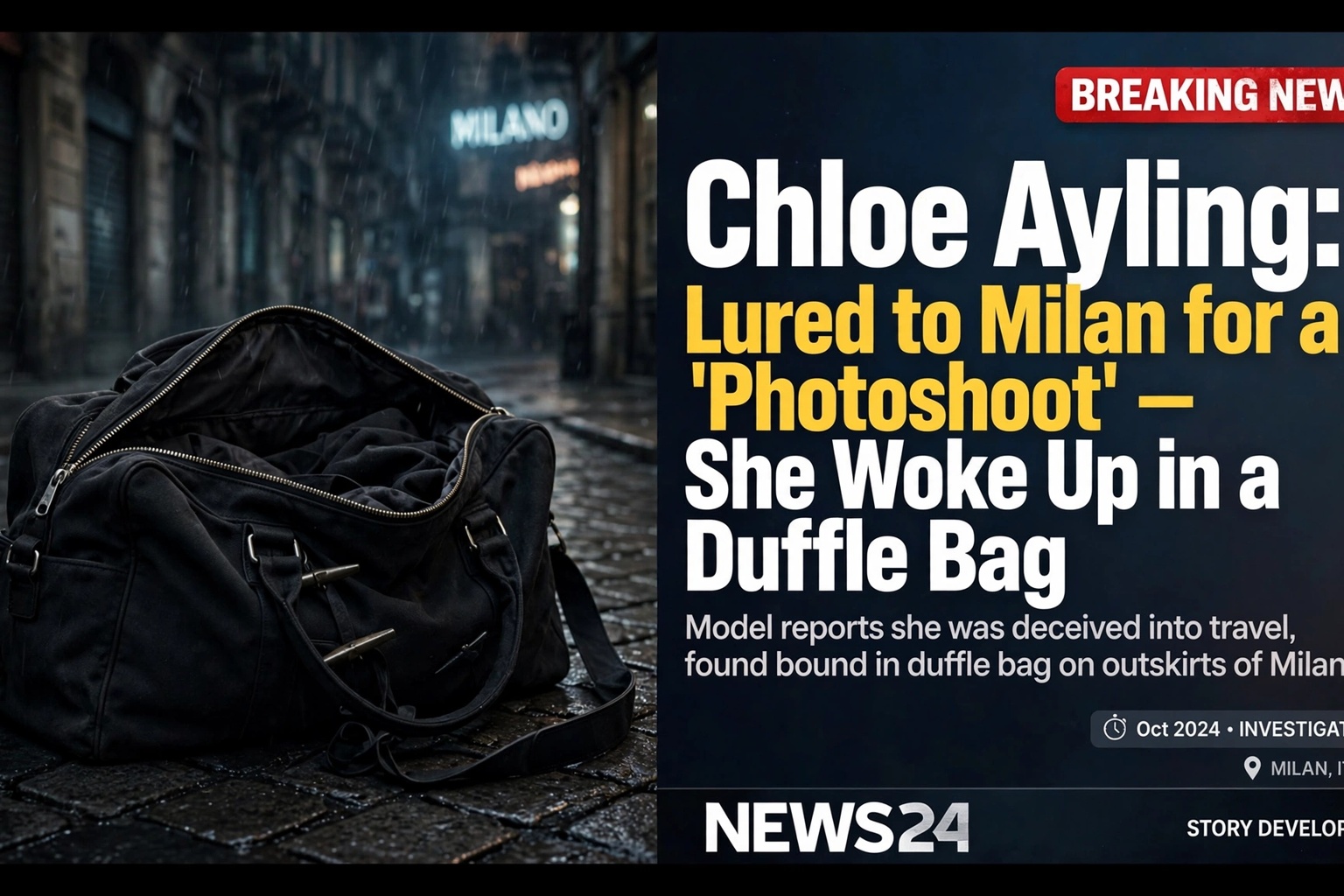
In July 2017, Chloe Ayling, a 20-year-old model from South London, flew to Milan for what her agent had booked as a routine photo shoot. She walked into the studio, noticed the strange silence, and then a masked man grabbed her from behind while another injected ketamine into her wrist.
She woke up handcuffed, gagged with tape, folded inside a duffle bag in the boot of a car — being driven 120 miles to a remote farmhouse near Turin.
Six Days in Captivity
Her captors, Polish brothers Łukasz and Michał Herba, told her they belonged to a criminal network called “Black Death” that auctioned women on the dark web. They demanded €300,000 from her agent and threatened to sell her online if the ransom was not paid. Forensic analysis later confirmed ketamine in her hair and Michał’s DNA in the vehicle.
For six days, held in a farmhouse two hours outside Milan, the 20-year-old did the only thing she could: she reasoned with them. She talked about her young child back home. She stayed calm enough to think. And on July 17, her captor drove her to the British consulate in Milan and released her.
Convictions — Then a Second Trial by Media
Łukasz Herba was convicted of kidnapping in Italy in June 2018 and sentenced to 16 years and 9 months in prison. His brother Michał was also convicted after extradition proceedings.
But Ayling’s ordeal did not end at the consulate. When she returned to the UK, public reaction turned hostile — she was accused of staging the kidnapping for publicity, subjected to a brutal televised interrogation, and targeted by trolls who told her to end her life. In 2024, the BBC dramatized her story in the six-part series Kidnapped: The Chloe Ayling Story, which she supported because, in her words, key facts had been missed by the media at the time.
The Lesson for Anyone Traveling to Meet Strangers
Ayling was not reckless. She had an agent, a booking, a professional reason to be there. The trap was the booking itself — arranged through her agent by a man using the alias “Andre Lazio,” later revealed as Łukasz Herba.
Her case is the reason verification matters more than trust: independently confirm every appointment, every address, every person expecting you. Call the studio. Check the company exists. Tell someone the exact address before you walk in. A legitimate booking survives scrutiny. A trap does not.
She survived because she kept thinking under terror — and because she never stopped talking her way toward release. Preparation gets you to the door safely. Composure gets you back out.
Why Her Case Changed the Conversation
Ayling’s kidnapping exposed a vulnerability most travelers never consider: the danger is not always a stranger in a dark alley — sometimes it is a calendar invitation. A “job” arranged through normal channels, confirmed by someone you trust, can still be a trap built by one determined person. Her agent had no reason to suspect the booking; the alias, the studio, the paperwork all looked professional.
That is why the verification rule has no exceptions: independently confirm the venue exists, call the number yourself, and search the booker’s name plus the word “scam” before you go. Professionals expect due diligence. Only predators are offended by it.
Sources
- Wikipedia — Kidnapped: The Chloe Ayling Story
- What to Watch — Is Kidnapped: The Chloe Ayling Story a true story?
Disclosure: The stories on Love Lies Abroad are based on publicly reported accounts. We are not stating these as facts — this is what was reported. If you are featured in a story and believe it is inaccurate, contact us and we will review it, correct it, or take it down.
Submit a correction, documentation, context, or a response for private editorial review. Contact the editorial desk.
Join the conversation
Load Facebook comments to read and reply using your Facebook account.