
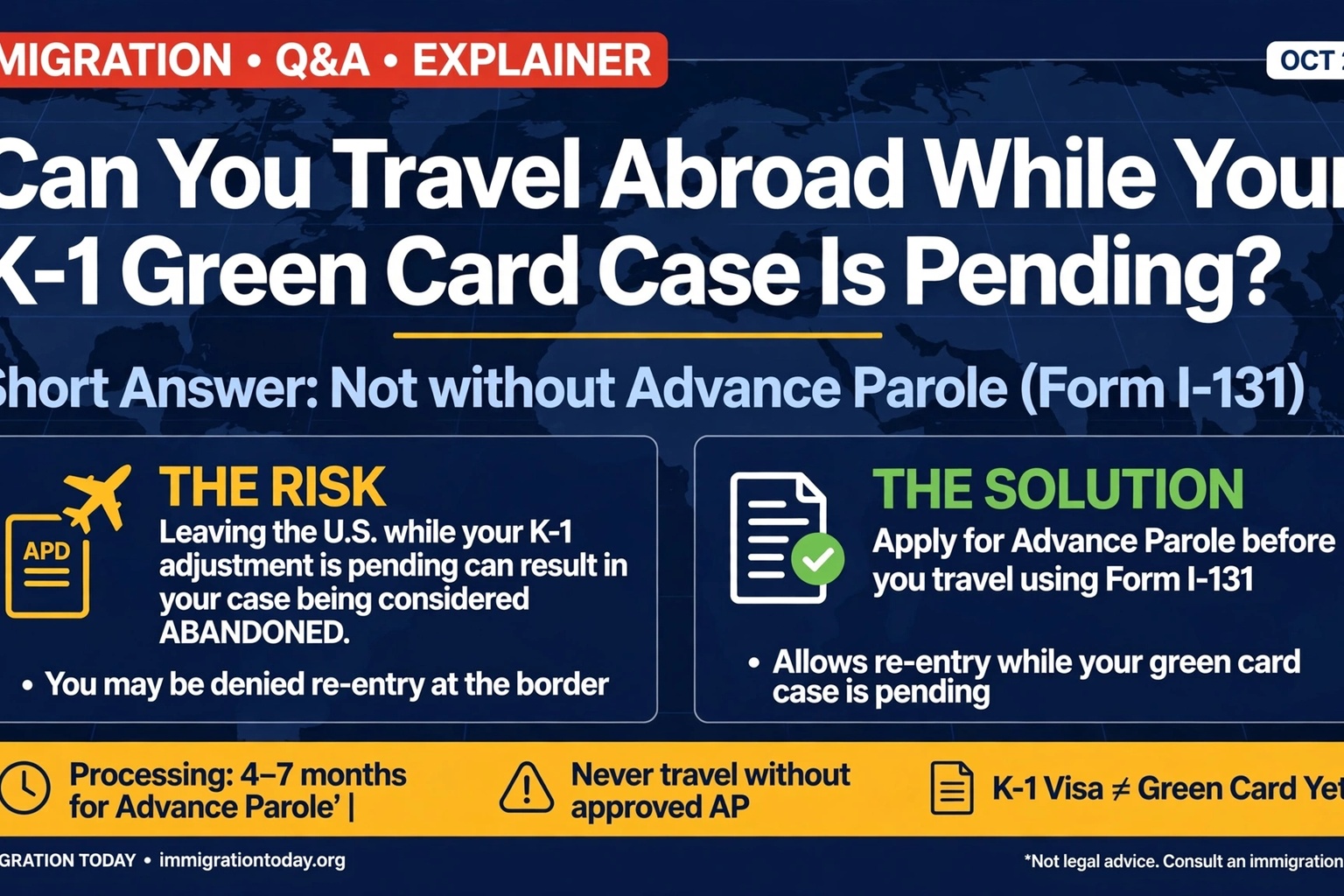
The wedding happened, the I-485 is filed, and then life intervenes — a parent’s surgery, a family emergency, a job that requires travel. The question every K-1 couple eventually faces: can the foreign spouse leave the United States while adjustment of status is pending? The answer is strict, the exceptions are narrow, and getting it wrong can destroy the green card case outright.
The abandonment rule
As a general rule, departing the United States while Form I-485 is pending, without advance parole, abandons the adjustment application. USCIS treats the departure as giving up the case: the filing fee is lost, the application is denied, and the person may have no valid status to return on — the K-1 admission expired with the 90-day window, and there is no visa to come back on. This is one of the harshest tripwires in family immigration, because the damage is done at the moment of departure, before anyone can intervene.
Advance parole: the permission slip
The safe path is Form I-131, Application for Travel Document, requesting advance parole — filed before traveling, approved before traveling, and carried when traveling. Under the current fee schedule, advance parole filed together with adjustment costs $630. Processing takes months, which is why it should be filed together with the I-485 immediately after the wedding, not when the emergency arises. A couple that files the I-131 on day one has options in month six; a couple that never filed has none. Note that advance parole authorizes travel while the case is pending — it is not a visa and not a guarantee of admission, but for adjustment applicants it is the established mechanism.
Emergency exceptions are narrow
USCIS can expedite advance parole requests in genuine emergencies, and field offices can sometimes issue emergency travel documents — but “expedite” is discretionary, evidence-heavy, and never guaranteed. It is not a substitute for having filed early, and it is not a process to count on with a flight next week. Couples with aging parents or unstable family situations abroad should treat the I-131 as mandatory, not optional, from the start.
Related traps
A few related points complete the picture. First, the K-1 visa itself is single-entry — it cannot be reused for a second trip. Second, traveling on advance parole does not reset or extend anything about the underlying case; it simply preserves it. Third, certain travel histories — particularly departures after long periods of unlawful presence — can trigger reentry bars at the border even with parole in hand, which is another reason complicated histories need attorney review before any travel.
After the green card arrives
Once the I-485 is approved, the permanent resident travels freely with the green card; trips under a year need no special document. The danger zone is strictly the pending-adjustment period. The rule of thumb is absolute: from the wedding until the green card is in hand, treat international travel as forbidden without an advance parole document already in hand. Informational only; urgent travel situations merit an immigration attorney’s advice before anyone boards a plane.
Sources: https://www.uscis.gov/i-485 https://www.uscis.gov/family/family-of-us-citizens/visas-for-fiancees-of-us-citizens
Disclosure: The stories on Love Lies Abroad are based on publicly reported accounts. We are not stating these as facts — this is what was reported. If you are featured in a story and believe it is inaccurate, contact us and we will review it, correct it, or take it down.
Submit a correction, documentation, context, or a response for private editorial review. Contact the editorial desk.
Join the conversation
Load Facebook comments to read and reply using your Facebook account.