
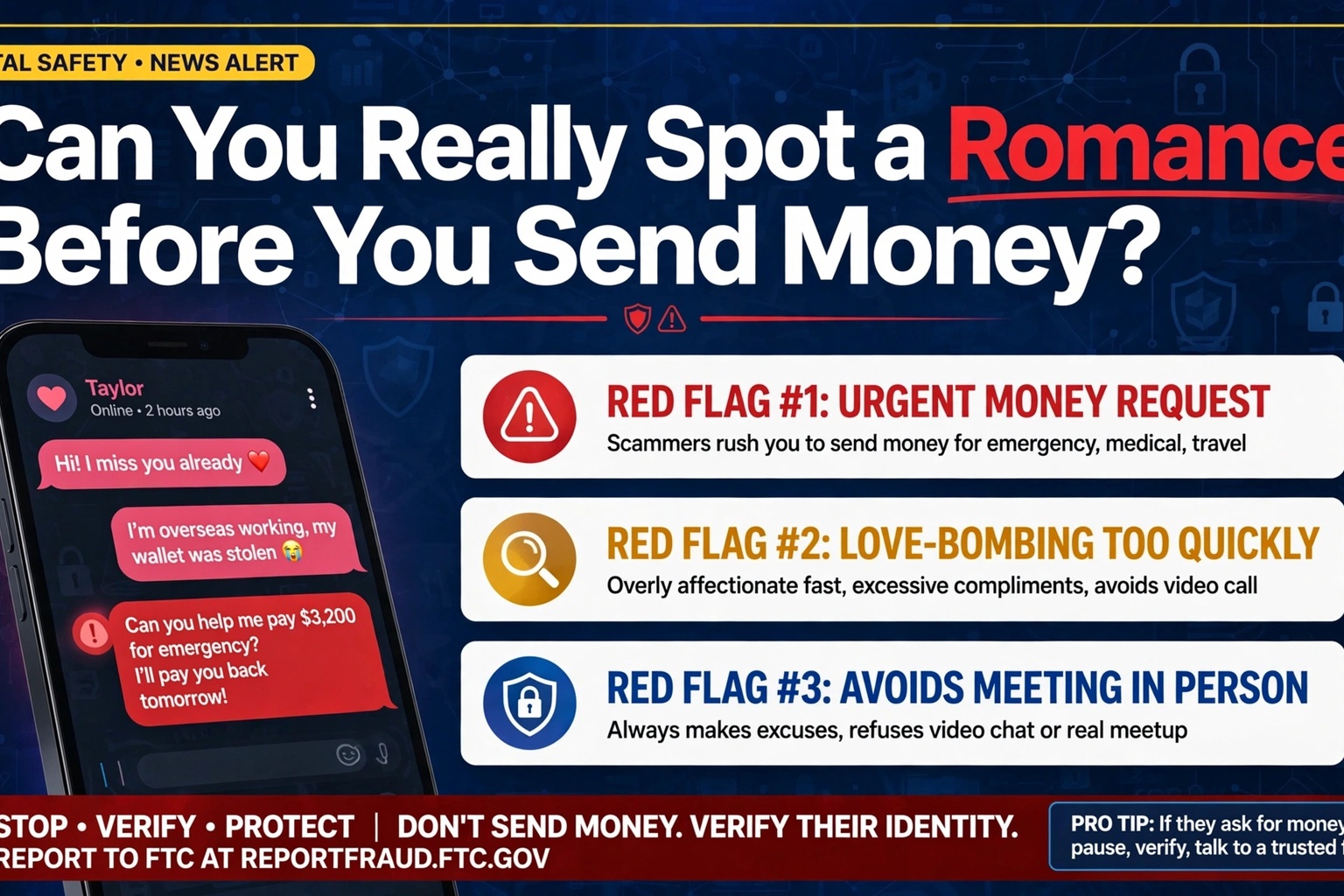
Here’s the uncomfortable truth about romance scams: by the time someone asks you for money, the trap has been set for weeks. The Federal Trade Commission says romance scammers strike up a relationship to build trust first — sometimes talking or chatting several times a day — and only then make up a story and ask for money. So the real question isn’t whether you can spot the ask. It’s whether you can spot the setup.
The good news: the setup has a pattern, and federal investigators have mapped it. The FBI’s Chicago field office warns that romance scammers follow a playbook — posing as interested romantic partners, exploiting personal and financial information, and asking victims to send money, share personal data, or even launder money on their behalf.
The setup phase has tells
Scammers can’t meet you in person. That’s the load-bearing lie of nearly every romance scam. The FTC lists the classics: living or traveling outside the country, working on an oil rig, serving in the military, or working with an international organization. If your match’s location always explains why they can’t get on a video call or meet for coffee, treat that as data, not coincidence.
They also move fast emotionally. Declarations of deep feeling within days, talk of a shared future within weeks — that’s love bombing, and it’s a tactic, not a connection. Real relationships develop at the speed of real life. Scams run on urgency.
The money phase has rules
Once trust is built, the stories start: medical expenses for them or a family member, a plane ticket to finally visit, visa fees, or fees to get them out of some trouble. The FTC notes they may even offer to help you get started in cryptocurrency investing — the gateway to the crypto variant of the scam.
And then there’s how they want the money: wired through Western Union or MoneyGram, loaded onto gift cards (Amazon, Google Play, iTunes, Steam) with the PIN codes handed over, sent through a money transfer app, or transferred as cryptocurrency. The FTC’s framing is blunt: they want your money in a way that makes it hard for you to get it back.
So can you spot it in time?
Yes — if you check the right things before your heart writes checks. The FBI’s tips: go slow and ask questions. If you suspect a scam, stop all contact immediately. Be cautious about sending money to someone you met online and haven’t met in person. Research the person’s picture and profile using online search tools — a reverse image search can reveal the photo belongs to someone else entirely. And be careful what you post publicly, because scammers use details from your social media to sharpen their approach.
The FTC’s bottom line is worth memorizing: never send money or gifts to a sweetheart you haven’t met in person. Not for the emergency. Not for the ticket. Not this once. That single rule, applied early, stops almost every version of this scam before it costs you a dime.
Disclosure: The stories on Love Lies Abroad are based on publicly reported accounts. We are not stating these as facts — this is what was reported. If you are featured in a story and believe it is inaccurate, contact us and we will review it, correct it, or take it down.
Submit a correction, documentation, context, or a response for private editorial review. Contact the editorial desk.
Join the conversation
Load Facebook comments to read and reply using your Facebook account.