
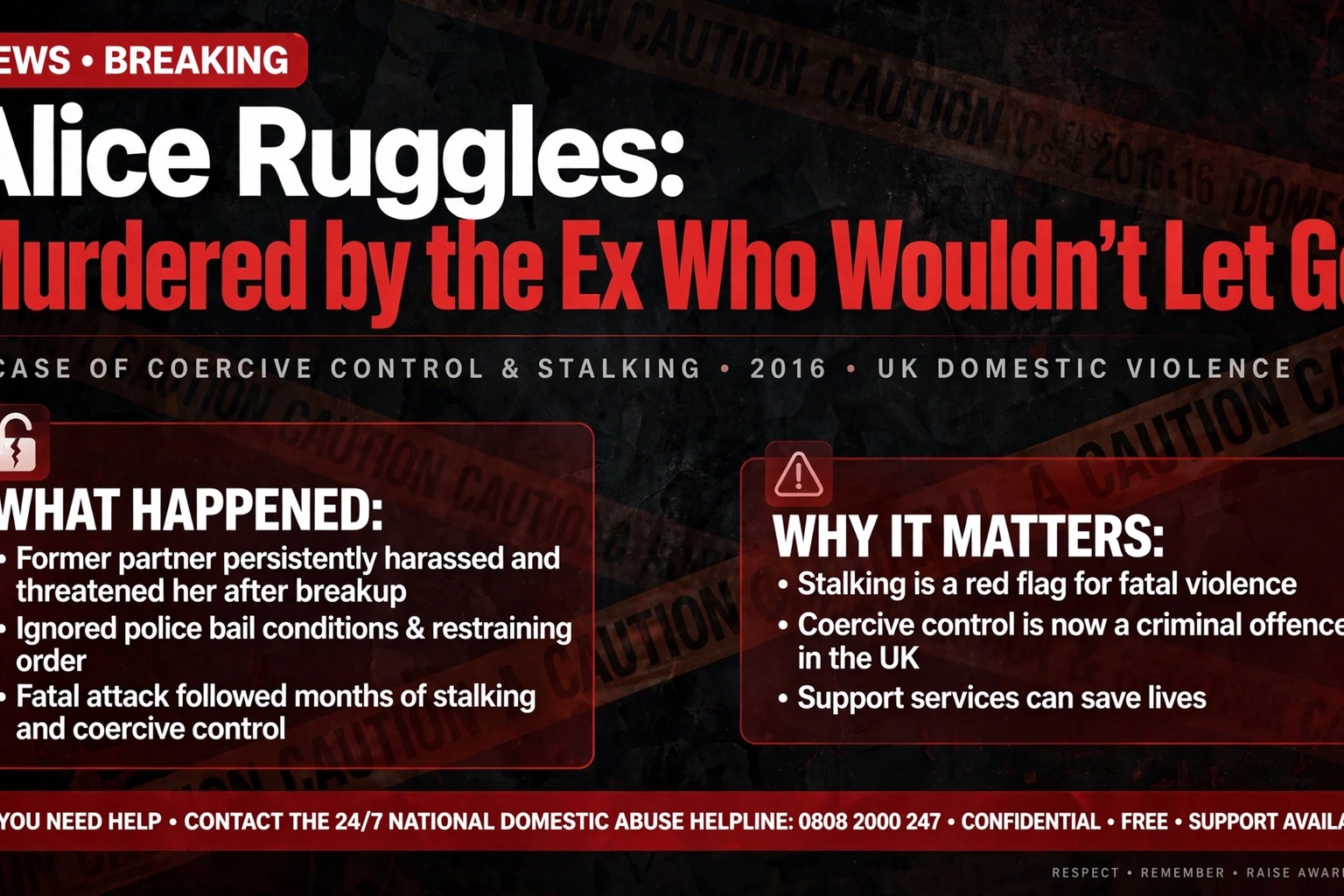
Alice Ruggles was 24, a graduate from Leicestershire working for Sky in Newcastle, described by friends as full of life. She met Trimaan “Harry” Dhillon, a 26-year-old lance corporal, online while he was serving in Afghanistan. The relationship was intense from the start — and quickly controlling. Dhillon isolated her from friends, demanded constant attention, and was serially unfaithful. When Alice ended it in August 2016, he refused to accept it.
What followed was a textbook stalking campaign. Dhillon hacked her Facebook to monitor her movements, sent pleading messages and crying selfies, contacted her mother on social media, and drove 120 miles from his Edinburgh barracks to knock on her ground-floor bedroom window at night. Alice went to Northumbria Police, who issued Dhillon a harassment warning — but she chose not to have him arrested, and he ignored the warning anyway.
On October 12, 2016, Dhillon broke into her Gateshead flat, cornered her in the bathroom, and cut her throat. She bled to death on the floor. In April 2017 he was convicted of murder and stalking and sentenced to life imprisonment with a minimum term of 22 years. A domestic homicide review made 20 recommendations to police, the Army, and the Home Office; her parents said her death was preventable.
Alice Ruggles did what victims are told to do — she reported, she documented, she asked for help. The ex who would not let go killed her anyway. Her parents now campaign for stronger stalking laws, so that the next woman who reports is believed the first time.
The relationship had moved fast and dark. They met online while Dhillon was deployed in Afghanistan and Alice was building her career with Sky in Newcastle; the intensity curdled quickly into control. Dhillon alienated her from friends, eroded her confidence, and demanded constant contact — all while being serially unfaithful. A previous partner had endured the same treatment until a restraining order ended it. When Alice finally broke it off in August 2016, Dhillon’s pleas turned to menace: he hacked her Facebook to track her movements, bombarded her with messages and weeping selfies, and lobbied her mother on social media to intervene.
Alice did everything victims are advised to do. She went to Northumbria Police, who issued Dhillon a formal harassment warning — which he ignored, even sending her a parcel afterward. In the days before her death he was stalking her flat at night, leaving chocolates and flowers on her bedroom windowsill like a taunt. On October 12, 2016, he drove the 120 miles from his Edinburgh barracks, broke in, and cut her throat in her own bathroom. Convicted in April 2017, he received life with a minimum of 22 years. A domestic homicide review produced 20 recommendations for police, the Army, and the Home Office. Her parents, Sue and Clive, now campaign for stronger stalking laws — arguing, with devastating credibility, that their daughter’s death was preventable.
Sources:
- Abuse Reports Must Be Taken Seriously After Alice Ruggles Murder — Care Appointments
- Alice Ruggles Murder Trial — Glasgow Times
Disclosure: The stories on Love Lies Abroad are based on publicly reported accounts. We are not stating these as facts — this is what was reported. If you are featured in a story and believe it is inaccurate, contact us and we will review it, correct it, or take it down.
Submit a correction, documentation, context, or a response for private editorial review. Contact the editorial desk.
Join the conversation
Load Facebook comments to read and reply using your Facebook account.