
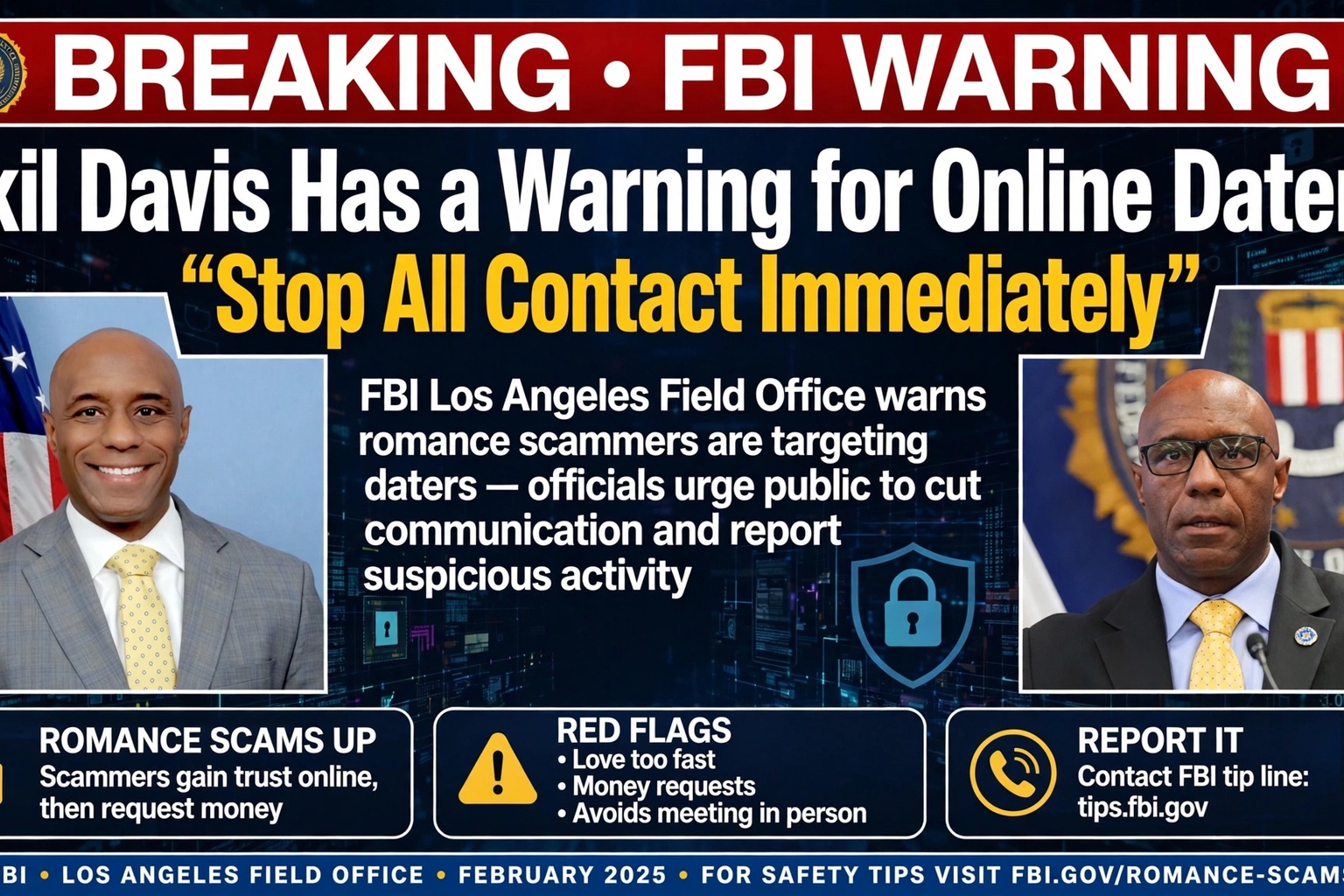
When the FBI’s Los Angeles office put out its romance scam warning, Assistant Director in Charge Akil Davis didn’t mince words: ‘Romance scams can have a devastating impact on hearts as well as bank accounts. Anyone looking for love in cyberspace should make sure they keep their feet on the ground by educating themselves about the risks. If you suspect an online relationship is a scam, stop all contact immediately.’
That’s the message from the top of one of the FBI’s largest field offices — and it’s aimed squarely at people dating across borders and screens, where romance scammers do their best work.
What the FBI is seeing
Davis’s office describes the pattern: criminals use fake online identities to gain a victim’s affection and trust. They’re present on most dating and social media sites. They work to establish a relationship as quickly as possible and endear themselves to the victim. Many propose marriage and make plans to meet in person. Eventually, they ask for money.
To dodge in-person meetings, the scammers claim to live or work in other parts of the country or world — the overseas worker, the deployed soldier, the international contractor. Once trust is built, the money requests arrive: a medical emergency, an unexpected legal fee, or some other false purpose.
The numbers behind the warning
The Los Angeles office reported that nearly 18,000 victims reported over $670 million in romance scam losses to the FBI’s Internet Crime Complaint Center in 2024 — and in California alone, more than 2,000 victims reported over $112 million in losses that same year. Romance scams, the FBI notes, have produced one of the highest loss totals of any internet-facilitated crime.
Davis’s office also names who gets targeted: while anyone can fall victim, bad actors are known to target women over 40 who are widowed, divorced, elderly, or disabled.
The FBI’s own checklist
The red flags Davis’s office lists: an individual professing love quickly, attempts to isolate you from friends and family, or making plans to visit that always collapse because of some emergency. ‘If you haven’t met the person after a few months, you have good reason to be suspicious.’
Their tips line up with the FTC’s: research the person’s photo and profile with online searches. Beware if they seem too perfect or rush you off the dating platform. Go slowly and ask lots of questions. Never send money to anyone you’ve only communicated with online or by phone.
And if you suspect a scam, take Davis’s advice literally — stop all contact immediately, and file a complaint with the FBI’s Internet Crime Complaint Center at ic3.gov. The FTC adds its own reporting channel at ReportFraud.ftc.gov. Reporting feels small. It’s how the FBI connects cases, finds the networks, and — in the best outcomes — gets money back.
Davis’s warning lands harder when you consider who else is sounding the alarm. The FBI’s Chicago office issued its own romance scam public service announcement with the same core message: go slow, ask questions, stop all contact if you suspect fraud, and never send money to someone you haven’t met in person. Two of the Bureau’s largest field offices, the same playbook description, the same advice. When federal investigators in different cities independently describe the identical con — fake identity, manufactured affection, urgent money request — it’s not a coincidence. It’s a crime wave with a documented signature. Learn the signature, and Davis’s warning becomes something you never need to hear twice.
Disclosure: The stories on Love Lies Abroad are based on publicly reported accounts. We are not stating these as facts — this is what was reported. If you are featured in a story and believe it is inaccurate, contact us and we will review it, correct it, or take it down.
Submit a correction, documentation, context, or a response for private editorial review. Contact the editorial desk.
Join the conversation
Load Facebook comments to read and reply using your Facebook account.