
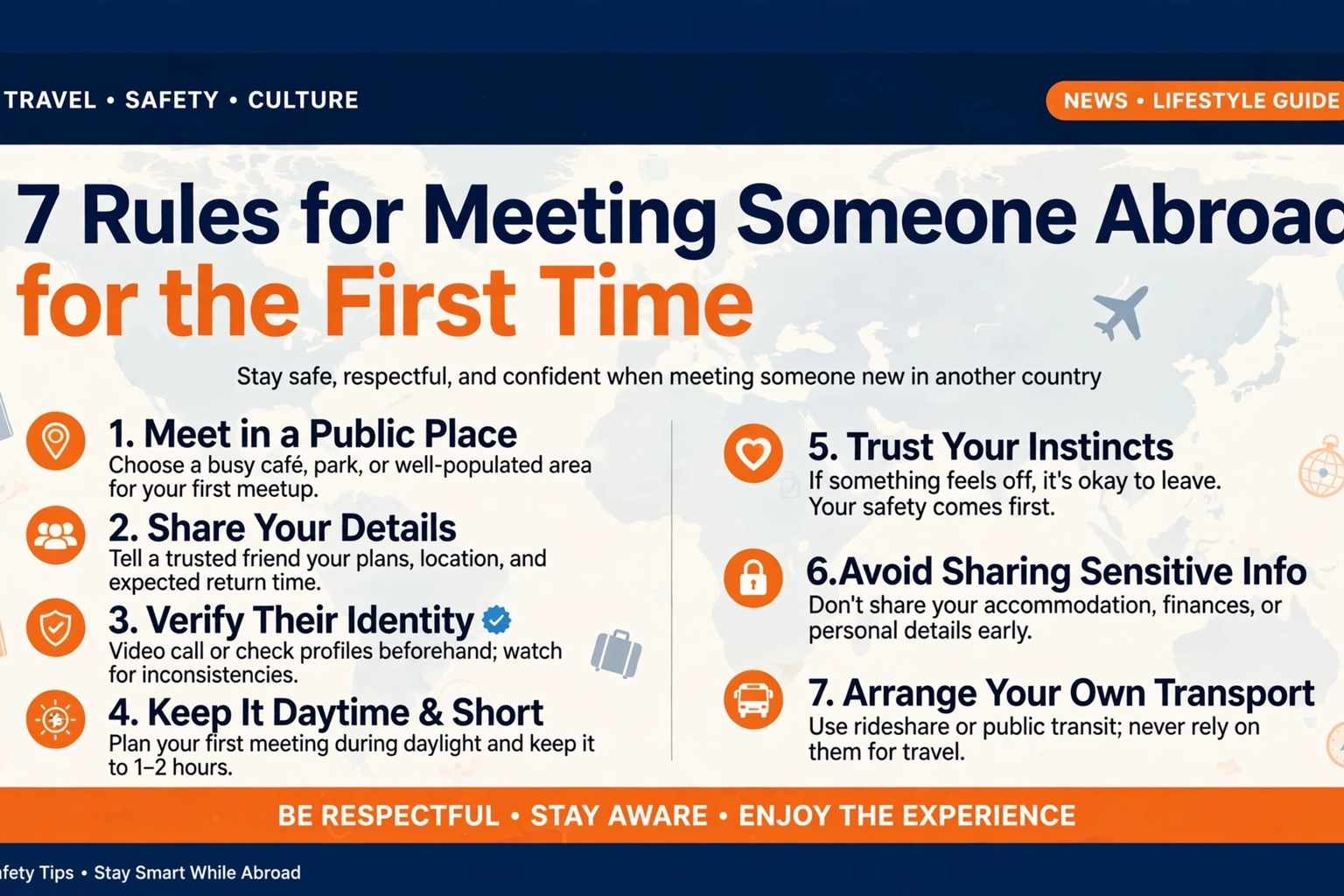
You’ve talked for months. The video calls felt real. The flight is booked. Now comes the part that actually determines whether this trip becomes a love story or a cautionary tale: the first meeting itself. Everything before this was preparation. These seven rules are the meeting.
1. Meet in public, stay in public
The first meeting happens in a busy public place, in daylight if possible — and the second, third, and fourth meetings do too. A café, a museum, a busy restaurant, a public park full of people. Not their home. Not your hotel room. Not a “quiet spot” they know. Public isn’t just about witnesses; it’s about exits, staff, and the simple fact that most bad behavior needs privacy to happen.
2. Get there and back on your own
Arrange your own transport both ways. Use a licensed taxi or a rideshare app with trip-sharing turned on, and share the trip with your check-in buddy in real time. Never accept a pickup from the airport, the station, or your hotel — however romantic it sounds. Your movement is yours to control, from arrival to departure, for the entire trip.
3. Tell someone the plan in detail
Before you walk in, one trusted person has: who you’re meeting (full name, photo, profile link), where (exact address), when (start time and when you’ll check in after), and what you’ll do if you miss check-in. This isn’t paranoia — it’s the same principle behind government traveler-registration programs: Canada’s travel.gc.ca portal lets Canadians register their whereabouts abroad, and the U.S. State Department runs the free STEP enrollment for Americans, both so officials can reach you in an emergency. Your buddy is your personal version of the same idea.
4. Keep your documents and devices on you
Passport, phone, payment cards, and a portable charger stay with you or locked in your hotel safe — never left at the table, never handed over “for a photo,” never stored in someone else’s bag or car. If your phone is your lifeline (and abroad, it is), treat it like one: charged, with local emergency numbers saved and data or a local SIM working before the date starts.
5. Watch the drinks — yours and the dynamic
Order your own drinks, watch them arrive, and never leave one unattended. This is standard guidance on official travel pages worldwide — the UK’s foreign travel checklist specifically warns travelers to be alert to spiked drinks — and it applies double on a first date with someone you’ve never met in person. The same principle covers food, and it covers pressure: anyone who pushes you to drink more, move venues, or “loosen up” is giving you information. Believe it.
6. Set a hard end time in advance
Decide before you arrive when the date ends — and tell your buddy that time. A first meeting with a natural endpoint (“I have dinner plans at seven”) is easier to leave than an open-ended evening, especially if the chemistry is good and your judgment is getting warm. You can always extend a great date tomorrow. You can’t un-extend a bad one tonight.
7. Debrief before you sleep
After the date, message your buddy: how it went, how you feel, what’s planned next. This does two things — it closes the safety loop for today, and it forces you to articulate your read on the person while it’s fresh. Write down anything that felt off, even if you can’t explain why. As the UK’s crisis-abroad guidance puts it, you are responsible for your own personal safety — so trust your read, and don’t be afraid to walk away. Your notes become your memory’s backup when infatuation starts editing the story.
None of these rules are romantic. That’s the point. Romance is what happens inside the safe container these rules build. Skip the container, and you’re not being spontaneous — you’re being unprotected.
Disclosure: The stories on Love Lies Abroad are based on publicly reported accounts. We are not stating these as facts — this is what was reported. If you are featured in a story and believe it is inaccurate, contact us and we will review it, correct it, or take it down.
Submit a correction, documentation, context, or a response for private editorial review. Contact the editorial desk.
Join the conversation
Load Facebook comments to read and reply using your Facebook account.