
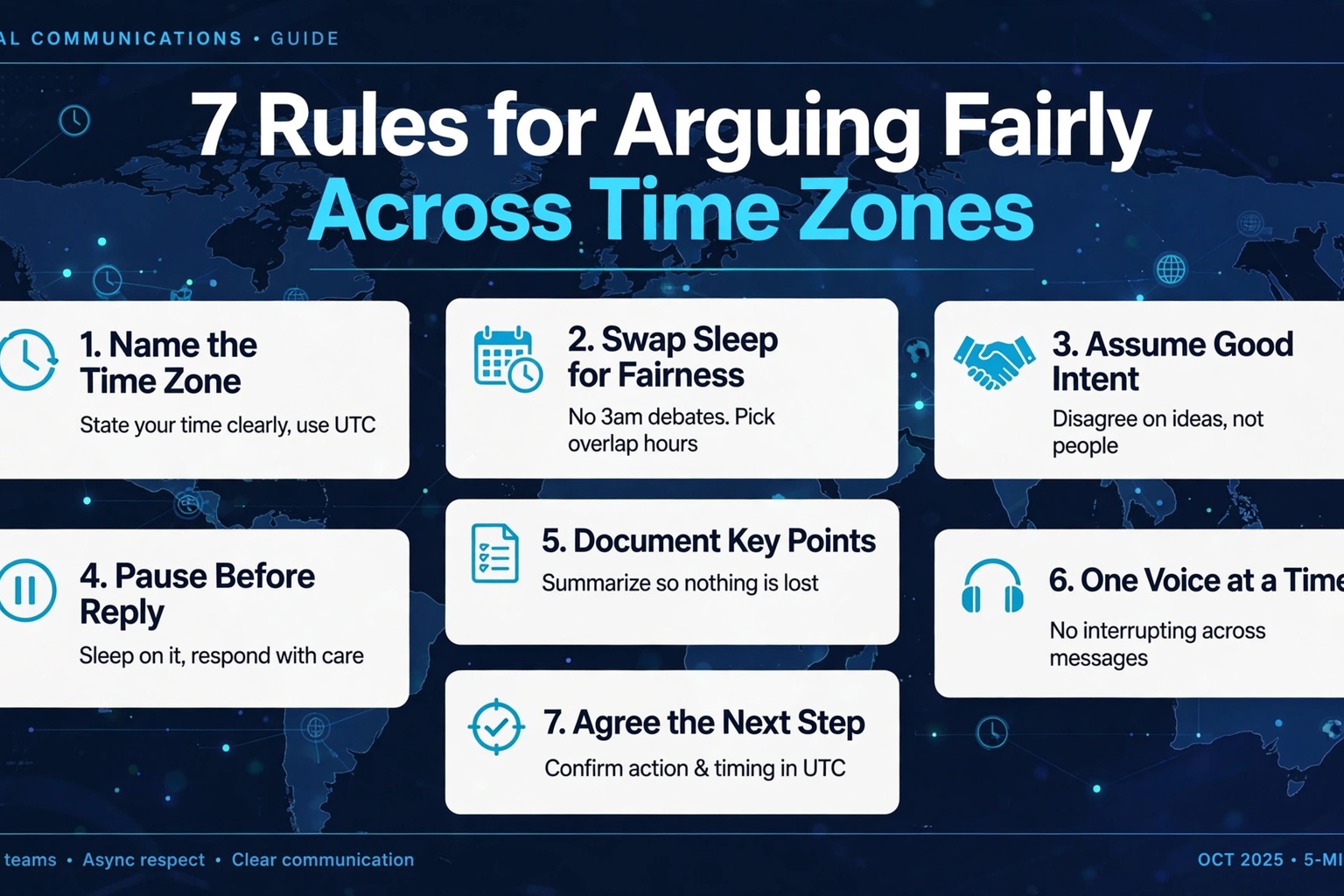
Fighting is hard enough when you can see the other person’s face. Now try it at 1 a.m., over text, with a nine-hour time difference and autocorrect mangling your feelings. Long-distance arguments have a special way of going nuclear: no tone of voice, no body language, no hug at the end. Just words on a screen, read in the worst possible light at the worst possible hour.
The good news: conflict itself is not the enemy. The Gottman Institute’s four decades of research show that what breaks couples is not fighting — it is how they fight. Contempt, stonewalling, and criticism corrode; repair attempts save. Distance just raises the stakes on getting the “how” right. Here are seven rules that actually work.
1. Never Start a Heavy Talk Over Text
Text strips out tone, and tired brains fill the gap with the worst interpretation. If it matters, it waits for voice or video. Send one text: “Can we talk about this on a call tonight? It matters to me.” That sentence alone defuses half of all LDR blowups.
2. Schedule the Fight (Yes, Really)
Ambushing someone with “we need to talk” at their midnight is a recipe for disaster. Agree on a window when you are both awake, fed, and reasonably calm. A scheduled disagreement feels less like an attack and more like teamwork.
3. Take the 20-Minute Rule Seriously
Gottman’s research on physiological flooding is blunt: once your heart rate passes about 100 beats per minute, no productive conversation is happening. Agree in advance that either of you can call a 20-minute pause — and that the pause is for calming down, not rehearsing comebacks. Then actually come back.
4. State Their Side Before Yours
Before you make your case, summarize theirs in a way they would agree is fair. “So you felt blindsided because I made the plan without asking.” This single habit — aiming for understanding before persuasion — is one of the strongest repair tools in couples research.
5. Ban the Read-Receipt Standoff
Nothing escalates a long-distance fight like watching “read 2:14 AM” with no reply. Agree now: during a conflict, read receipts are off, or a “need an hour” message is always acceptable. Silence with a stated return time is respect; silence without one is gasoline.
6. End Every Fight With a Repair, Not a Winner
Close with something explicit: “We’re okay?” “I love you, we’ll figure this out.” When you cannot end a fight with physical closeness, you need a verbal ritual that does the same job. Never let a call end on a slammed emotional door.
7. Debrief Within 48 Hours
Once the heat is gone, spend ten minutes on what happened: what triggered it, what helped, what to do differently. Couples who debrief turn one fight into an upgrade for every future disagreement. Couples who don’t just wait for the rerun.
The Takeaway
Distance does not cause bad fights; bad fight habits do, and distance just amplifies them. Put these seven rules in place during peacetime, and your 1 a.m. disagreements become something closer to collaboration — two people on the same team, in different time zones, solving the same problem.
Sources
- Regain: Gottman Method — What Is the Gottman Institute?
- The Gottman Institute: Enriching Your Marriage by Creating Shared Meaning
- EBSCO Research Starters: Long-Distance Relationships
Disclosure: The stories on Love Lies Abroad are based on publicly reported accounts. We are not stating these as facts — this is what was reported. If you are featured in a story and believe it is inaccurate, contact us and we will review it, correct it, or take it down.
Submit a correction, documentation, context, or a response for private editorial review. Contact the editorial desk.
Join the conversation
Load Facebook comments to read and reply using your Facebook account.