
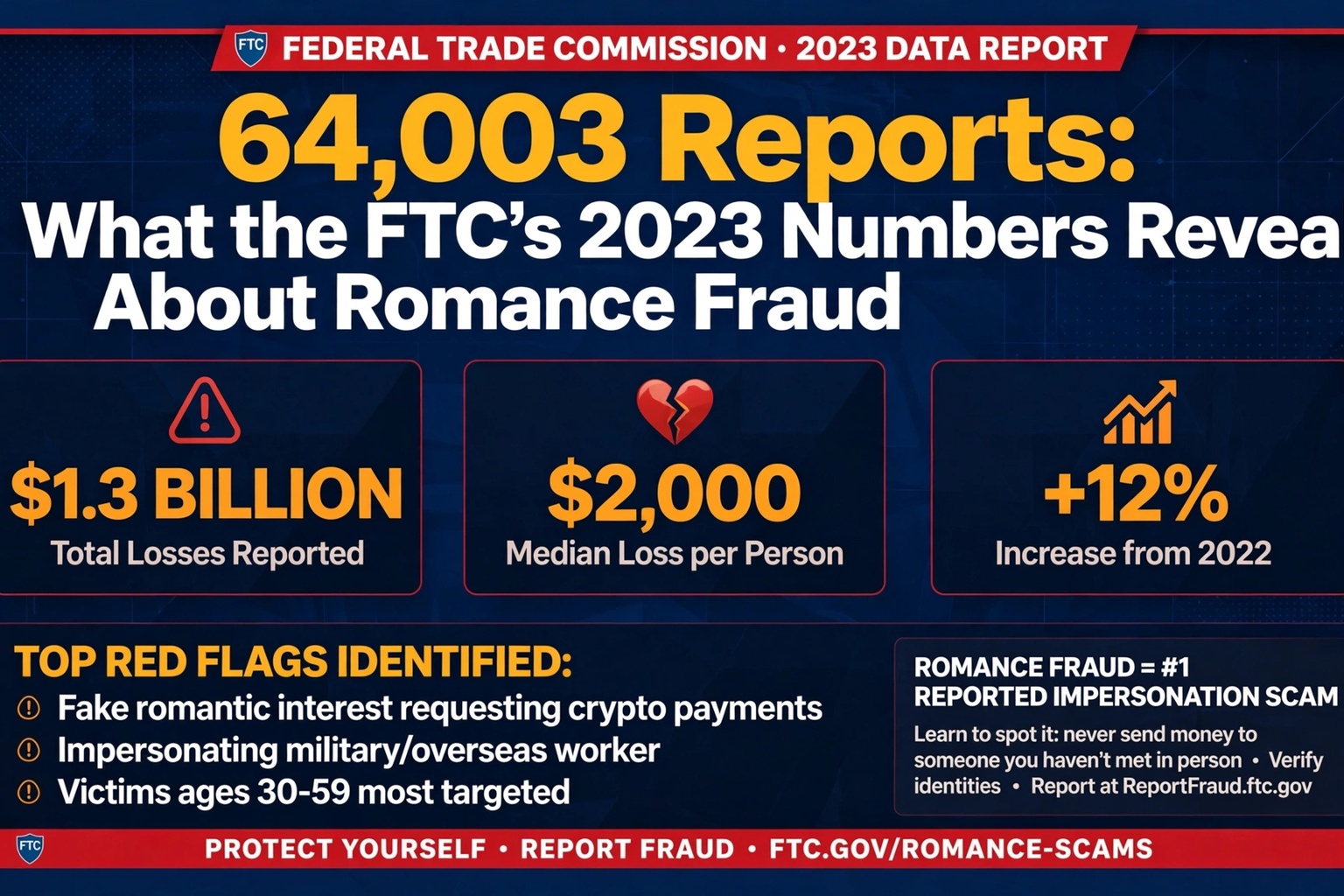
64,003. That’s how many Americans told the Federal Trade Commission they’d been caught in a romance scam in 2023. Their reported losses: about $1.14 billion. The median loss: $2,000. The figures come from the FTC’s Consumer Sentinel Network, cited in the Senate’s Romance Scam Prevention Act report — and each number tells a different part of the story.
What 64,003 means
Sixty-four thousand reports in a single year is roughly 175 people a day deciding to tell the federal government that someone they loved never existed. And the FBI is explicit that this is an undercount — the crime is perceived as embarrassing and intensely personal, so many victims never report at all. The real number of victims is higher. Nobody knows how much higher.
The Senate report adds the trend context: 2023’s toll was roughly double the roughly $500 million lost just four years earlier. This isn’t a stable problem. It’s a growing industry.
What $1.14 billion means
It means romance fraud out-earns most legitimate businesses. It means the criminal organizations running these schemes — which the Senate report says are increasingly sophisticated, transnational, and AI-assisted — have a billion-dollar incentive to keep refining the con. Every dollar in that total represents weeks of manufactured affection converted to cash.
It also means the money moves through specific channels. The FTC’s data shows scams originating on social media have exploded — the agency reported $2.7 billion in social-media-scam losses since 2021, with romance scams the second-largest loss category on social platforms. The Senate report found scammers deliberately pull victims off dating apps to dodge fraud detection, then work them in private channels.
What $2,000 means
The median is the most human number in the dataset. Half of reporting victims lost more than $2,000; half lost less. This isn’t a story about millionaires being fleeced — it’s about ordinary people losing a month’s rent to a ghost. The Senate report notes the victims aren’t who stereotypes suggest: the scams heavily target the elderly (FBI data: over 6,700 people over 60 lost nearly $367 million in 2023) and the military community (the DOJ warns nearly 40 percent of its fraud losses come from imposter and romance scams).
64,003 reports. $1.14 billion. $2,000 median. Read them together and the picture is clear: a mass-market fraud, growing fast, aimed at the lonely, operating at industrial scale. The FTC’s counter is unglamorous but effective: never send money to a sweetheart you haven’t met in person — and if you’ve been targeted, report it at ReportFraud.ftc.gov, because every report makes the next dataset harder for the scammers to hide in.
The 2023 numbers also explain why Congress is now involved. The Senate’s Romance Scam Prevention Act report cites the FTC data as the justification for requiring dating platforms to notify users when a contact gets banned for fraud — closing the gap where a platform can identify a criminal, kill the account, and leave every targeted user in the dark. The bill’s safe harbor provision encourages platforms to ban aggressively without fear of liability. Whether it passes or not, the data has already done its real job: proving, in numbers no one can wave away, that 64,003 reports and $1.14 billion in a single year is not a collection of personal failures but a mass-market fraud operating at industrial scale. The reports are the dataset. The dataset is the warning. And the warning, translated for your dating life, is the FTC’s one-line version: never send money to a sweetheart you haven’t met in person.
Disclosure: The stories on Love Lies Abroad are based on publicly reported accounts. We are not stating these as facts — this is what was reported. If you are featured in a story and believe it is inaccurate, contact us and we will review it, correct it, or take it down.
Submit a correction, documentation, context, or a response for private editorial review. Contact the editorial desk.
Join the conversation
Load Facebook comments to read and reply using your Facebook account.