
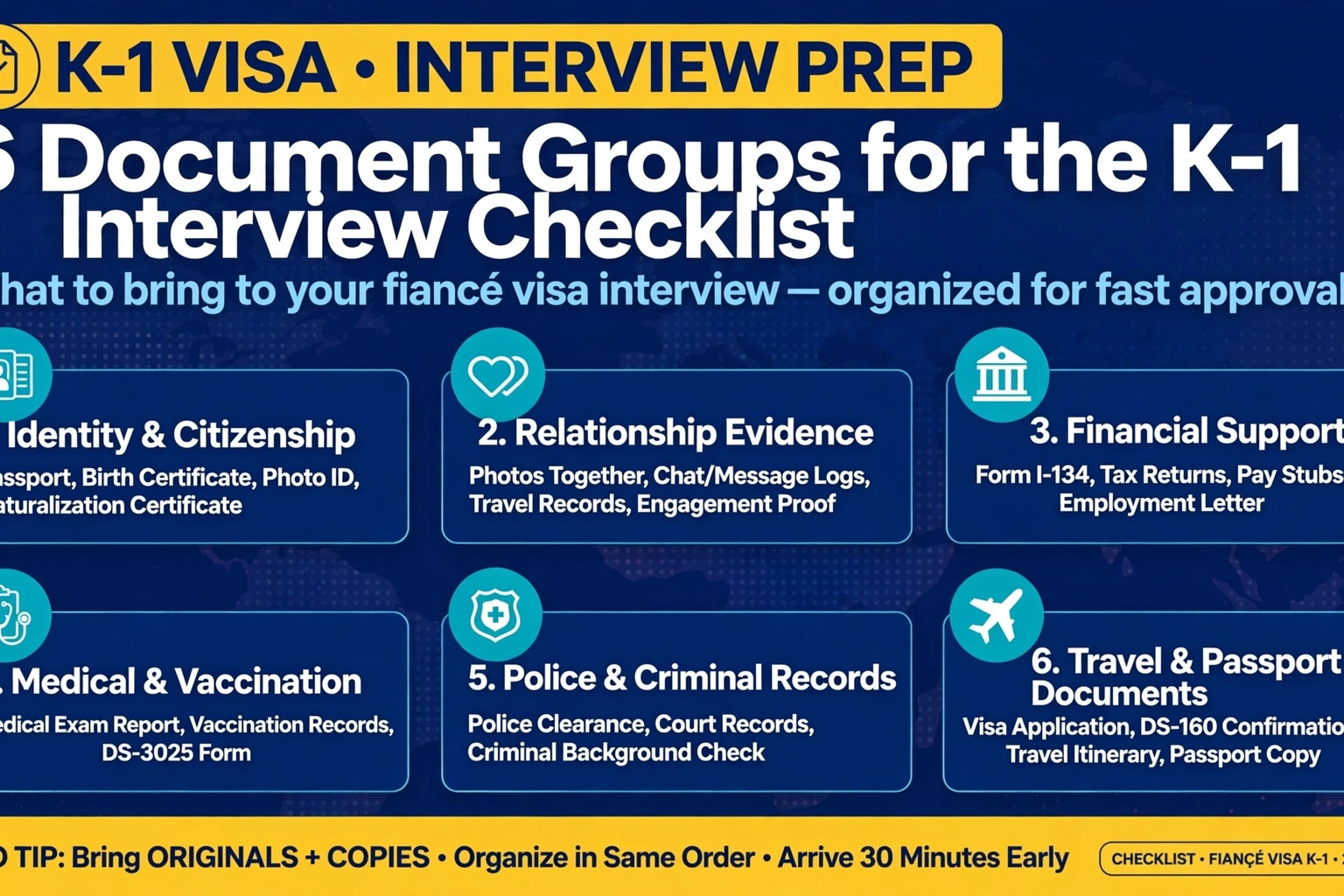
Embassy interviews are won in the weeks before they happen. Consular officers decide quickly, files are thick, and “I can send that later” often becomes a 221(g) delay of weeks or months. Organize these six document groups before the appointment and you remove the most common failure points in the K-1 interview.
1. Passport and photographs
A passport valid well beyond the intended travel period, plus passport-style photographs meeting the State Department’s specifications. Check the validity rules for the specific post — many require the passport to be valid at least six months beyond the intended stay, and photo requirements (size, background, recency) are enforced literally. An expired passport or non-compliant photo is a same-day rescheduling.
2. Birth certificate
The applicant’s birth certificate, or acceptable secondary evidence where civil records are genuinely unavailable — some countries’ record-keeping requires alternatives, and the State Department’s country-specific reciprocity information describes what each post accepts. Every document not in English needs a full, certified English translation; partial or uncertified translations are a classic avoidable delay.
3. Police certificates
Certificates from countries where the applicant has lived for extended periods, generally since age 16. Obtaining these can take months in some countries — start early, because this is the document group most likely to delay an interview, and some certificates themselves expire if the interview is scheduled too far out. Research each country’s issuance process before assuming a timeline.
4. Medical examination results
The sealed results from the panel physician’s exam, completed before the interview at a physician the embassy designates. Do not open the sealed envelope under any circumstances; officers will not accept opened results, and a broken seal means repeating the exam. Confirm which vaccinations are required for immigration purposes, since missing vaccinations are a common reason exams need follow-up visits.
5. The I-134 financial package
Form I-134 from the petitioner with supporting financial evidence — tax returns, employment verification letter, pay stubs — plus a complete joint sponsor package if one is needed. Financial shortfalls discovered at the interview window are a classic 221(g) trigger, and they are entirely preventable with honest arithmetic beforehand: count the household correctly, measure against 100% of the Federal Poverty Guidelines, and bring originals where the post requires them.
6. Relationship and marriage-freedom evidence
Proof the relationship is genuine — photos together across multiple visits, travel records, communication logs — and proof both parties are legally free to marry: divorce decrees, annulment records, or death certificates for every prior marriage of either partner. International divorces should be checked for legal validity in advance. Bring originals where required; embassies differ on what they inspect versus retain.
Final preparation
Confirm the exact list against the specific embassy’s K-1 instructions, because requirements genuinely vary by post — a checklist from another country’s embassy is a starting point, not authority. Organize everything in the order the appointment letter lists, and arrive with time to spare. The interview itself is short; the preparation is the whole game. Informational only.
Sources: https://www.uscis.gov/family/family-of-us-citizens/visas-for-fiancees-of-us-citizens https://www.uscis.gov/i-134
Disclosure: The stories on Love Lies Abroad are based on publicly reported accounts. We are not stating these as facts — this is what was reported. If you are featured in a story and believe it is inaccurate, contact us and we will review it, correct it, or take it down.
Submit a correction, documentation, context, or a response for private editorial review. Contact the editorial desk.
Join the conversation
Load Facebook comments to read and reply using your Facebook account.