

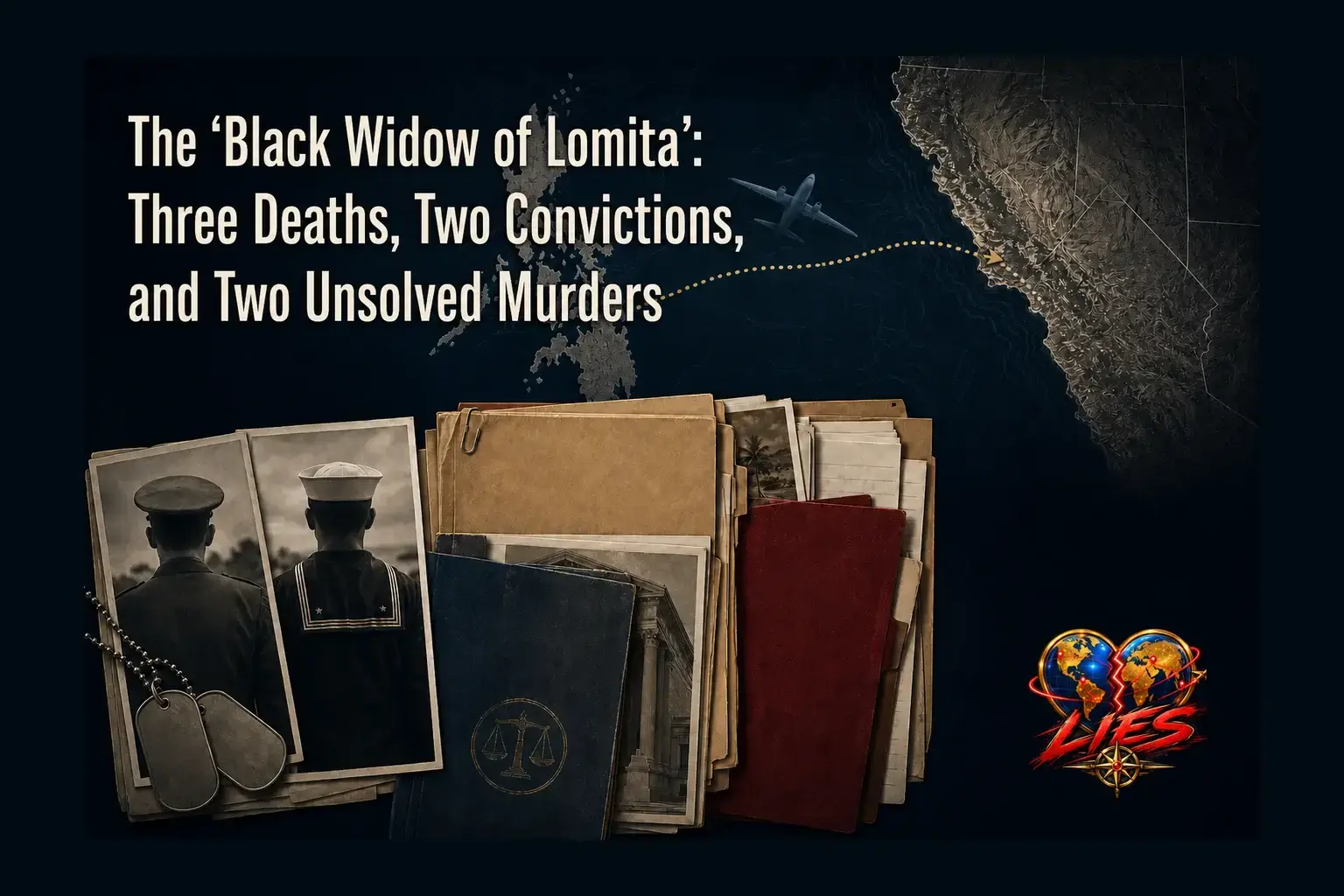
Nineteen years apart, two American servicemen married the same woman, traveled to the Philippines as their marriages were ending, and were shot to death. Then the woman their families suspected was herself killed inside a secured California home. The final murder produced two convictions. The first two did not.
1. The murder that reopened an old story
On April 18, 2006, retired Navy officer Larry Risken was in the Philippines for what was supposed to be a family visit. His marriage to Sonia Rios Risken had deteriorated, and people close to him said he intended to end it. But he had long cared about Sonia’s relatives there, especially a niece and nephew he had hoped to adopt. According to CBS News’ 48 Hours, he organized a sixteenth-birthday celebration for the niece, Quinzy, during the trip.
When another young relative developed an eye infection, Larry helped take her to a hospital. As the group prepared to leave, two people approached on a motorcycle. A gunman fired into the vehicle, striking Larry in the head and abdomen. He died at the hospital.
The circumstances made the killing look targeted. Nothing was reported stolen. A private investigator hired by Larry’s family later told CBS that, in his view, the gunman knew exactly whom he had come to kill. That was an investigator’s assessment, not a judicial finding, and the Philippine homicide remained unresolved.
At first, California crime reporter Larry Altman treated the death as a grim but ordinary overseas homicide story. Then came the message that changed its meaning: “This isn’t the first time.”
2. “This isn’t the first time”
Altman had covered enough murders to recognize how quickly a case can disappear from public view. Larry’s killing might have followed that pattern. But after his first report appeared, readers contacted him with a startling connection: Sonia had previously been married to another American serviceman, Marine veteran Earl John Bourdeau. Earl had also died by gunfire while visiting Sonia’s family in the Philippines.
The resemblance was immediate and disturbing. The same woman. Two marriages. Two husbands who reportedly wanted out. Two trips to the Philippines. Two fatal shootings in the presence or orbit of her relatives.
Resemblance, however, is not proof. Separate killings can share suspicious features without having the same organizer, and reporting can make coincidences look cleaner than the underlying evidence. No California court ever tried Sonia for either husband’s death. The later appellate opinion in Sonia’s own murder case summarized why investigators and relatives had suspected her, but it did not convert that suspicion into a conviction.
Still, Altman’s discovery gave the story a second timeline—one beginning almost two decades earlier.
3. Earl Bourdeau—nineteen years earlier
Earl Bourdeau enlisted in the United States Marine Corps in 1963. He met Sonia in the Philippines and later built a life with her in Lomita, a small city in the South Bay region of Los Angeles County. CBS reported that the marriage lasted roughly two decades. Earl’s brother Dennis remembered him as someone who worked hard and carried the responsibilities of the household.
By 1987, the marriage was ending. The California Court of Appeal later wrote that Earl wanted a divorce before traveling to the Philippines. CBS reported that the stated purpose of the trip included dealing with a family taxi business. On August 15, 1987, while staying at a home connected to Sonia’s relatives, Earl was shot at close range as he rested in a living room.
A Philippine investigator interviewed by 48 Hours said there was no convincing sign of forced entry. CBS reported that five people were arrested, including two of Sonia’s brothers, but that the case stalled and did not produce a conviction. The exact procedural history of those Philippine charges is not established by the California appellate record, so it should not be described more definitively than the available reporting allows.
Dennis and other members of Earl’s family came to believe Sonia had arranged the killing for financial gain. They pointed to insurance proceeds and to the location and timing of the death. Those were the family’s allegations. Sonia was never prosecuted for Earl’s murder, and no court adjudicated the family’s theory.
4. A body left thousands of miles from home
The loss was compounded by what happened to Earl’s remains. His family in Iowa did not receive his body for burial. For years, Dennis had an empty place to visit and no physical certainty that his brother would ever come home.
The absence mattered both emotionally and evidentially. To Earl’s relatives, a burial thousands of miles away felt like another barrier between them and the truth. They suspected that keeping the remains in the Philippines prevented an independent examination. That suspicion, too, was never proved in court.
Time passed. Leads went cold. The family’s demand narrowed from solving the crime to recovering Earl. Dennis kept searching, even as the story vanished from the American news cycle. It would take Larry Risken’s death—and a national television investigation—for anyone to find the grave again.
5. Sonia’s second marriage
Sonia had grown up near Sangley Point, a former United States naval installation in the Philippines, and moved to the United States in the 1960s. In California, she became a successful business owner with a beauty salon in Lomita. Friends described a forceful, private woman who cultivated connections to the military community.
Larry Risken followed his father into the Navy and rose to the rank of commander. After a brief courtship, he and Sonia married in 1990. CBS reported that they held three ceremonies, none attended by Larry’s immediate family. Over time, Larry became estranged from relatives who believed Sonia was isolating him.
After leaving active duty in 1995, Larry became a special-education teacher at Lawndale High School. Colleagues remembered his concern for students beyond the classroom. He also became close to Sonia’s niece Quinzy and nephew Jetmark in the Philippines. Larry expected that the couple would adopt them, but the adoption never happened. His sister Sherry Jackson told CBS that disputes over that failed plan deepened the marital breakdown.
By 2006, Larry had told Sonia he wanted to end the marriage, according to witnesses later quoted by CBS and summarized in court records. He nevertheless continued with a long-planned trip to see the young relatives. He went without Sonia.
6. Larry’s final trip to the Philippines
Larry’s family said they feared the trip. Their concern is important context, but it cannot establish who organized what came next. On the evening of Quinzy’s birthday celebration, Larry turned his attention to the relative with the eye infection and accompanied the family group to the hospital.
In the parking area, a motorcycle carried the attacker to the vehicle. Witnesses heard shots, and the gunman escaped with the driver. Larry was the target. Philippine investigators did not identify and convict the shooter.
The death left two investigations separated by nineteen years but linked in public perception. Earl had been a Marine; Larry had spent a career in the Navy. Both had married Sonia. Both reportedly wanted a divorce. Both died from gunfire in the Philippines while visiting her relatives.
Those parallels powered the “Black Widow of Lomita” label that followed Sonia in news coverage. A label is not a verdict. It became a concise way to market an extraordinary case, but it also risked presenting the unproved conclusion before the evidence.
Case timeline
Earl Bourdeau is killed
Earl John Bourdeau is shot to death while visiting Sonia’s family in the Philippines.
Sonia and Larry marry
Sonia Rios and Navy officer Larry Risken marry in California.
Larry Risken is killed
Larry is shot outside a Philippine hospital and dies.
Extortion emails target Larry’s family
Emails sent in John Bourdeau’s name seek money from Larry’s family; investigators later trace the account to Eric De La Cruz.
Threats at Sonia’s salon
Sonia reports two threatening encounters at her Lomita salon; a telephone number is linked to Fernando Romero.
Sonia Rios Risken is murdered
Sonia is shot to death inside her Lomita home.
Earl comes home
After a 48 Hours investigation identifies Earl’s remains, his family buries him beside his parents in Iowa.
Two arrests
Eric De La Cruz and Fernando Romero are arrested in connection with Sonia’s murder.
Two convictions
A jury convicts both men of first-degree murder and conspiracy to commit murder.
Judgments affirmed
The California Court of Appeal affirms both judgments.
Sources
- California Court of Appeal — People v. Romero et al., B232533 — Opinion filed January 15, 2013; primary record for the California convictions and appeal.
- CBS News / 48 Hours — Conspiracy to Kill — Original January 2009 investigation, including the recovery and return of Earl Bourdeau’s remains.
- CBS News / 48 Hours — Conspiracy to Kill — case update — August 2009 update following the arrests.
- CBS Los Angeles — ‘Black Widow’ Murderers Convicted — Contemporaneous report of the February 17, 2011 verdicts.
- Los Angeles Times — Jury convicts two in ‘Black Widow of Lomita’ murder — Contemporaneous trial report published February 18, 2011.
- Los Angeles Times Homicide Report — Sonia Risken — Victim record.
- Paramount Press Express — 48 Hours: Conspiracy to Kill — CBS program record.
- NBC Dateline — The Black Widow of Lomita — NBC program record; Dateline later revisited the case.
- California Department of Corrections and Rehabilitation — Board of Parole Hearings — April 2026 results — Current custody and hearing-status source.
Submit a correction, documentation, context, or a response for private editorial review. Contact the editorial desk.
Join the conversation
Load Facebook comments to read and reply using your Facebook account.