
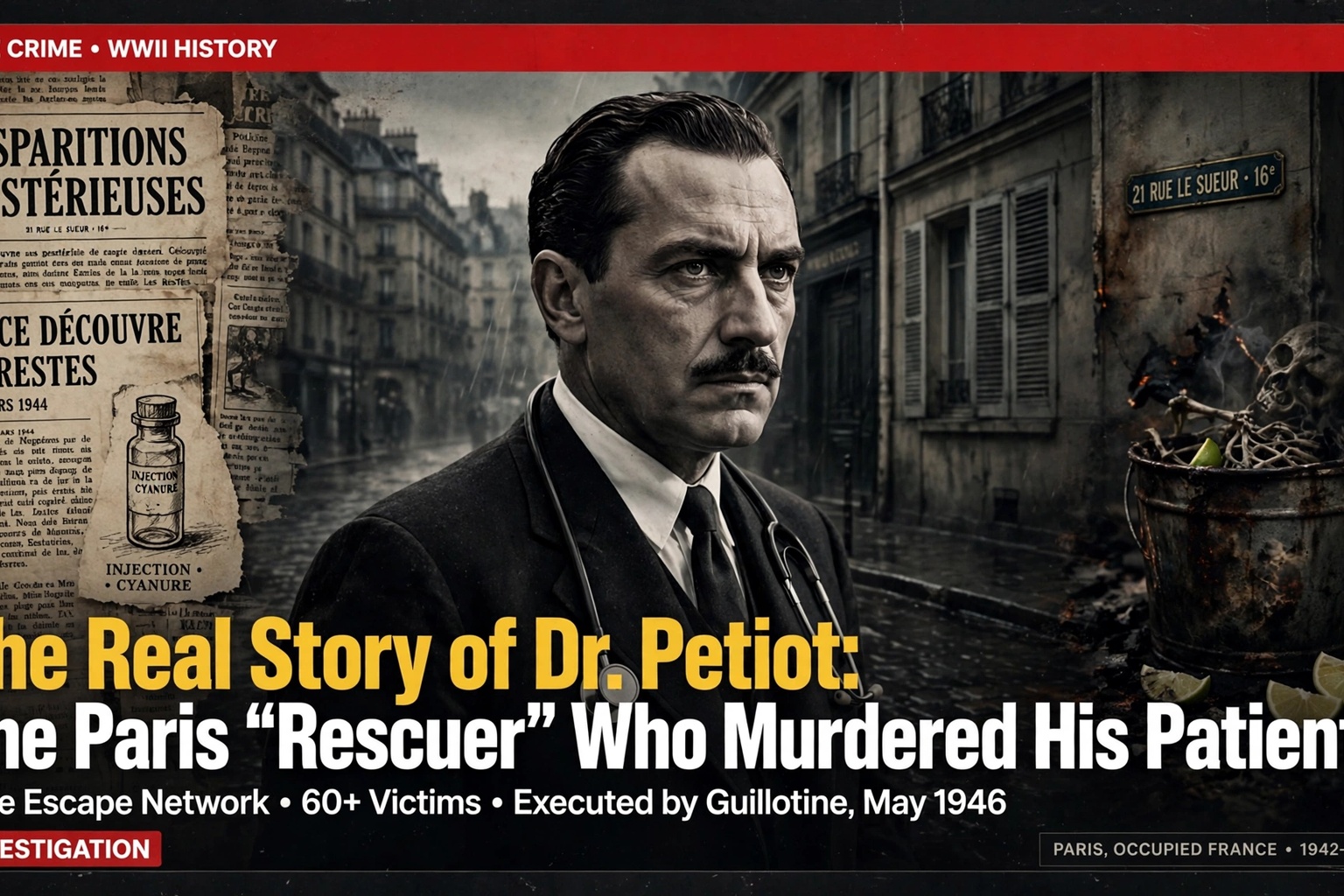
During the Nazi occupation of Paris, Dr. Marcel Petiot offered something priceless: escape. Under the alias “Dr. Eugène,” he claimed to run a network that could smuggle Jews and others hunted by the Gestapo out of France to South America, via Portugal — for a large fee. Desperate people paid, packed their valuables, and followed his instructions to his house at 21 Rue Le Sueur. None of them ever left.
Petiot told his victims they needed vaccinations before travel, then injected them with poison. He stole their money and possessions and disposed of the bodies — first in the Seine, later burned in his basement furnace or dissolved in quicklime. In March 1944, neighbors complained about a foul stench and smoke pouring from his chimney; police and firemen found human remains in the furnace, the basement, and a quicklime pit in the yard. Petiot, who had arrived mid-search on a bicycle, talked his way past the officers by claiming the bodies were Gestapo agents he had killed as a Resistance fighter — and vanished for seven months.
He was finally arrested in October 1944, recognized at a Paris metro station. At his 1946 trial he insisted every victim had been an enemy of France, even claiming 63 killings as patriotic acts. The court convicted him of 26 murders. He was guillotined on May 25, 1946.
The real story of Dr. Petiot is not just about a serial killer. It is about how the Holocaust itself became his hunting ground — how he turned the desperation of people fleeing genocide into a business, and how the chaos of occupied Paris gave him both his victims and his cover.
Petiot’s “escape network” was a masterpiece of predatory theater. Operating as “Dr. Eugène,” he charged 25,000 francs a head and worked through accomplices who funneled desperate clients to him — Jews, Resistance fighters, anyone the Gestapo wanted. At 21 Rue Le Sueur, a townhouse he had soundproofed, he would explain that the receiving country required vaccinations. The syringe held cyanide. He watched them die, stripped them of cash, jewelry, and even furniture — which he later collected from their homes — and destroyed the bodies in his basement furnace or a quicklime pit in the yard.
The scheme might have run indefinitely if not for the stench. In March 1944, neighbors complained about foul smoke billowing from his chimney, and police called the fire brigade, who found human remains burning in the coal stove. Petiot happened to cycle up mid-search and, with astonishing nerve, convinced the officers the corpses were Gestapo agents he had executed as a Resistance hero — then rode away and vanished for seven months. He was recognized and arrested at a Paris metro station on October 31, 1944. At his 1946 trial he claimed every killing was a patriotic act, even boasting of 63 victims, but the thefts betrayed him: this was murder for profit. The guillotine fell on May 25, 1946.
Sources:
Disclosure: The stories on Love Lies Abroad are based on publicly reported accounts. We are not stating these as facts — this is what was reported. If you are featured in a story and believe it is inaccurate, contact us and we will review it, correct it, or take it down.
Submit a correction, documentation, context, or a response for private editorial review. Contact the editorial desk.
Join the conversation
Load Facebook comments to read and reply using your Facebook account.