
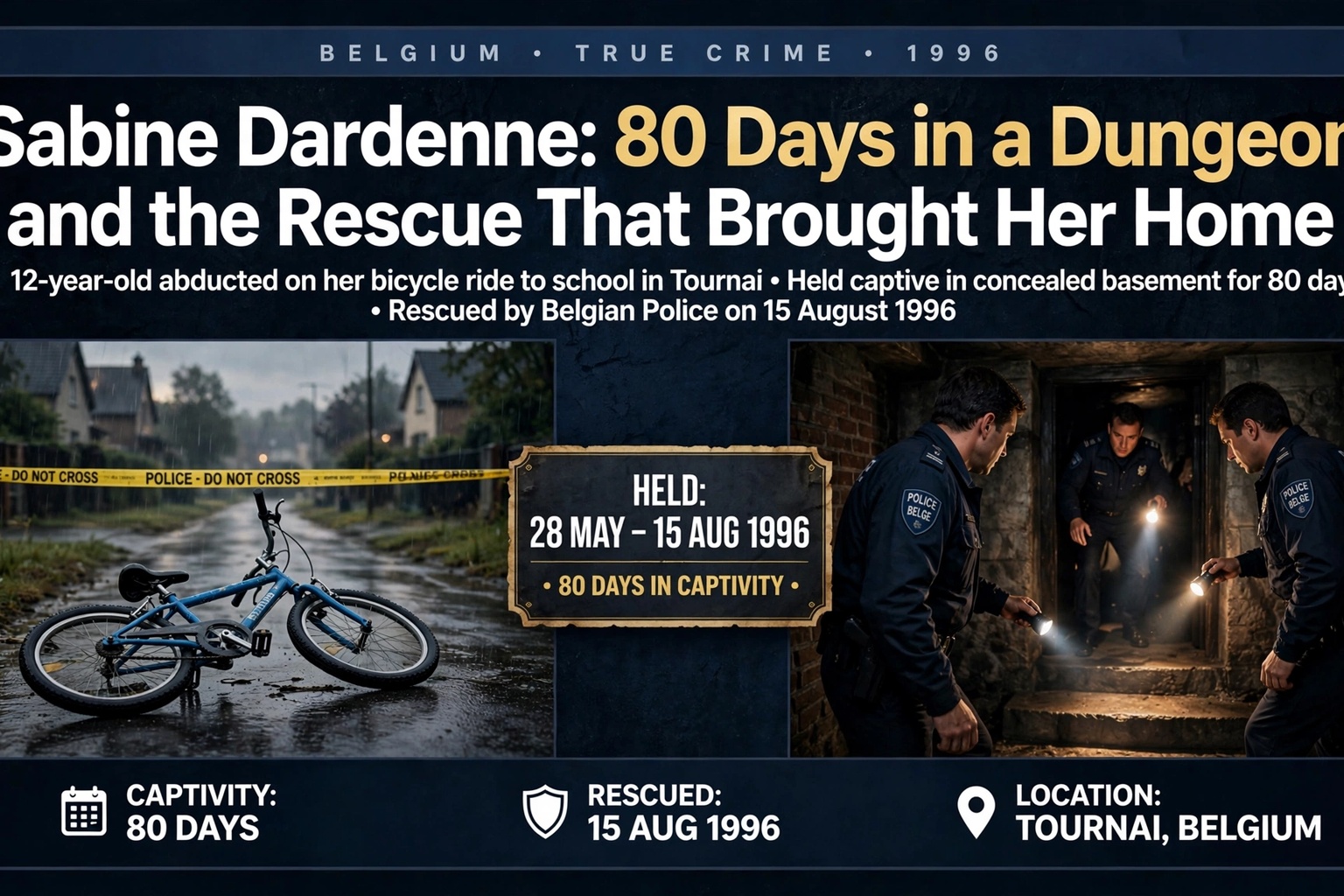
On May 28, 1996, twelve-year-old Sabine Dardenne was riding her bicycle to school in Belgium when Marc Dutroux abducted her. She spent 80 days in a hidden concrete dungeon beneath his house — isolated, abused, and told her parents had abandoned her. She survived. And her survival helped end one of Europe’s most notorious crime sprees.
80 Days Underground
Dutroux convinced the twelve-year-old that he was her only ally — that her parents had failed to pay a ransom and that fictitious men wanted to kill her. He let her write letters to her family that he never sent. When she asked for a friend to visit, he abducted fourteen-year-old Laetitia Delhez on August 9 and put her in the dungeon too, saying, “Look what I’ve done for you.”
That second abduction was his undoing. Witnesses had noted his van’s registration number. Police traced it, arrested Dutroux on August 13, 1996 — and two days later, on August 15, raided the house and found both girls alive.
The Case That Shook a Country
The dungeon also held the bodies of four other victims: eight-year-olds Melissa Russo and Julie Lejeune, who had starved to death, and teenagers An Marchal and Eefje Lambrecks. Dutroux was eventually convicted of the abductions and murders. The case exposed catastrophic police failures — officers had searched his house twice before and heard children’s cries, dismissing them — and triggered national outrage in Belgium, including the famous White March of hundreds of thousands of protesters.
Sabine Dardenne later wrote the memoir I Choose to Live. Laetitia Delhez returned to private life with her family.
The Lesson
Dardenne was a child, and her case is extreme. But two details carry a lesson for every adult traveler: isolation was the weapon — Dutroux’s power depended on no one knowing where she was — and a single observed detail broke it — a license plate number, remembered by a witness.
Your adult version: never be untraceable. Someone always knows where you are. Your location is always shared. Your documents are always copied. And pay attention to the small details — the plate number, the address, the name — because in the cases that end with a rescue, it is always a small detail that starts one.
The Cost of Being Heard
Dardenne’s rescue also exposed something ugly: the system had chances to save her — and the other victims — much earlier. Police had searched Dutroux’s house twice during the investigation. Officers reported hearing children’s voices and dismissed them. Two girls starved to death in that dungeon while their captor sat in prison for an unrelated car theft, because no one connected the dots in time.
The lesson is not just about criminals. It is about institutions: never assume someone else is handling it. If you report something and nothing happens, report it again, louder, to someone higher. If a check-in contact raises the alarm and local police shrug, they call the embassy. Then the media. Then everyone. Dardenne was saved by persistence — a witness who remembered a plate number, police who finally acted. In your own safety system, build the same redundancy: if one channel fails, the next one is already dialed.
Sources
- Wikipedia — Sabine Dardenne
- DyerBolical — Belgium’s Reign of Terror: Serial Killers Who Paralyzed a Nation
Disclosure: The stories on Love Lies Abroad are based on publicly reported accounts. We are not stating these as facts — this is what was reported. If you are featured in a story and believe it is inaccurate, contact us and we will review it, correct it, or take it down.
Submit a correction, documentation, context, or a response for private editorial review. Contact the editorial desk.
Join the conversation
Load Facebook comments to read and reply using your Facebook account.