
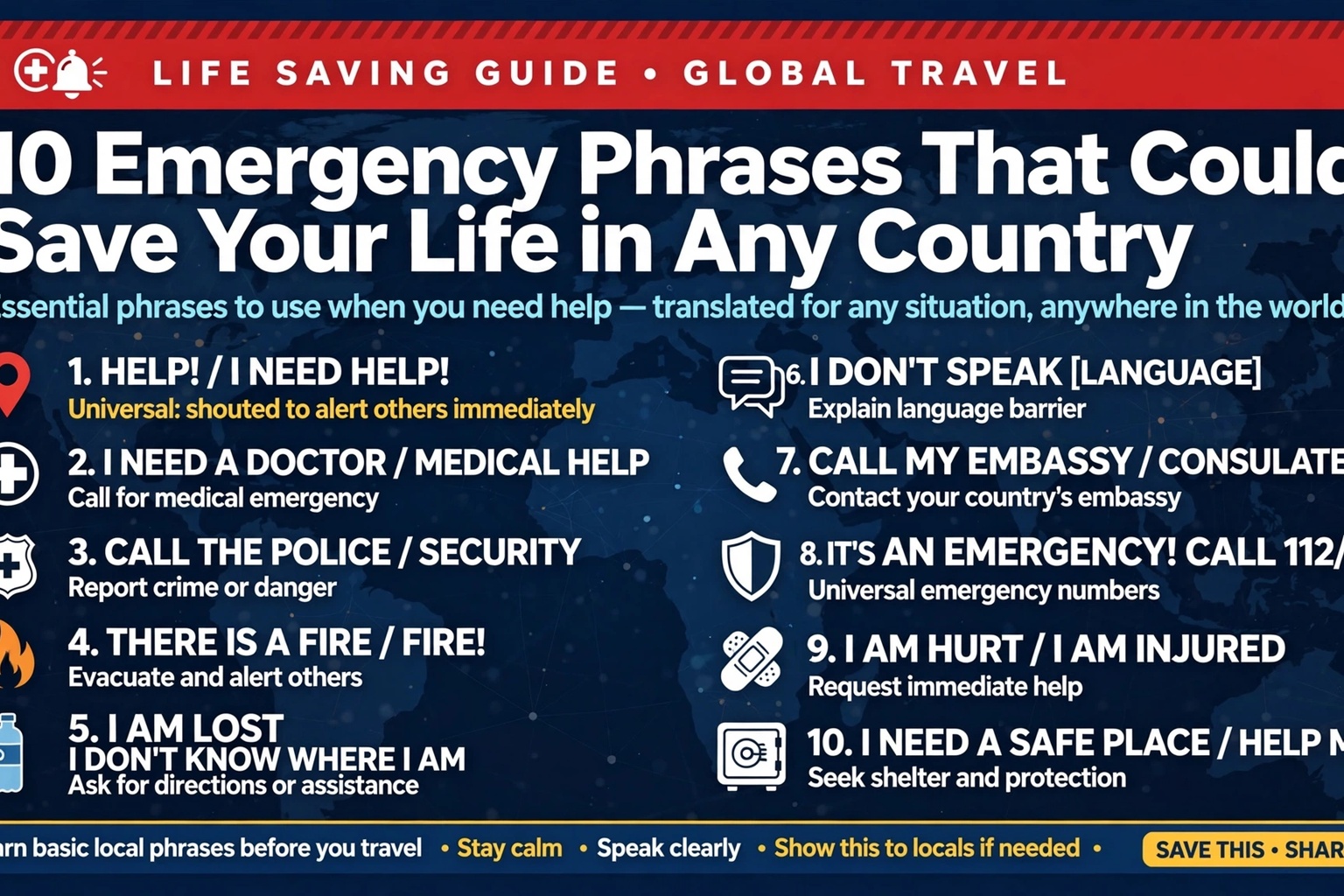
In an emergency abroad, language is not a courtesy — it is a tool. You do not need fluency. You need ten phrases, practiced until they are muscle memory, that work in any country on earth.
Learn the English versions cold, then learn them in the language of your destination. Write them on your emergency card. Practice saying them out loud before you fly.
The Ten
1. “Help!”
Spanish: ¡Ayuda! (ah-YOO-dah) · French: Au secours! (oh suh-KOOR) · Italian: Aiuto! (ah-YOO-toh) · German: Hilfe! (HIL-feh) · Portuguese: Socorro! (soh-KOH-hoo) · Thai: Chuay duay! · Japanese: Tasukete! · Tagalog: Tulong! · Turkish: İmdat! · Arabic: An-najda!
2. “Call the police!”
Spanish: ¡Llame a la policía! · French: Appelez la police! · Italian: Chiami la polizia! · German: Rufen Sie die Polizei! · Portuguese: Chame a polícia!
3. “I need a doctor.”
Spanish: Necesito un médico. · French: J’ai besoin d’un médecin. · Italian: Ho bisogno di un medico. · German: Ich brauche einen Arzt.
4. “Where is the hospital?”
Spanish: ¿Dónde está el hospital? · French: Où est l’hôpital? · Italian: Dov’è l’ospedale?
5. “I am lost.” / 6. “I need help.”
These two unlock kindness everywhere. Strangers help lost people. Say them clearly and slowly.
7. “Leave me alone!”
Spanish: ¡Déjeme en paz! · French: Laissez-moi tranquille! · Italian: Mi lasci in pace! · German: Lassen Sie mich in Ruhe! — Loud, firm, public. Harassment thrives on your silence.
8. “Take me to the police station / my hotel.”
Write the address on a card and point. To a taxi driver, a pointed address beats a thousand words.
9. “I am American / British / Australian — I need my embassy.”
Spanish: Necesito mi embajada. · French: J’ai besoin de mon ambassade. — Saying your nationality plus “embassy” is understood by police worldwide.
10. “Do you speak English?”
Ask it in their language first — ¿Habla inglés? / Parlez-vous anglais? / Parla inglese? / Sprechen Sie Englisch? — it opens doors that demanding English slams shut.
Make Them Stick
Say each phrase out loud five times before your trip. Save them in your phone’s notes. Put the top three on your emergency card. In a crisis you will not rise to the occasion — you will fall to the level of your preparation. Ten phrases is a light backpack for the weight it carries.
Beyond Words: Non-Verbal Emergency Tools
Words fail sometimes — shock, injury, or a hand over your mouth. Know the non-verbal backups: the Canadian hand signal for distress (hand up, thumb tucked, fingers folded over the thumb) is recognized by domestic-violence organizations worldwide and has been used in video calls to silently summon help. A whistle on your keychain needs no language at all. And most smartphones can trigger an SOS — five rapid presses of the power button on many models — that calls emergency services and texts your location to emergency contacts automatically. Set it up before departure, test it once, and know it is there. When words are impossible, signals still speak.
Sources
- Wikipedia — Emergency telephone number
- UK Foreign, Commonwealth & Development Office — Travel Advice
- Wikipedia — Smart Traveler Enrollment Program
Disclosure: The stories on Love Lies Abroad are based on publicly reported accounts. We are not stating these as facts — this is what was reported. If you are featured in a story and believe it is inaccurate, contact us and we will review it, correct it, or take it down.
Submit a correction, documentation, context, or a response for private editorial review. Contact the editorial desk.
Join the conversation
Load Facebook comments to read and reply using your Facebook account.