
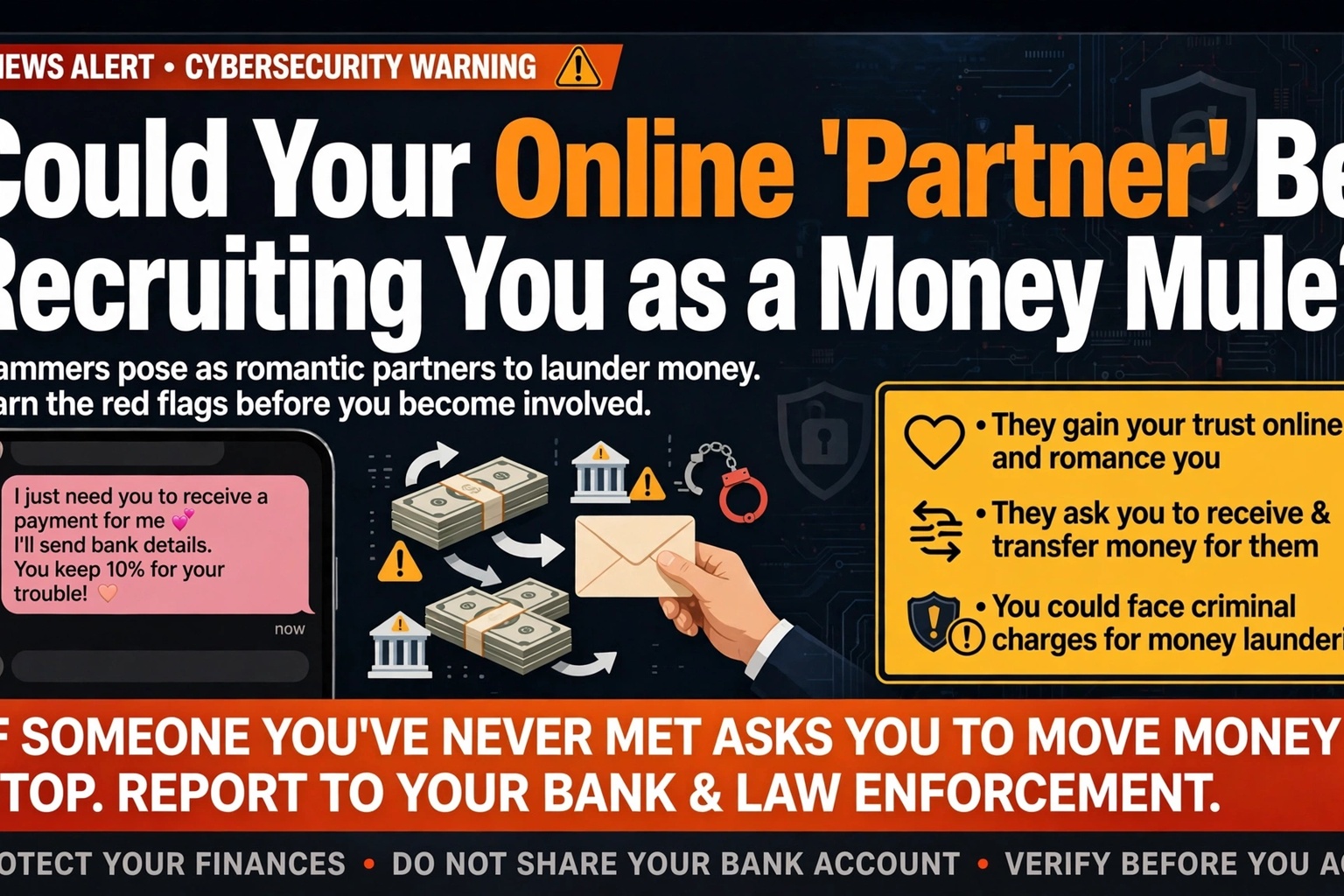
It starts as a favor. Your online partner’s ‘client’ needs to send them money, but their account is frozen — could it go through yours? Or a ‘business associate’ overpaid by check — could you deposit it and wire back the difference? Or the simplest version: a package arrives, and you’re asked to forward it. It feels like helping someone you love. Federal investigators have a different word for it: money mule.
The FBI’s Chicago field office lists it among romance scammers’ standard exploitations — criminals use victims for ‘money laundering on their behalf.’ You wouldn’t just be a victim. You’d be a participant in a federal crime.
How the recruitment works
The mule request never comes first. It comes after weeks or months of the FTC-described trust-building — constant contact, manufactured intimacy, the relationship feeling real. By the time the ‘favor’ arrives, refusing feels like betraying a partner, not declining a stranger.
The scripts are consistent: receive money and forward it (keeping a ‘cut’ as thanks), deposit checks and wire the funds onward, receive and reship packages (often containing fraudulently purchased goods or the proceeds of other scams), or open bank or crypto accounts in your name for the ‘partner’s business.’ Each one makes you the visible layer of someone else’s crime — the name on the account, the address on the package, the face on the camera at the bank.
Why ‘I didn’t know’ isn’t the shield people think
Here’s the part the romance framing obscures: moving money for criminals is money laundering, and depositing bad checks is bank fraud — regardless of whether a sweetheart asked nicely. The FBI warns victims explicitly about being exploited for money laundering because investigators see it constantly: victims who thought they were helping a partner discover they’re under investigation themselves.
The FTC’s companion warning covers the check variant: never deposit or cash a check for someone you’ve never met. The check will bounce — they always do — and you’ll owe the bank the full amount plus potential fraud scrutiny.
The test that exposes it
Ask one question: would a legitimate business run its finances through a romantic partner’s personal bank account? No business does this. No employer pays you by having clients wire your personal checking account. No ‘frozen account’ story survives contact with reality — banks freeze accounts through formal processes, not through girlfriends.
If your online partner asks you to move money, receive packages, or open accounts, the FBI’s guidance is the same as for every other red flag: stop all contact immediately. Don’t explain, don’t negotiate, don’t ‘just do this one favor.’ Then report to ic3.gov and the FTC at ReportFraud.ftc.gov — and tell your bank what happened before the bank’s fraud department tells you.
The person who loves you doesn’t need you to commit felonies for them. The criminal who needs a mule tells you it’s love. Learn the difference before the favor becomes a case file.
Disclosure: The stories on Love Lies Abroad are based on publicly reported accounts. We are not stating these as facts — this is what was reported. If you are featured in a story and believe it is inaccurate, contact us and we will review it, correct it, or take it down.
Submit a correction, documentation, context, or a response for private editorial review. Contact the editorial desk.
Join the conversation
Load Facebook comments to read and reply using your Facebook account.