
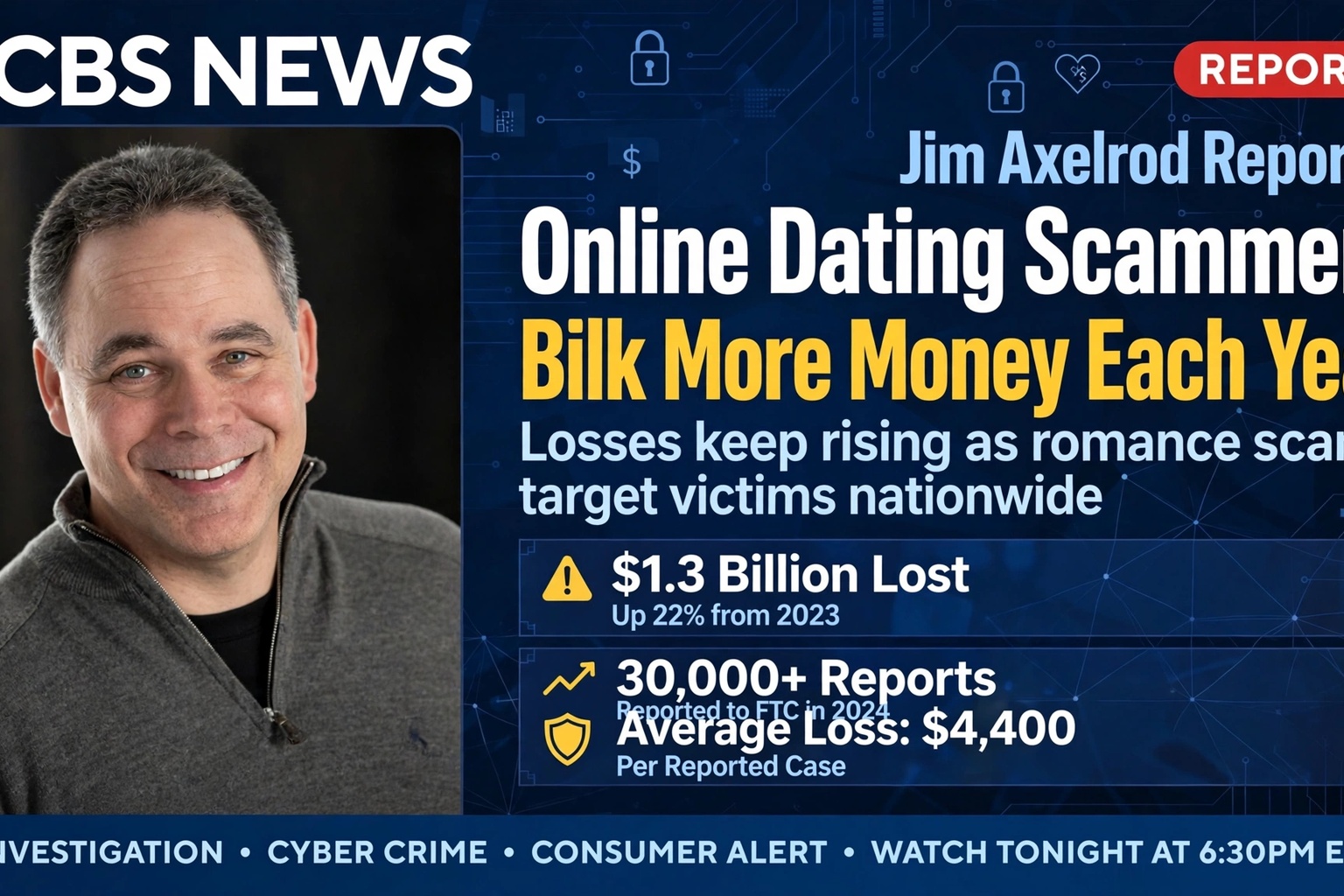
CBS News correspondent Jim Axelrod’s December 2024 investigation, ‘Online Dating Scammers Bilk More Money Each Year,’ put the romance scam crisis on the national news agenda — and helped build the case for the bipartisan bill now moving through Congress. His reporting captured what the data had been screaming: the losses keep climbing, and the system keeps failing the victims.
The Senate’s Romance Scam Prevention Act report cites Axelrod’s reporting in its official background section, alongside the FTC figures that frame the crisis: 2023 saw more than 64,000 Americans lose over $1 billion to romance scams — double the roughly $500 million lost just four years earlier — and 2024 added over 59,000 consumers losing nearly $1.2 billion, with a median loss of $2,000.
What the reporting exposed
Axelrod’s piece centered on the human cost behind the statistics — and on the legislative response taking shape. The bill it spotlighted, S. 841, the Romance Scam Prevention Act, would require online dating service providers to notify members when someone who messaged them has been banned for fraud. The Senate report explains the gap the bill closes: scammers deliberately move victims off dating apps to text or email so the platform can’t detect the fraud — and even when platforms do ban a scammer, the scammer’s other contacts are never told the person they trusted was flagged as a fraudster.
That notification gap is staggering when you think about it. A platform can identify a criminal, terminate the account, and leave every person that criminal messaged in the dark — still chatting, still trusting, still wiring money to a ghost.
Why journalism moved the needle
FTC data spotlights had documented the trend for years. But Axelrod’s reporting did what data alone rarely does: it attached the numbers to the legislative fix and put both in front of a mass audience. The Senate report’s citation of his work shows the pipeline working — reporting surfaces the human story, data proves the scale, legislation follows.
The bill also includes a safe harbor provision to encourage platforms to ban fraudsters aggressively without fear of liability — addressing the industry’s quiet reluctance to police its own user base.
What it means for you right now
The law isn’t passed yet. Until it is, the notification system is still you: reverse-image-search the photos, search the job plus ‘scammer,’ talk to someone you trust before money moves, and treat any push off-platform as a warning. The FTC’s standing guidance holds — never send money or gifts to a sweetheart you haven’t met in person, and report suspected scams at ReportFraud.ftc.gov.
Axelrod’s reporting proved the scammers are billing more every year. The question the bill tries to answer is whether the platforms that host the hunt will finally be required to warn the hunted.
Axelrod’s reporting also highlighted the structural fix the Senate report proposes: a safe harbor provision encouraging dating platforms to ban suspected fraudsters aggressively, without fear of being sued for it. The industry’s quiet reluctance to police its own users has been part of the problem — banning scammers costs engagement metrics, and warning their targets costs even more. The bill tries to flip those incentives. But legislation moves slowly and scammers move daily, so the practical defense remains personal and procedural: keep conversations on the platform, verify identities through reverse image searches and independent checks, involve a trusted friend before money enters the picture, and treat urgency as a tactic rather than a circumstance. Journalism exposed the billing. The data proved the scale. Your vigilance is the part no bill can automate.
Disclosure: The stories on Love Lies Abroad are based on publicly reported accounts. We are not stating these as facts — this is what was reported. If you are featured in a story and believe it is inaccurate, contact us and we will review it, correct it, or take it down.
Submit a correction, documentation, context, or a response for private editorial review. Contact the editorial desk.
Join the conversation
Load Facebook comments to read and reply using your Facebook account.