
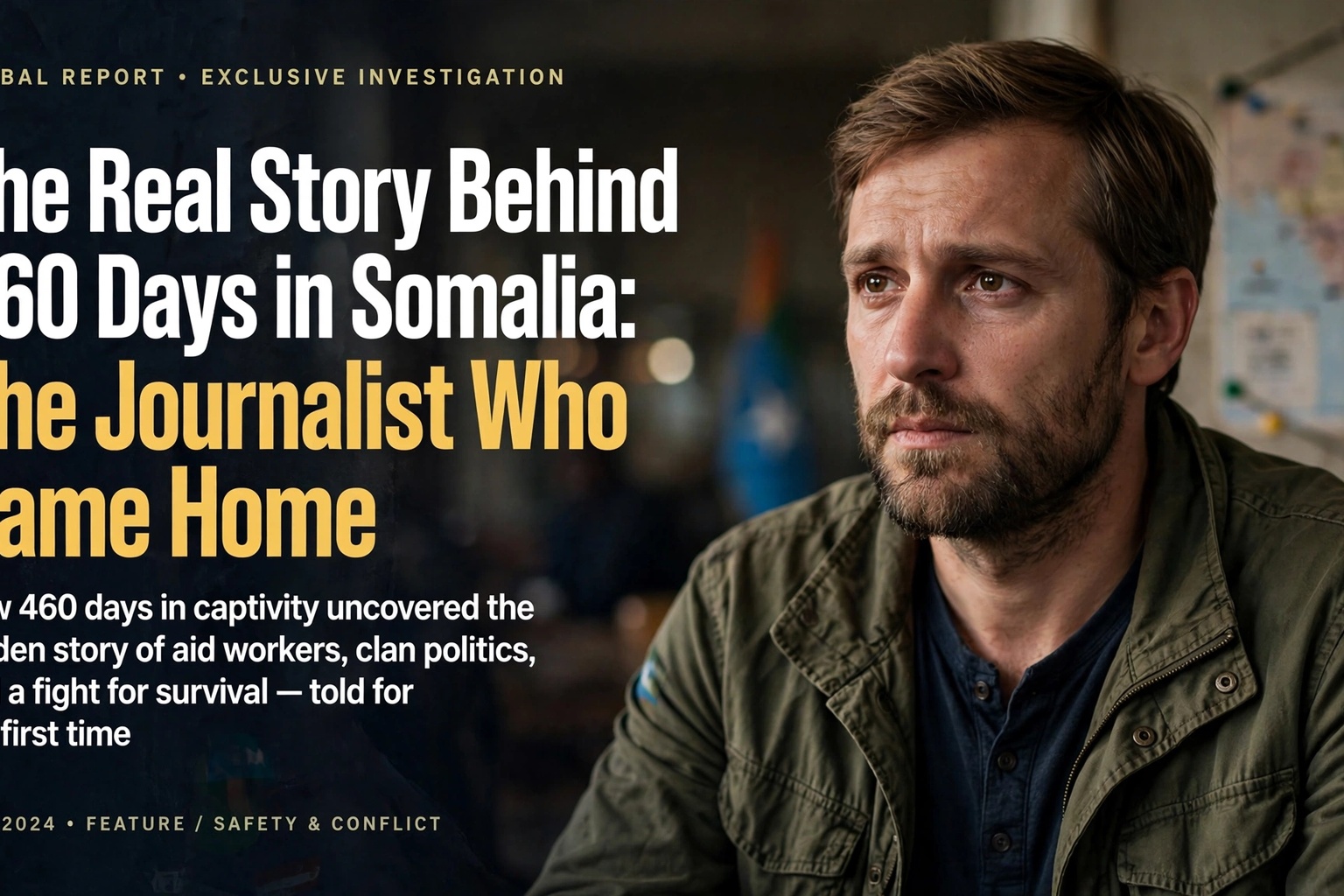
In August 2008, Canadian freelance journalist Amanda Lindhout and Australian photographer Nigel Brennan were reporting near Mogadishu, Somalia, when gunmen seized them. What followed was 460 days of captivity — beatings, torture, starvation, chains in a dark room — before their families raised a ransom through a private firm and secured their release on November 25, 2009.
She was hospitalized in Nairobi for two weeks with acute malnourishment. She has said she felt suicidal after her release. And then she did something extraordinary: she rebuilt.
What Actually Happened
Lindhout had gone to Somalia because few journalists were covering it — she wanted human-interest stories other reporters were not getting. On August 23, 2008, she and Brennan were taken hostage at gunpoint. The kidnappers initially demanded millions of dollars. For over a year, her mother, Lorinda Stewart, became the family’s lead negotiator, spending fifteen and a half months working to bring her daughter home — a story Stewart later told in her own book, One Day Closer.
In captivity, Lindhout has described being separated from Brennan, tortured, and assaulted by teenage captors. She survived, she has said, partly by retreating in her mind to what she called her “house in the sky” — vivid memories of the world beyond the walls. After her release, she wrote the bestselling memoir A House in the Sky with journalist Sara Corbett.
Justice, Years Later
In 2015, Canadian police arrested Ali Omar Ader — the man Lindhout knew as “Adam,” the kidnappers’ chief negotiator — after a five-year undercover sting that began when he contacted her on Facebook. He was convicted in a Canadian court for his role in the hostage-taking. At his sentencing hearing, Lindhout testified about the severe anxiety, depression, and nightmares the captivity left her with — and said she had chosen to forgive him.
The Lesson Beneath the Headlines
Lindhout’s story is extreme, but its core lesson applies to every woman traveling abroad to meet someone: her mother was her lifeline because her mother knew exactly where she was, who she was with, and what to do when she went silent. Stewart had binders of material, recordings, contacts. She could act because she had information.
Before you travel, give someone at home the same power: your full itinerary, the person’s identity, your check-in schedule, and written instructions for what to do if you miss a check-in. Lindhout survived 460 days. What brought her home was not luck — it was a mother who knew where to look and refused to stop.
What She Built After
Lindhout did not only survive — she converted the worst experience of her life into work that helps others. She founded the Global Enrichment Foundation, supporting education and aid initiatives in Somalia and Kenya, the very region where she was held. She has spoken publicly about choosing forgiveness, not as absolution for her captors, but as self-preservation: carrying hatred, she has said, would have kept her chained long after the chains came off.
There is a hard lesson in that for anyone facing fear about travel: courage is not the absence of fear, it is preparation plus the refusal to surrender your future to one terrible chapter. Lindhout’s mother kept binders. Lindhout kept her mind. Between those two disciplines — documentation and determination — a woman came home from 460 days of hell and built something good from it.
Sources
Disclosure: The stories on Love Lies Abroad are based on publicly reported accounts. We are not stating these as facts — this is what was reported. If you are featured in a story and believe it is inaccurate, contact us and we will review it, correct it, or take it down.
Submit a correction, documentation, context, or a response for private editorial review. Contact the editorial desk.
Join the conversation
Load Facebook comments to read and reply using your Facebook account.