
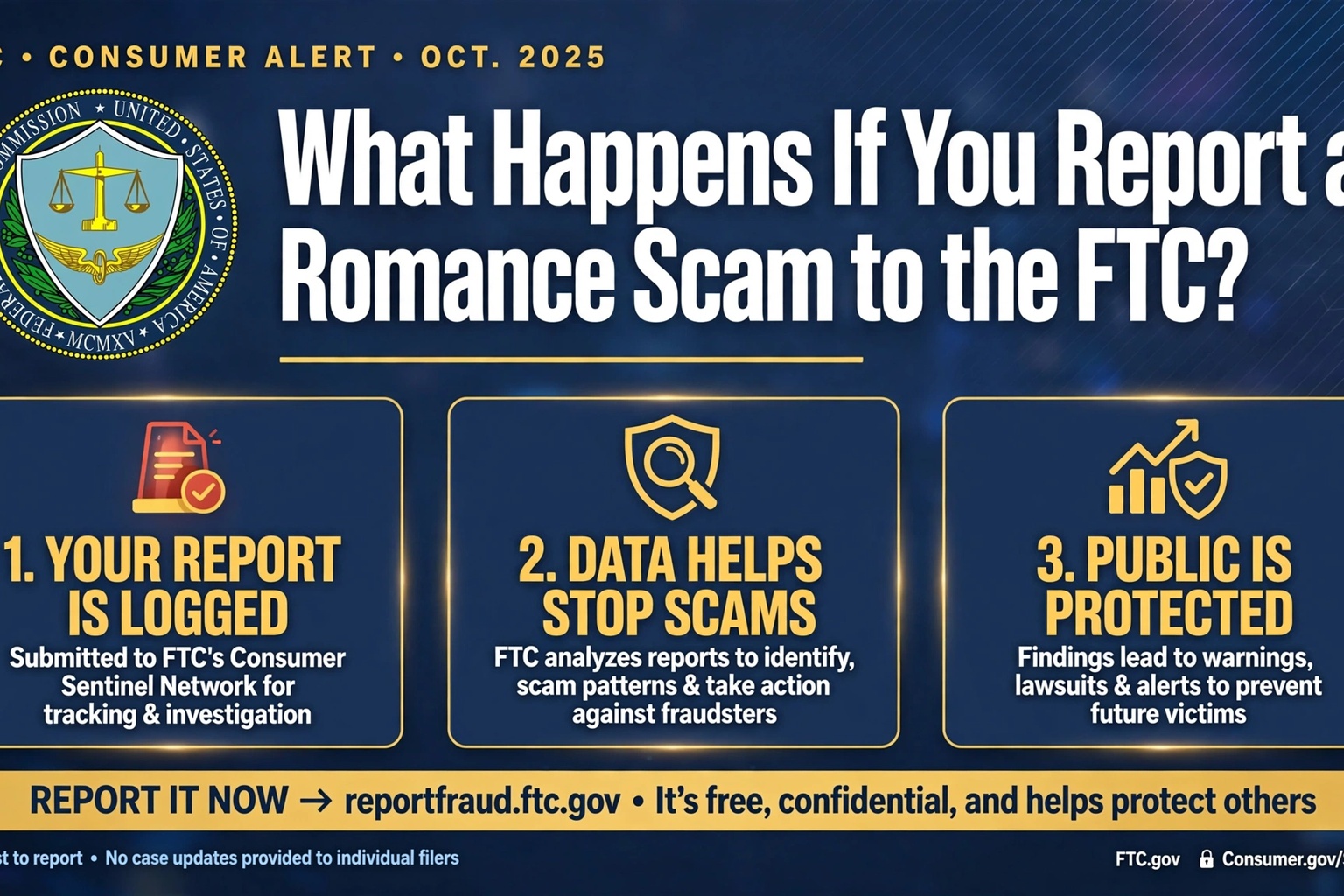
You’ve realized the ‘soldier’ was a script. The money’s gone, the profile’s gone, and you’re staring at the FTC’s ReportFraud.ftc.gov page wondering: does this actually do anything? It’s a fair question — and the honest answer is more encouraging than most victims expect.
Short version: your report becomes data, and the data becomes cases. Long version: here’s the actual machinery.
Where your report goes
FTC reports feed the Consumer Sentinel Network, a database the FTC shares with thousands of law enforcement agencies. The Senate’s Romance Scam Prevention Act report drew its headline figures — 64,003 reports and $1.14 billion in 2023 losses; 59,000-plus consumers and nearly $1.2 billion in 2024 — directly from Sentinel data. Your report doesn’t sit in a drawer. It becomes part of the dataset that proves the scale of the problem to Congress, which is currently considering legislation requiring dating platforms to warn users about banned scammers.
The FTC is upfront that it doesn’t resolve individual cases — it’s not a police department and won’t get your money back directly. But Sentinel reports trigger investigations, enforcement actions, and consumer alerts when patterns emerge. The scammer who took your money has likely targeted dozens of others; your report may be the one that completes someone else’s pattern.
What the FBI does with its reports
The FBI’s Internet Crime Complaint Center (ic3.gov) works differently: IC3 complaints are reviewed by analysts and can be referred to field offices for investigation. The FBI’s Chicago office notes that with a report, the Bureau can work directly with local law enforcement and financial institutions to try to secure the return of financial losses — especially if you report quickly, before the money has been laundered through multiple hops.
Speed matters enormously. Wire transfers, crypto transactions, and gift card drains get harder to reverse with every hour. The FTC’s guidance says: if you paid a scammer, contact the company or your bank immediately, tell them you paid a scammer, and ask for a refund — then report.
What to report, and to whom
The full checklist: report to the FTC at ReportFraud.ftc.gov. Report to the FBI at ic3.gov. Notify the dating app or social platform where you met the scammer — they can ban the account and, under proposed legislation, may one day have to warn the scammer’s other contacts. If the scammer claimed to be military, the military’s criminal investigative organizations take those reports too.
And keep everything: messages, photos, phone numbers, email addresses, wallet addresses, transaction receipts. Investigators build cases from exactly this material.
So what happens when you report? Maybe nothing you can see. Or maybe your report is the thread that unravels the network. The FTC’s data spotlights — the ones that moved Congress to act — are built from reports like yours. Filing one is the difference between being a statistic nobody counted and being the evidence that ends the scam for the next person.
Disclosure: The stories on Love Lies Abroad are based on publicly reported accounts. We are not stating these as facts — this is what was reported. If you are featured in a story and believe it is inaccurate, contact us and we will review it, correct it, or take it down.
Submit a correction, documentation, context, or a response for private editorial review. Contact the editorial desk.
Join the conversation
Load Facebook comments to read and reply using your Facebook account.