
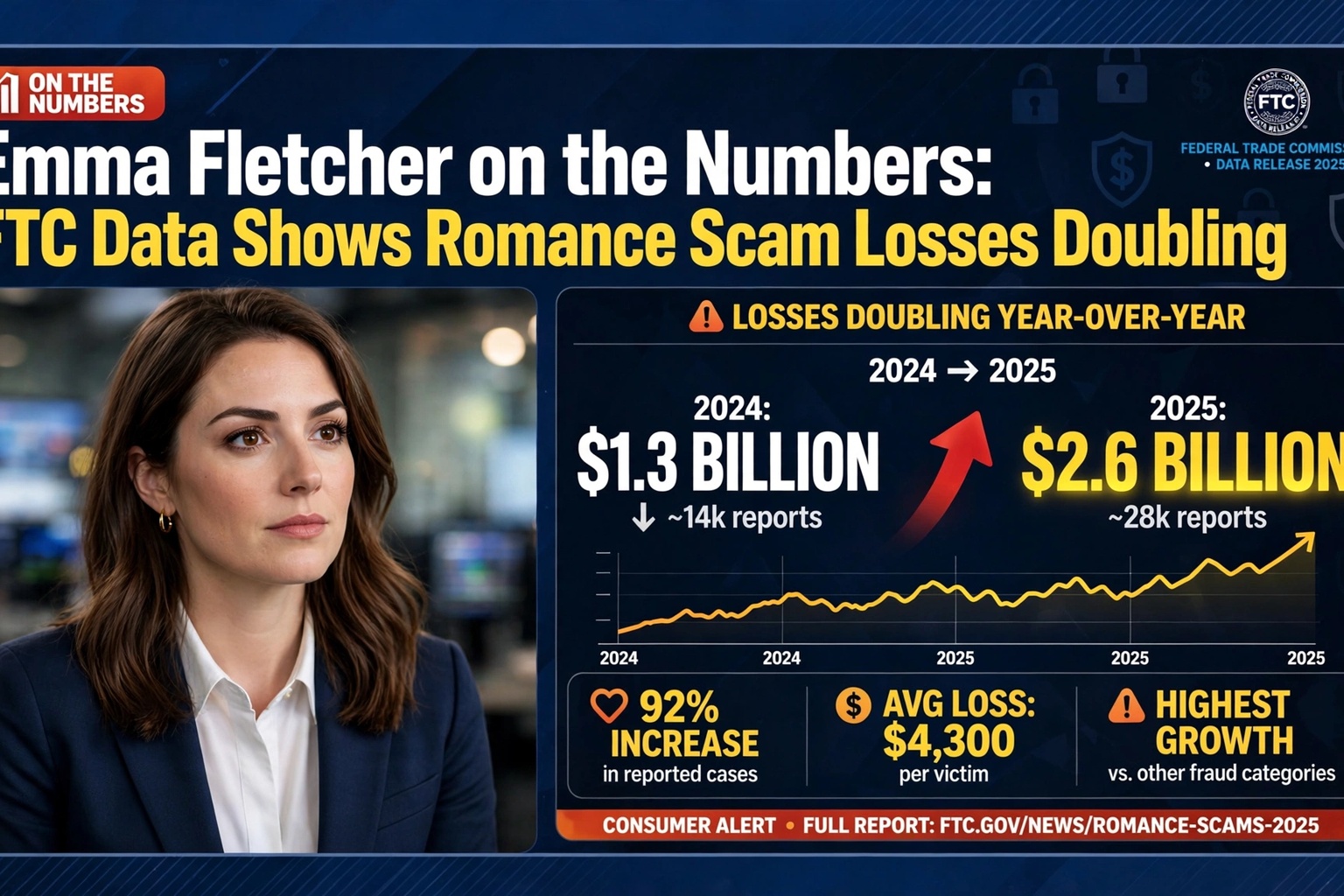
FTC data analyst Emma Fletcher has been tracking romance scam losses for years through the agency’s data spotlight series — and her 2021 analysis, ‘Romance Scams Take Record Dollars in 2020,’ captured the moment the problem went from serious to staggering. Her finding: Americans reported losing a record $304 million to romance scams in 2020, up about 50 percent from the year before.
That was the warning shot. What came next proved her right to be alarmed.
The trajectory Fletcher documented
The FTC’s February 2022 data spotlight, ‘Reports of Romance Scams Hit Record Highs in 2021,’ showed the records falling again — with reported losses climbing past half a billion dollars. Then came the years the Senate’s Romance Scam Prevention Act report tallied from FTC Consumer Sentinel data: 2023 brought 64,003 reports and about $1.14 billion in losses; 2024 brought over 59,000 consumers losing nearly $1.2 billion. The median loss held at $2,000.
Read Fletcher’s 2020 record ($304 million) against 2023’s $1.14 billion and the picture is stark: reported losses roughly tripled in three years. The Senate report notes 2023’s total was double what was lost just four years earlier — the curve isn’t flattening.
What the data spots reveal about method
Fletcher’s analyses and the FTC’s subsequent spotlights show the mechanics behind the money. Romance scams are a subcategory of imposter scams — fraud built on manufactured trust — and imposter scams have been the most reported online fraud category for four straight years, driven in part by romance fraud’s rise.
The Senate report adds the operational detail: scammers find victims on dating apps, then move them off-platform to text or email to evade fraud detection. Congress is now considering the Romance Scam Prevention Act, which would require dating services to notify users when someone who messaged them gets banned for fraud — a direct response to the data Fletcher and her colleagues have been publishing.
Why one analyst’s charts matter to your dating life
Data spotlights feel abstract until you’re the data point. Fletcher’s work matters because it proves the pattern: this isn’t bad luck or personal failure, it’s a measured, growing, industrial fraud with a consistent signature — fake profiles, manufactured intimacy, urgent money requests via irreversible channels.
The FTC’s guidance, which the data supports, is procedural, not emotional: never send money or gifts to a sweetheart you haven’t met in person. Reverse-image-search the photos. Search the job plus ‘scammer.’ Talk to someone you trust before money moves. And report at ReportFraud.ftc.gov — because the reports are the data, and the data is what turns one victim’s story into the warning that saves the next thousand.
Fletcher’s 2020 analysis captured the inflection point: $304 million in reported losses, up roughly 50 percent in a single year, a record at the time. Nobody reading it could have predicted $1.14 billion three years later — but the direction was already set. The FTC’s data spotlights work like seismographs: each one records the tremor, and together they reveal the earthquake building underneath. The Senate report’s citation of Fletcher’s work in the official legislative record shows the pipeline functioning as designed — analyst documents the trend, the data proves the scale, Congress drafts the fix. For daters, the takeaway from Fletcher’s charts isn’t statistical. It’s personal: you are not too smart to become a data point. The victims in her datasets thought so too. Process beats pride — verify the identity, keep money out of it, and report what you see so the next spotlight has fewer of your fellow daters in it.
Disclosure: The stories on Love Lies Abroad are based on publicly reported accounts. We are not stating these as facts — this is what was reported. If you are featured in a story and believe it is inaccurate, contact us and we will review it, correct it, or take it down.
Submit a correction, documentation, context, or a response for private editorial review. Contact the editorial desk.
Join the conversation
Load Facebook comments to read and reply using your Facebook account.