
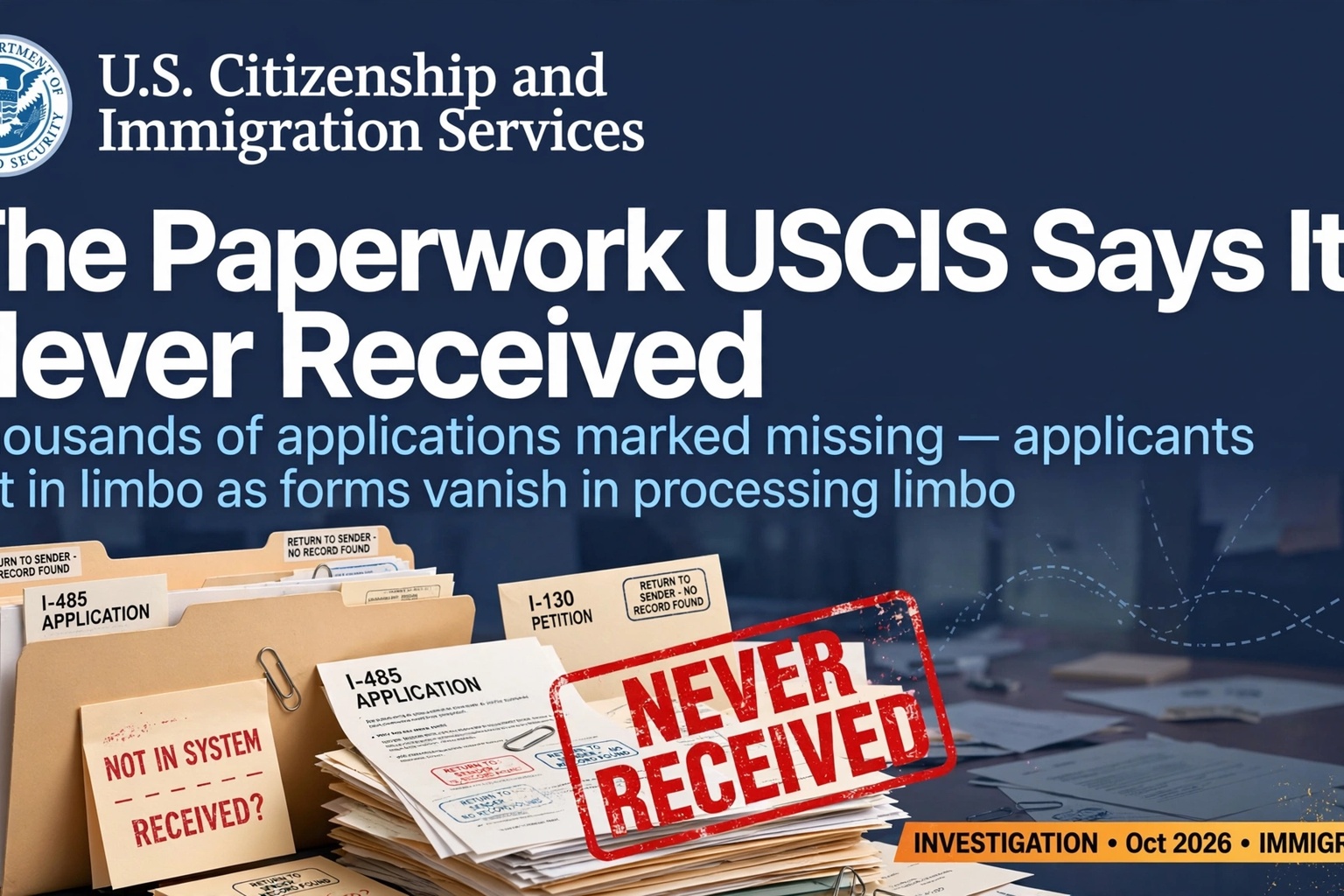
Few moments in immigration practice are as maddening as this one: you mailed everything, delivery was confirmed, and USCIS insists a critical document never arrived. The RFE response, the address change, the evidence package — vanished into the bureaucracy. These are not urban legends or excuses. Lost and misrouted filings are a documented hazard of a paper-heavy system processing millions of cases, and K-1 couples lose months to them every year.
How filings go missing
The usual culprits are unglamorous. Mail sent to the wrong service center or lockbox, because filing locations changed since the guide you read was written. A filing without the receipt number on every page, so separated pages cannot be matched to the case. Documents that arrived but were never linked to the file they belonged to. An address change reported to one USCIS system but not the others, so correspondence — including the RFE itself — went to the old mailbox. USCIS handles volume at a scale where anything that cannot be mechanically matched to a case risks sitting in limbo indefinitely.
Building a paper trail that survives
Every submission should go by traceable mail with delivery confirmation, and the tracking number should be logged against the case number in your own records. Keep complete copies of everything sent — every page — because “resend it” is the standard remedy and you cannot resend what you did not copy. Put the receipt number on every page of every submission, including exhibits. File address changes through the official USCIS change-of-address process within 10 days of moving, and confirm the change took effect rather than assuming it. For online-filed components, save every confirmation screen and receipt.
When USCIS loses it anyway
If an RFE response or filing is not acknowledged, the escalation path starts with a case inquiry through USCIS online tools, attaching proof of delivery — the tracking record showing what arrived where and when. Where a denial rests on evidence that was timely filed but never matched to the case, a motion to reopen may be available, arguing the decision was based on an incomplete record through no fault of the filer. These motions have strict deadlines and demanding evidentiary requirements; they are not do-it-yourself projects in most cases. Congressional casework can sometimes help locate a misrouted filing.
The unsolved-file mindset
Assume nothing arrived until the case tracker or a written notice says so. Never send an original you cannot replace — send copies unless the instructions demand originals, and keep the originals. Log every interaction with a date. Paranoia about paperwork is the rational posture in this system, and the couples who keep the best records are the ones who recover fastest when the system loses something. If a lost filing has already produced a denial, get counsel before the motion deadline passes. Informational only.
Consider creating a simple case log: every mailing with its tracking number, every call with the date and representative’s ID, every notice with its date received. When something goes missing — and eventually something will — the log turns a frantic search into a five-minute lookup, and it gives an attorney or congressional caseworker exactly what they need to help.
Sources: https://www.uscis.gov/i-129f https://www.uscis.gov/i-485
Disclosure: The stories on Love Lies Abroad are based on publicly reported accounts. We are not stating these as facts — this is what was reported. If you are featured in a story and believe it is inaccurate, contact us and we will review it, correct it, or take it down.
Submit a correction, documentation, context, or a response for private editorial review. Contact the editorial desk.
Join the conversation
Load Facebook comments to read and reply using your Facebook account.