
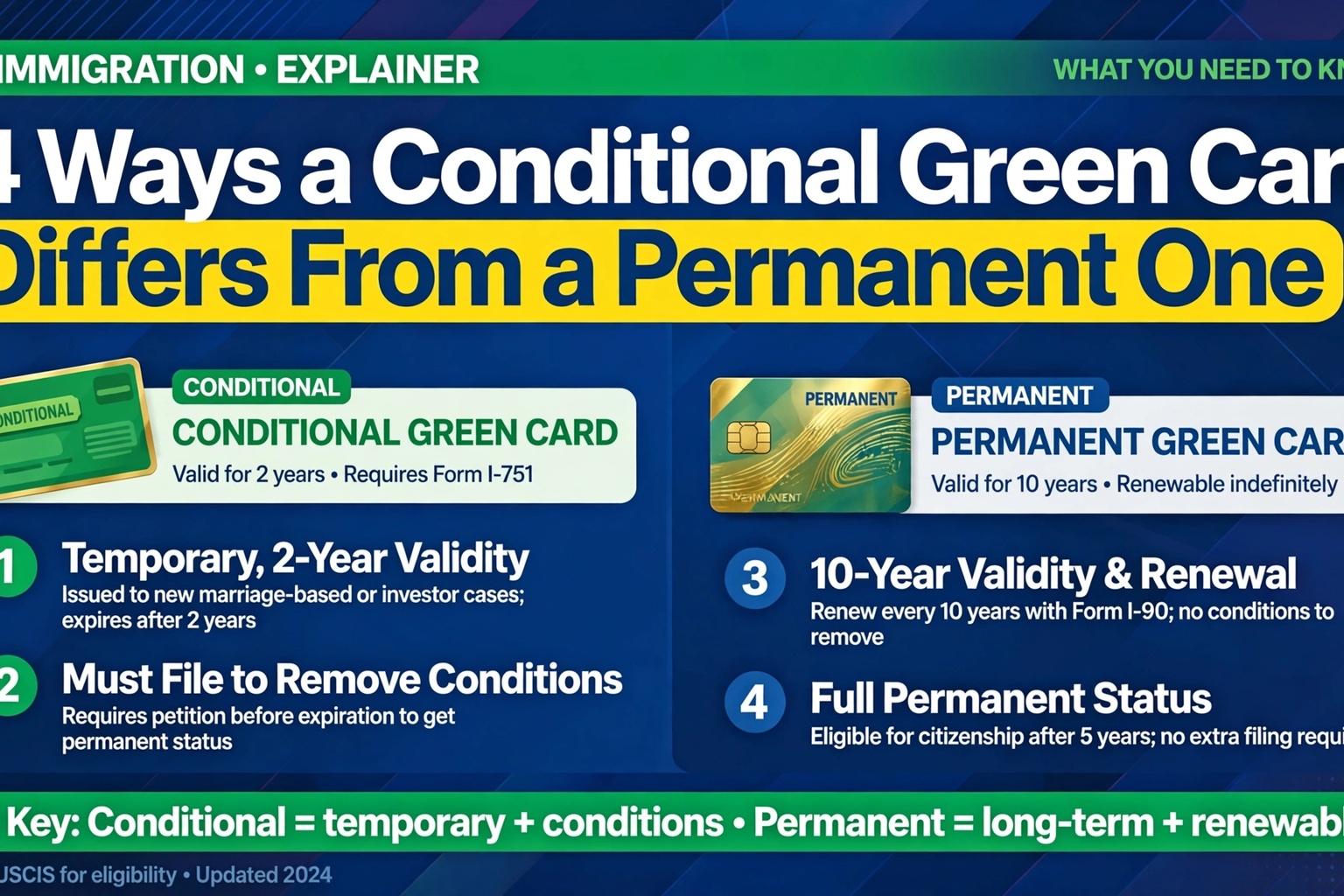
Many K-1 couples are surprised at the adjustment interview — or when the card arrives — to learn the green card is conditional. If the marriage is less than two years old on the day residence is granted, the card is valid for two years, not ten. The conditions are removable, the process is routine, but the differences from a standard green card are real and worth understanding in advance.
1. It expires in two years, by design
A conditional permanent resident card expires on its second anniversary. This is not a mistake, not a punishment, and not a sign something went wrong. Congress created conditional residence for marriages under two years old at the time of grant, to allow the government a second look at the marriage’s bona fides before conferring full permanent residence. The card itself looks nearly identical to a standard green card; the expiration date tells the story.
2. You must petition to remove conditions: Form I-751
Unlike a ten-year card, which is simply renewed with a form and a fee, a conditional card requires Form I-751, Petition to Remove Conditions on Residence, filed jointly by the couple in the 90-day window before the card expires. The current filing fee is $750. Missing the window has severe consequences — USCIS can terminate conditional status and place the immigrant in removal proceedings. Calendar the 90-day window the day the conditional card arrives; it is the most important date in the two years that follow.
3. The evidence burden returns
The I-751 requires fresh proof that the marriage is genuine and ongoing: joint federal tax returns, a shared lease or mortgage, joint bank accounts, joint insurance policies, photos together across the two years, and children’s birth certificates if applicable. The strongest I-751 packages are built continuously, not assembled at month twenty-one — couples should keep building the paper trail from the wedding onward. File jointly, with both spouses’ signatures, and include a cover letter mapping the evidence.
4. Divorce does not end the road — but changes it
If the marriage ends before conditions are removed — through divorce, annulment, or the death of the spouse — the immigrant spouse is not automatically out of options. The law provides a waiver of the joint filing requirement for cases including divorce from a good-faith marriage and battery or extreme cruelty by the U.S. citizen spouse. The waiver requires strong evidence that the marriage was entered in good faith, and it is firmly attorney territory: the evidentiary standard is demanding, and a denied waiver leads to termination proceedings. Congress created the waiver precisely because it knew some marriages fail for legitimate reasons, and adjudicators take good-faith showings seriously when they are well documented.
After conditions are removed
An approved I-751 produces the standard ten-year permanent resident card, renewable indefinitely, and the conditional period counts fully toward the residence requirements for naturalization. Plan for the I-751 from day one of the conditional card — the couples who sail through are the ones who never stopped documenting. Informational only.
Sources: https://www.uscis.gov/i-485 https://www.uscis.gov/i-751
Disclosure: The stories on Love Lies Abroad are based on publicly reported accounts. We are not stating these as facts — this is what was reported. If you are featured in a story and believe it is inaccurate, contact us and we will review it, correct it, or take it down.
Submit a correction, documentation, context, or a response for private editorial review. Contact the editorial desk.
Join the conversation
Load Facebook comments to read and reply using your Facebook account.