
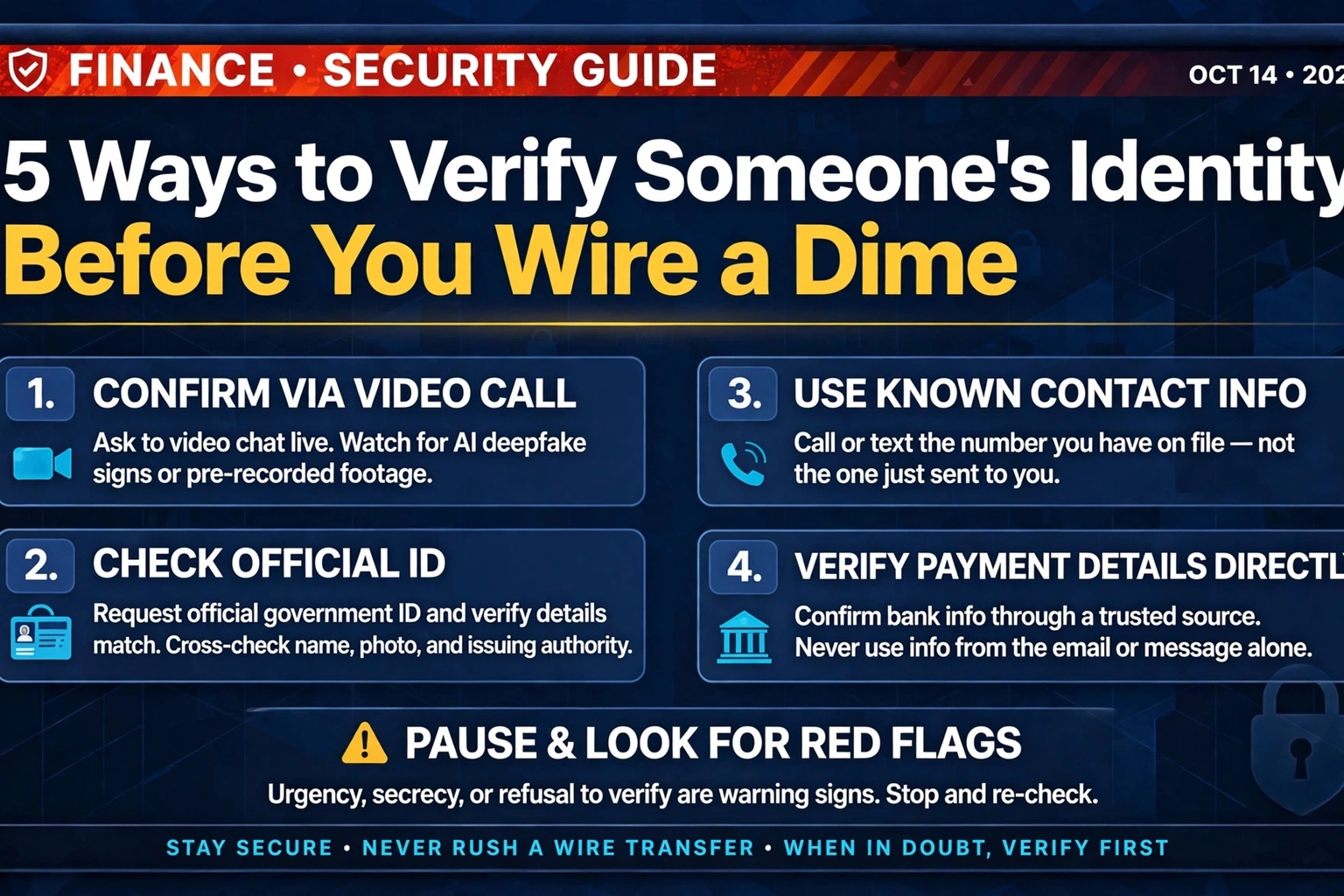
Every romance scam runs on the same fuel: an unverified identity. The person you’re falling for might be exactly who they claim — or a criminal running five identical ‘relationships’ from a laptop overseas. The difference between a love story and a police report is usually about twenty minutes of verification. Here are five checks the FBI and FTC effectively endorse, and none of them cost a cent.
1. Reverse-image-search every photo
Drag their profile pictures into a search engine’s image search. The FBI’s Chicago office explicitly advises researching ‘the individual’s picture and profile using other online search tools.’ If the same face appears under different names, on stock photo sites, or on a real person’s Instagram from three years ago, you’re looking at a stolen identity, not a soulmate.
2. Search the job plus the word ‘scammer’
This is the FTC’s own suggested test: search for the type of job the person claims plus the word ‘scammer’ — ‘oil rig scammer,’ ‘US Army scammer,’ and so on. Romance scam scripts are mass-produced. If your match’s life story matches dozens of victim reports nearly word for word, it’s a script, not a life.
3. Demand a live video call — and watch closely
A real person can get on a live call. The excuses — broken camera, bad connection, military security — are the tell. And if they do appear on video, stay alert: scammers increasingly use prerecorded clips or real-time face filters. Ask them to do something unscripted on camera, like holding up three fingers or turning their head side to side. A recording can’t improvise.
4. Verify the details that should be verifiable
Real people leave traces: a workplace with a real website, colleagues, a professional license, a property record. Search their name with their city, their employer, their claimed credentials. Be careful what you conclude from absence alone — but a person with zero verifiable footprint who also can’t video call and needs your money is not a mystery. It’s an answer.
5. Get a second human opinion
The FTC says it plainly: talk to someone you trust, and ask whether friends or family are concerned about your new love interest. Scammers work hard to isolate victims from exactly these people — the FBI lists isolation attempts as a core red flag — because an outside perspective breaks the spell. If your match discourages you from telling anyone about the relationship, treat that as verification in itself.
Run all five before any money moves, and run them early — verification works best before the emotional investment makes the results feel like an attack. The FTC’s standing rule is the backstop for everything above: never send money or gifts to a sweetheart you haven’t met in person.
Verification has a sixth step most people skip: preserve the evidence as you go. Save messages, screenshots of the profile, phone numbers, email addresses, photos they sent, and records of any money moved — before the profile disappears. The FBI’s Chicago office notes that reports let the Bureau work with local law enforcement and financial institutions to try to recover losses, but investigators can only work with what victims preserved. Screenshots take seconds; a vanished profile takes your evidence with it. Run the five checks above before money moves, keep the receipts regardless, and remember the hierarchy: verification first, emotion second, money never — not to someone you haven’t met in person. That’s not cynicism. That’s the FTC’s standing guidance, and it’s saved more heartbreak than any dating advice ever written.
Disclosure: The stories on Love Lies Abroad are based on publicly reported accounts. We are not stating these as facts — this is what was reported. If you are featured in a story and believe it is inaccurate, contact us and we will review it, correct it, or take it down.
Submit a correction, documentation, context, or a response for private editorial review. Contact the editorial desk.
Join the conversation
Load Facebook comments to read and reply using your Facebook account.