
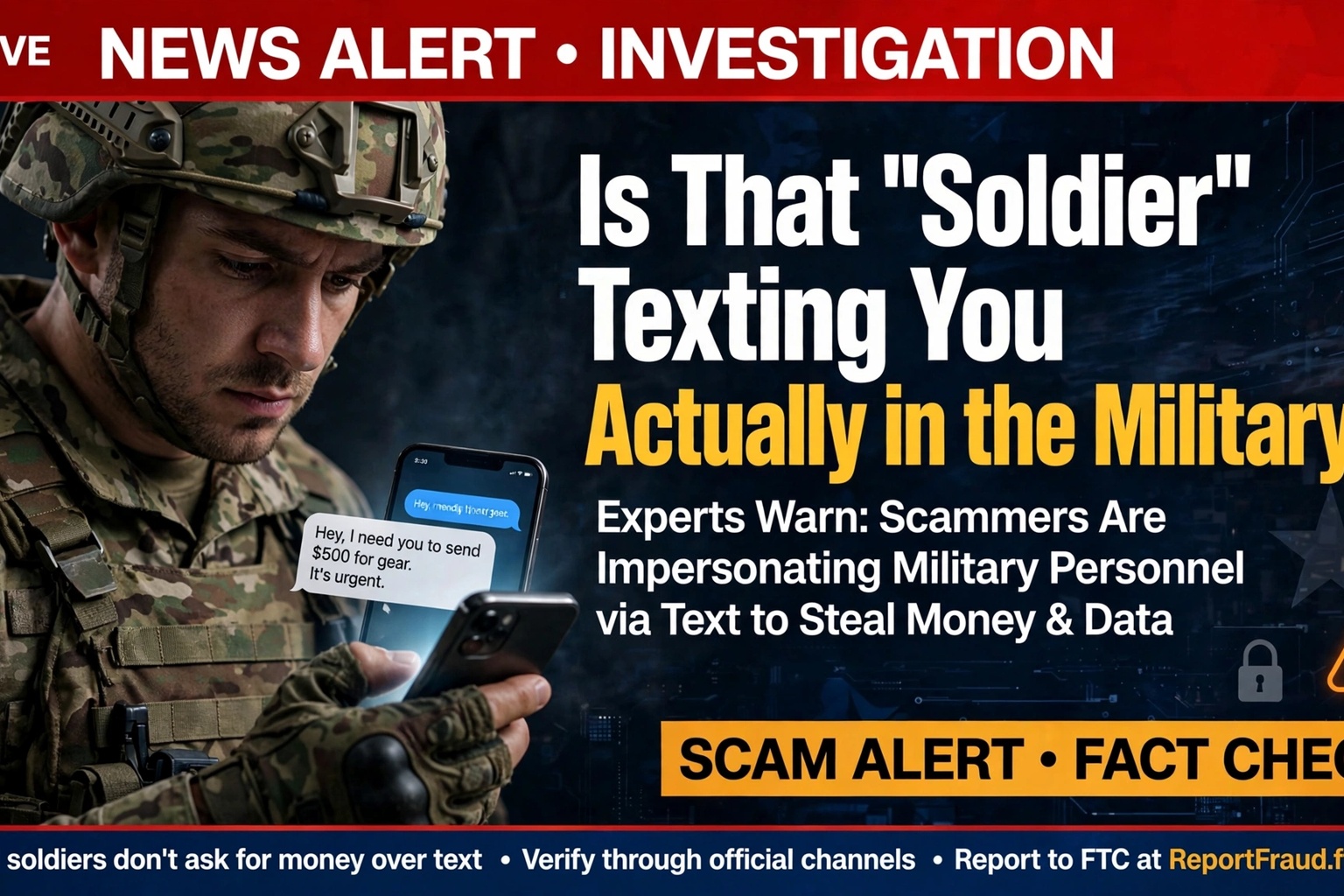
He’s deployed. Communication is spotty — operational security, you understand. He can’t video call. He can’t receive packages at his APO address right now. But he’s a sergeant, or a captain, and his photos in uniform look legitimate, and he’s falling for you hard between missions.
The FTC names this exact lie in its official romance scam guidance: scammers say they can’t meet you in person, and one of the standard covers is ‘in the military.’ The uniform is one of the most abused costumes in the entire scam wardrobe — because it bundles authority, sympathy, and an airtight excuse for never meeting into a single persona.
How the military persona works
The script is standardized. He’s stationed overseas or on deployment. He needs money for things that sound military but aren’t: a ‘leave fee’ to come home, a replacement fee, a customs charge, a lost-equipment fine, or money to ‘buy out’ the rest of his contract. None of these are real. The U.S. military does not charge service members fees to take leave, does not fine them for losing equipment via wire transfer from a girlfriend, and does not sell early outs.
The Senate’s romance scam report adds a grim data point on why this persona persists: the Department of Justice has warned that nearly 40 percent of the military community’s fraud losses were the result of imposter and romance scams. Scammers don’t just impersonate soldiers — they target real military families too.
The verification tests
Real service members can be verified through channels that don’t involve wiring money. The FTC’s general advice applies double here: search the claimed unit or story plus the word ‘scammer’ — military impersonation scripts are so standardized that other victims have posted the same story nearly word for word.
Second, reverse-image-search the uniform photos. Stolen valor photos circulate in scammer networks for years; the same ‘sergeant’ has proposed to dozens of women under dozens of names.
Third, apply the money test. Any request for money tied to military procedures — leave fees, deployment costs, communication fees — is automatically fake. The military pays its people; it doesn’t crowdfund their leave through girlfriends met on Facebook.
The FTC’s bottom line is the whole defense: never send money or gifts to a sweetheart you haven’t met in person. A real soldier understands operational security. A fake one is counting on you not understanding military procedure. Learn the difference before you learn it the expensive way.
There’s a final verification step that costs nothing: learn what the military actually does. Service members don’t pay for leave, don’t pay for replacements, don’t pay customs fees on personal equipment, and don’t need romantic partners to wire money for any administrative process. The entire financial architecture of military life runs through the Department of Defense — not through a girlfriend’s MoneyGram. Any request for money tied to military procedure is automatically disqualifying, no matter how real the uniform photos look or how convincing the story sounds. The FTC’s guidance for suspected scams applies in full: stop communicating immediately, talk to someone you trust, search the story plus the word ‘scammer,’ and report it at ReportFraud.ftc.gov. The uniform commands respect. The scammer wearing it deserves a report.
Disclosure: The stories on Love Lies Abroad are based on publicly reported accounts. We are not stating these as facts — this is what was reported. If you are featured in a story and believe it is inaccurate, contact us and we will review it, correct it, or take it down.
Submit a correction, documentation, context, or a response for private editorial review. Contact the editorial desk.
Join the conversation
Load Facebook comments to read and reply using your Facebook account.