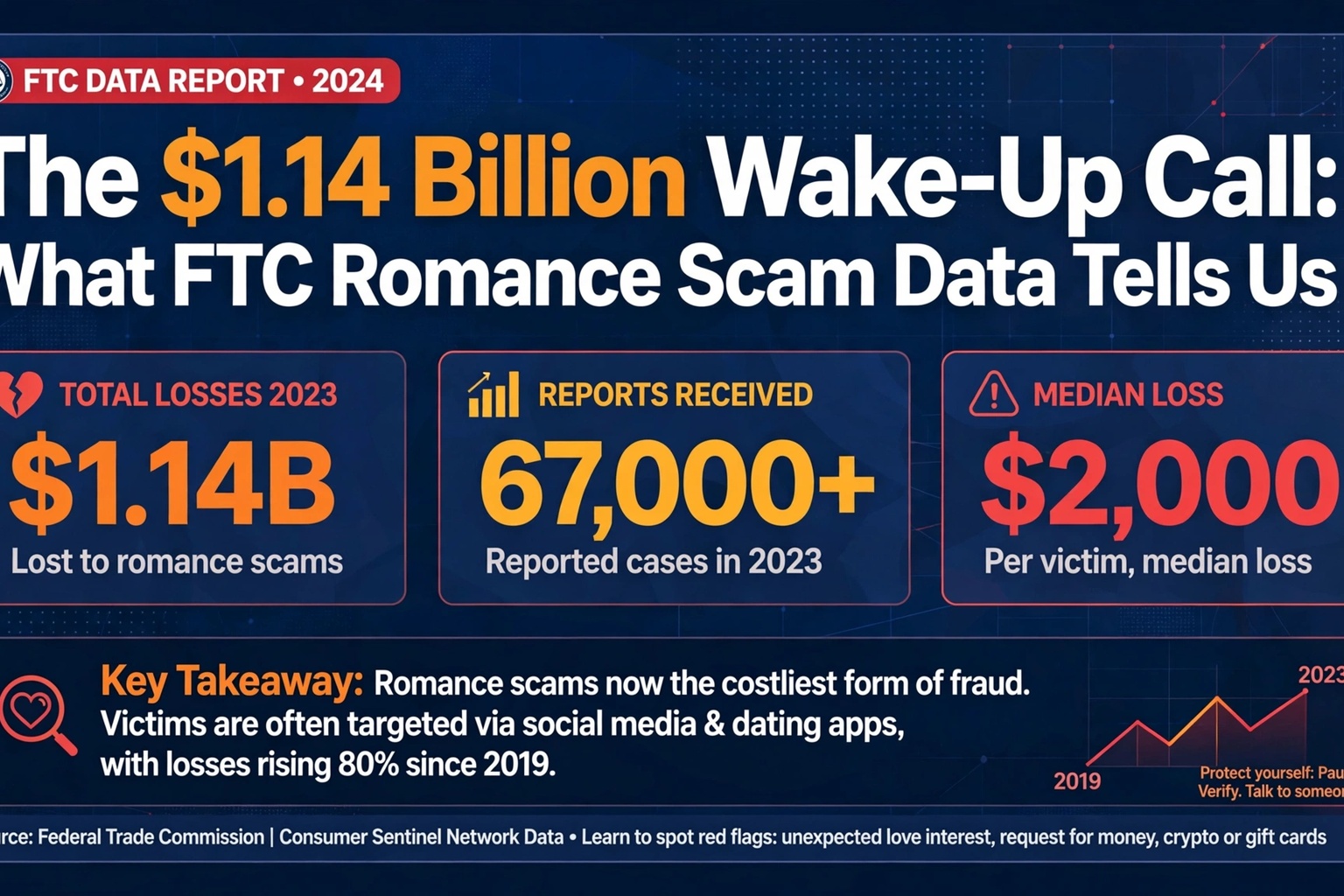
In 2023, Americans filed 64,003 romance scam reports with the Federal Trade Commission. Reported losses: about $1.14 billion. The median victim lost $2,000. Those figures come from the FTC’s Consumer Sentinel Network, cited in the Senate’s Romance Scam Prevention Act report — and they’re the kind of numbers that should end the idea that romance fraud is a niche problem.
It isn’t niche. It’s one of the most expensive fraud categories in the country, and the trend line is brutal.
The trend: up, up, up
The Senate report lays out the arc. In 2023, more than 64,000 Americans lost over $1 billion to romance scams — roughly double the roughly $500 million lost just four years earlier. In 2024, the toll held: over 59,000 consumers lost nearly $1.2 billion, again with a median loss of $2,000. The report describes it as a four-year trend of romance scams remaining one of the most popular scams among online fraudsters.
And the FTC’s broader data adds context. The agency’s 2026 data spotlight found that reported losses to scams originating on social media are eight times higher than in 2020 — and that romance scams accounted for $298 million in reported losses originating on social media in 2025 alone. The hunting ground moved to the feed, and the numbers followed.
Why the median matters more than the total
$1.14 billion is abstract. $2,000 — the median reported loss — is a rent payment, a car repair, an emergency fund. The median tells you this isn’t a story about a few spectacular victims. It’s tens of thousands of ordinary people losing meaningful money to someone who never existed.
Imposter scams, the FTC’s umbrella category for romance fraud, have been the most prevalent form of online scam reported to the agency for four straight years — driven in part, the Senate report notes, by the rise in romance scams.
What the data is really saying
Every one of these figures is a floor, not a ceiling. They’re built from people who chose to file a report — and the FBI openly acknowledges that victims often don’t report because the crime feels embarrassing and intensely personal. The real total is higher. Probably much higher.
The $1.14 billion wake-up call isn’t that scammers are clever. It’s that the system works at scale: find the lonely, manufacture the love, monetize the trust. The data proves the business model is thriving. The only question is whether the next report has your name in it — and the FTC’s answer to that is the same as ever: never send money to a sweetheart you haven’t met in person, and report what you see at ReportFraud.ftc.gov.
The Senate report adds demographic detail that should sharpen everyone’s attention: FBI data showed more than 6,700 people over age 60 lost nearly $367 million to romance scams in 2023, and the Justice Department has warned that nearly 40 percent of the military community’s fraud losses came from imposter and romance scams. The victims aren’t naive teenagers — they’re retirees, veterans, widows, and working adults. The scammers go where the savings are and where the loneliness lives. That $1.14 billion isn’t an abstraction assembled from other people’s mistakes. It’s a measurement of how well an industrial process converts human longing into cash — and the only proven circuit breaker remains the FTC’s unglamorous rule: never send money to a sweetheart you haven’t met in person.
Disclosure: The stories on Love Lies Abroad are based on publicly reported accounts. We are not stating these as facts — this is what was reported. If you are featured in a story and believe it is inaccurate, contact us and we will review it, correct it, or take it down.
Submit a correction, documentation, context, or a response for private editorial review. Contact the editorial desk.
Join the conversation
Load Facebook comments to read and reply using your Facebook account.