
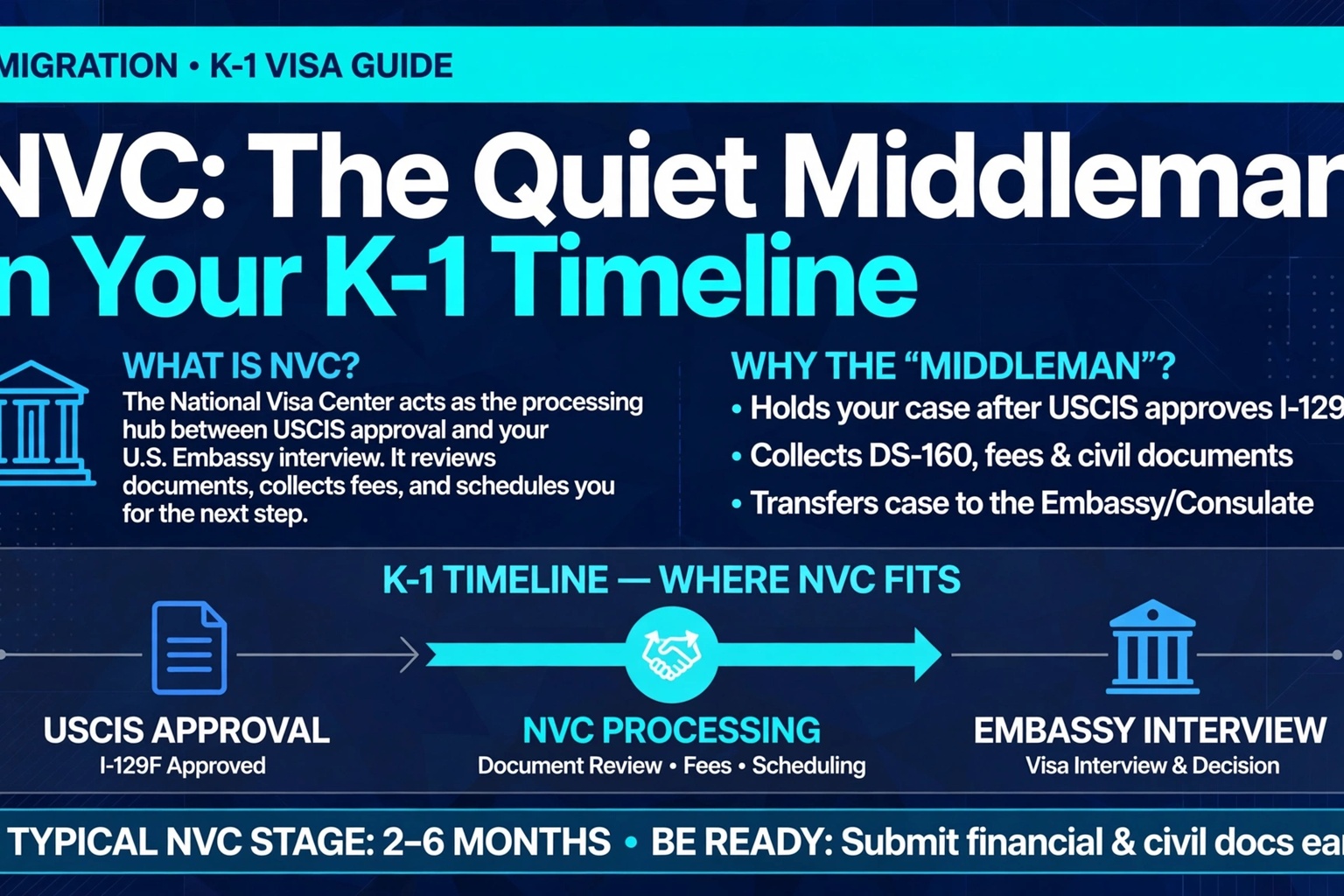
Between USCIS approval and the embassy interview sits an agency most couples have never heard of until their case lands there: the National Visa Center in Portsmouth, New Hampshire. The NVC does not approve or deny anything, yet misunderstanding its role causes some of the most avoidable anxiety in the K-1 process — panicked calls about “lost” cases that are simply moving between buildings.
What the NVC actually does
When USCIS approves the I-129F, it forwards the petition to the NVC. The NVC assigns a case number, performs its checks, and forwards the file to the U.S. embassy or consulate with jurisdiction over the beneficiary. For K-1 cases the NVC’s role is essentially logistical — unlike family immigrant visa cases, there is no fee payment or document upload through the NVC’s online Consular Electronic Application Center for K applicants. Knowing this prevents the most common NVC-stage confusion: trying to complete immigrant-visa steps that do not apply to K cases.
How long it takes
The NVC stage is typically the shortest part of the journey, often measured in weeks. After forwarding, the embassy takes over and contacts the applicant with interview instructions. Couples sometimes panic during this handoff because two different agencies’ trackers show different statuses — USCIS showing the case completed, the NVC showing it in transit, the embassy showing nothing yet. That is normal workflow, not a lost file. Give the handoff its weeks before treating silence as a problem.
What can go wrong
The classic NVC-stage problems are administrative rather than legal. A petition arriving near the end of its four-month validity needs the consular officer’s revalidation — routine, but it must happen. A case-number letter sent to an outdated address leaves the couple unable to track the file; keep addresses current with both USCIS and the NVC. Confusion about which embassy received the file arises when the beneficiary lives outside their country of nationality — jurisdiction follows residence and post capacity, not just citizenship. And in rare stretches of high volume, the NVC’s own queue adds weeks nobody predicted.
Working with the process
The NVC offers phone and online inquiry channels for case status; use the case number from its notice for every inquiry, since names alone do not reliably locate files. Calling repeatedly does not move a file faster — the NVC processes in order, and inquiries are for genuine anomalies, not impatience. Once the embassy confirms receipt, the action shifts to the applicant: scheduling the panel physician exam, assembling the document groups, and preparing for the interview. Understanding that the NVC is a courier with a database — not a decision-maker — sets the right expectations for the quietest stage of the case. Informational only.
While the NVC holds the file, use the time productively: gather police certificates, book the medical exam for shortly after the case reaches the embassy, and assemble the I-134 financial package. The NVC stage feels like dead time, but couples who treat it as preparation time routinely reach the interview weeks ahead of those who wait for the embassy’s letter to start.
Sources: https://www.uscis.gov/i-129f https://www.uscis.gov/family/family-of-us-citizens/visas-for-fiancees-of-us-citizens
Disclosure: The stories on Love Lies Abroad are based on publicly reported accounts. We are not stating these as facts — this is what was reported. If you are featured in a story and believe it is inaccurate, contact us and we will review it, correct it, or take it down.
Submit a correction, documentation, context, or a response for private editorial review. Contact the editorial desk.
Join the conversation
Load Facebook comments to read and reply using your Facebook account.