
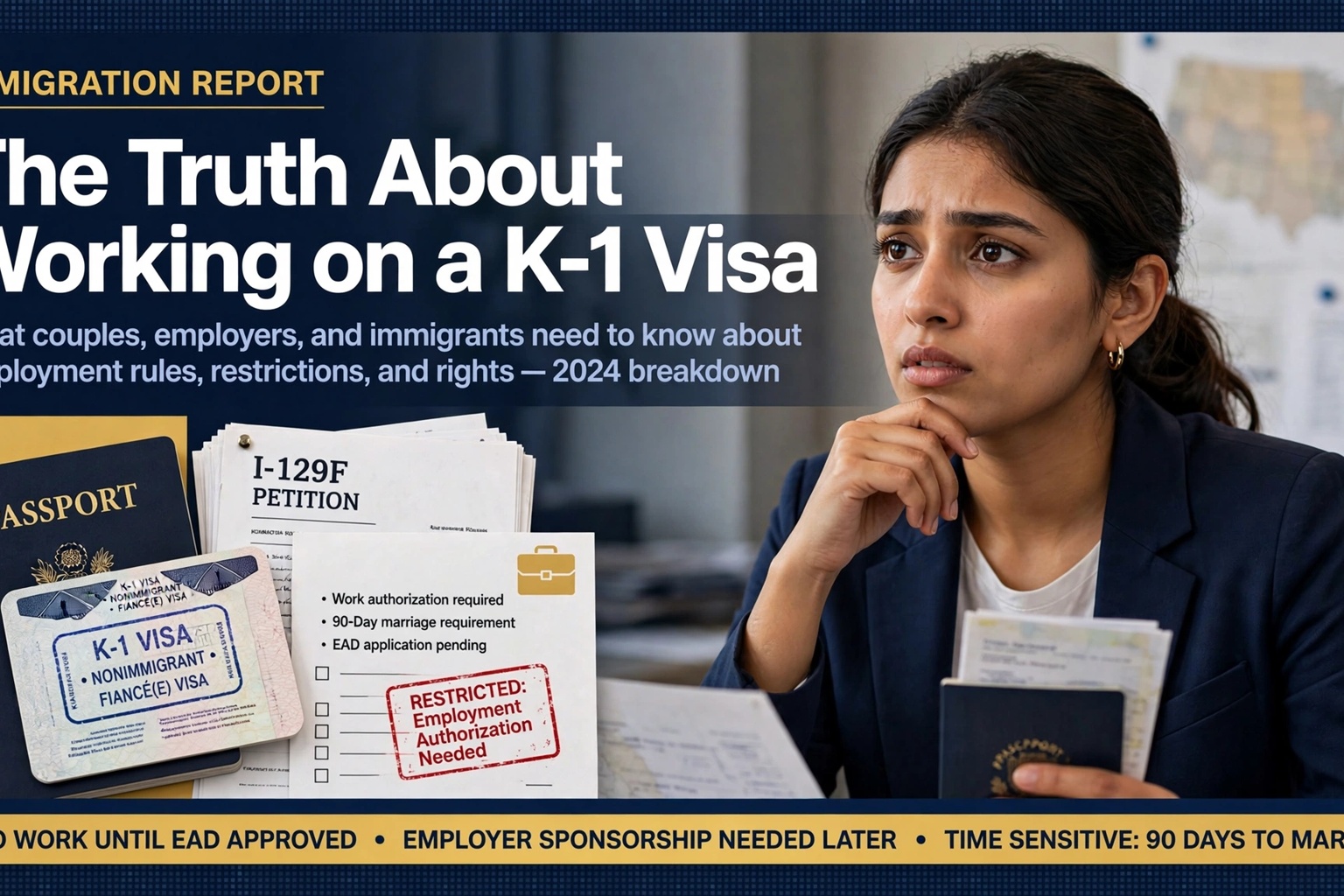
Can a K-1 fiance(e) work after arriving in the United States? Forums give confident answers in both directions. The technical answer is yes — K-1 nonimmigrants are eligible to apply for employment authorization. But the real story is that the work authorization available during the 90-day K-1 window is so constrained by timing that most couples should budget and plan as if the answer is no.
What the law allows — and why it rarely helps
A K-1 entrant may apply for an Employment Authorization Document, but the authorization is tied to the 90-day admission period. In practice, the application takes long enough to adjudicate that the 90-day window often closes before any card arrives — and once the window closes, that particular authorization is spent. Couples counting on K-1-period income to cover rent are usually disappointed, and the disappointment arrives at the worst possible moment financially.
The realistic path: work authorization after marriage
The meaningful work permit comes after the wedding. When the foreign spouse files Form I-485 for adjustment of status, the filing can include Form I-765 for employment authorization based on the pending adjustment application — a far more useful document that remains valid while the green card case is pending. Under the current fee schedule, the I-765 filed together with adjustment costs $260. File it with the I-485 immediately after the wedding rather than waiting; every week of delay is a week added to the no-income stretch. Processing still takes months, so the realistic plan is a single-income household from arrival through the arrival of this card.
Why unauthorized work is dangerous
Working without authorization — including informal cash work that feels invisible — can create serious problems. Officers ask about employment history at the adjustment interview, and unauthorized work can raise legal issues depending on the posture of the case. Beyond the legal exposure, inconsistencies between testimony and the record damage credibility on the bona fides of the marriage itself — the central question of the adjustment interview. The short-term income is never worth the long-term risk to the green card.
Special situations
Couples where the foreign spouse must work immediately — a single-income household is genuinely unaffordable — should confront that reality before filing the I-129F, not after arrival. In some cases the CR-1 spousal path, which confers work authorization on the day of admission, is the financially responsible choice despite its longer pre-entry wait. Remote work for a foreign employer while in the United States sits in a legal gray area that deserves individualized attorney advice, not forum consensus.
Planning guidance
Save for the no-income stretch during the petition stage, file the I-765 with the I-485 on day one after the wedding, and treat any advice promising quick K-1 work authorization with deep skepticism — the 90-day clock is the whole story. Informational only; employment questions with complications deserve an immigration attorney.
One practical tip: keep records of the job search even before authorization arrives — applications, correspondence, offers contingent on work permission. When the EAD finally comes, having a pipeline ready can cut weeks off the unemployed stretch, and it costs nothing to prepare while waiting.
Sources: https://www.uscis.gov/i-485 https://www.uscis.gov/family/family-of-us-citizens/visas-for-fiancees-of-us-citizens
Disclosure: The stories on Love Lies Abroad are based on publicly reported accounts. We are not stating these as facts — this is what was reported. If you are featured in a story and believe it is inaccurate, contact us and we will review it, correct it, or take it down.
Submit a correction, documentation, context, or a response for private editorial review. Contact the editorial desk.
Join the conversation
Load Facebook comments to read and reply using your Facebook account.