
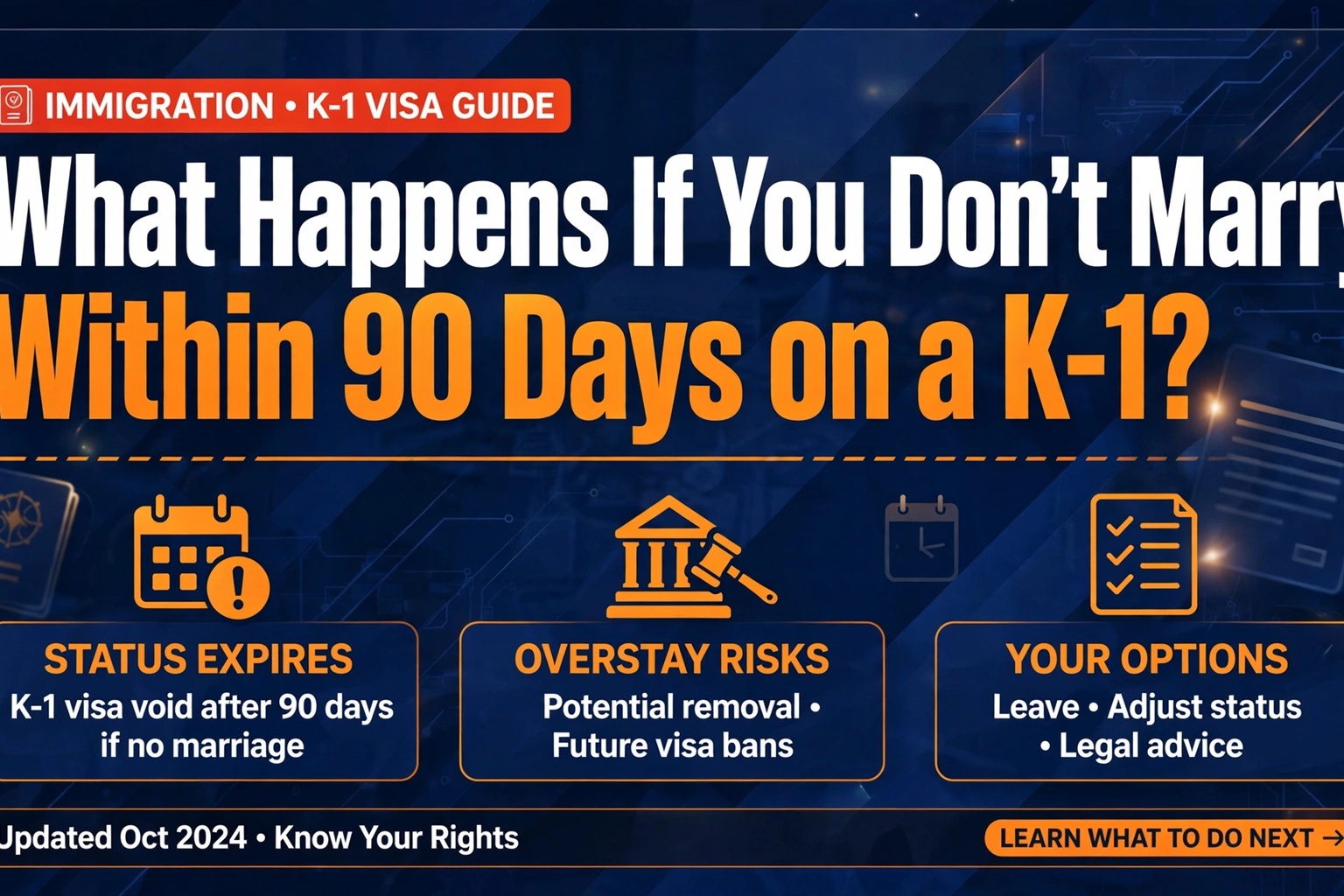
Life interferes with plans: a family emergency, a lost job, a relationship that needs more time to be sure. But the K-1 90-day marriage clock does not pause for any of it, and couples who assume flexibility exists where it does not can turn a timing problem into a multi-year separation. Here is what the law actually does when day 90 passes without a wedding.
Status ends on day 90
K-1 admission is authorized for 90 days and cannot be extended, renewed, or converted to another status from inside the United States. When the window closes without marriage to the petitioner, the foreign national is out of status and expected to depart. There is no grace period written into the statute, no pandemic-style automatic extension, and no way to “pause” the clock by leaving and reentering — the K-1 is a single-entry visa, and departure ends that admission.
Unlawful presence starts accruing
Remaining after the 90 days accrues unlawful presence, which carries the well-known three- and ten-year bars on reentry: departure after more than 180 days of unlawful presence triggers a three-year bar; departure after a year or more triggers ten years. These bars apply at the next visa application, which means every month of unauthorized stay is borrowed against the couple’s future together. There is no waiver of the 90-day marriage requirement itself.
No alternative marriage fixes it
A persistent misconception is that marrying a different U.S. citizen resets the situation. It does not. The K-1 category permits adjustment of status only through marriage to the petitioner who filed the I-129F — the statute is explicit, and decades of case law enforce it. A marriage to anyone else leaves the K-1 entrant with no adjustment path from that admission, regardless of how genuine the new marriage is.
What about a late wedding to the petitioner?
Couples sometimes ask whether marrying the petitioner on day 100 or day 200 cures the problem. The marriage itself is legally valid, but the immigration consequences of the overstay do not vanish: the period of unlawful presence still counts, and adjustment filed after the 90-day window faces the reality that status expired. An attorney needs to evaluate the specific timeline before the couple assumes the late marriage fixed everything.
What to do before the clock runs out
If the wedding cannot happen in time, the legally safe move is departure before day 90, preserving the ability to pursue other visa options — including a future K-1 or a spousal visa — without bars. If departure is impossible or the deadline has already passed, speak with an immigration attorney immediately, not after months of unauthorized stay when options have narrowed sharply. Every day past 90 without a plan makes the eventual case harder and more expensive. Informational only.
Couples sometimes wonder whether a brief trip abroad “resets” the situation after the deadline. It does not reset the unlawful presence already accrued, and departure after 180 days triggers the three-year bar on return. The math only ever gets worse with time — which is why the decision point is before day 90, never after.
Sources: https://www.uscis.gov/family/family-of-us-citizens/visas-for-fiancees-of-us-citizens https://www.uscis.gov/i-485
Disclosure: The stories on Love Lies Abroad are based on publicly reported accounts. We are not stating these as facts — this is what was reported. If you are featured in a story and believe it is inaccurate, contact us and we will review it, correct it, or take it down.
Submit a correction, documentation, context, or a response for private editorial review. Contact the editorial desk.
Join the conversation
Load Facebook comments to read and reply using your Facebook account.