
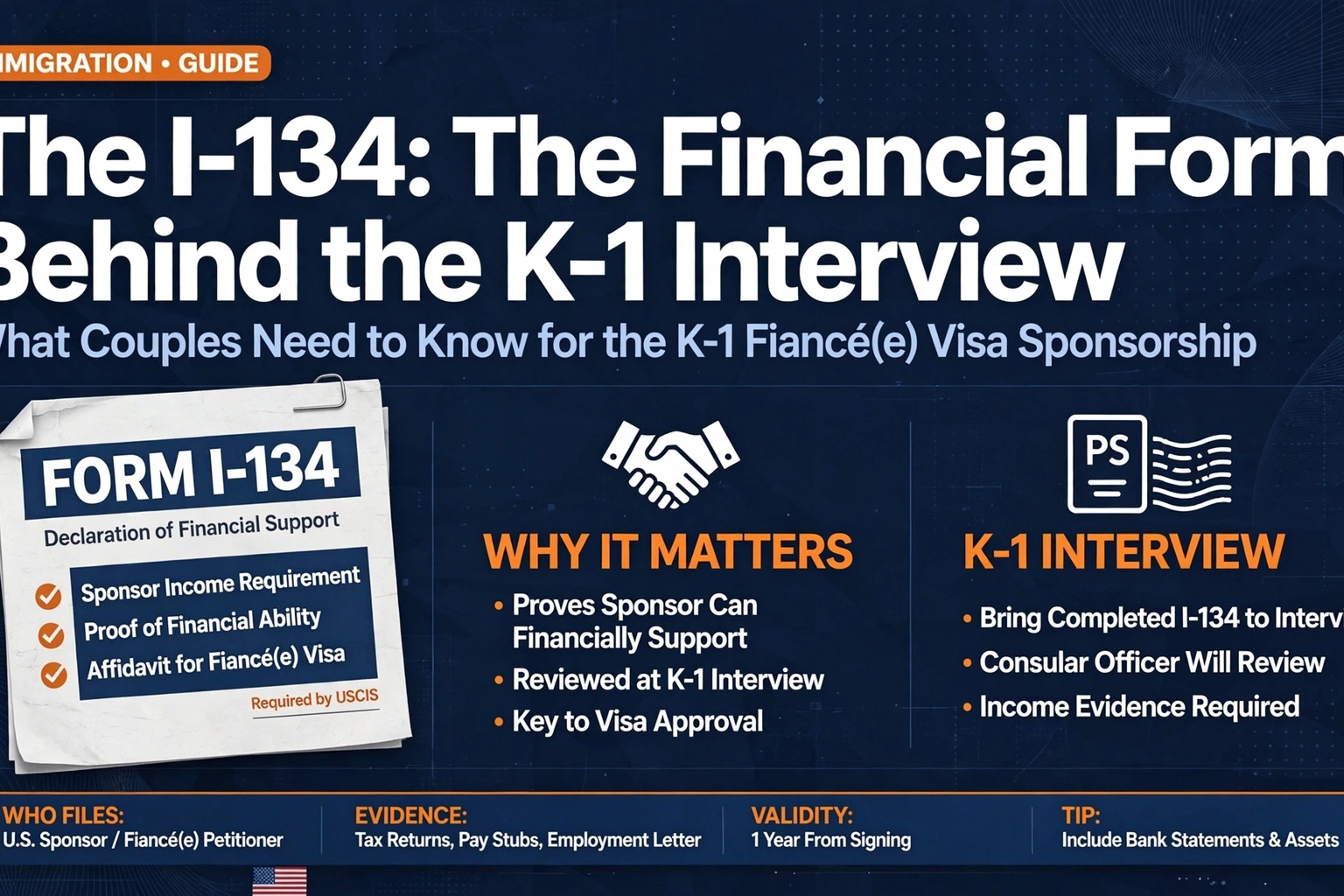
Long before anyone discusses wedding plans, the K-1 interview turns to money. Form I-134, Affidavit of Support, is the document in which the U.S. citizen petitioner promises — under penalty of perjury — to financially support the fiance(e). Consular officers treat it as a gatekeeper, and weak financial evidence is one of the quietest reasons K-1 cases stall at the window.
What the I-134 requires
The petitioner demonstrates income and assets sufficient to support the beneficiary, measured against the Federal Poverty Guidelines for the petitioner’s household size. For K visa purposes the threshold is generally 100% of the guidelines — notably lower than the 125% standard that applies later to the I-864 affidavit of support in the green card stage. Evidence typically includes recent federal tax returns, an employment verification letter stating position and salary, and recent pay stubs. Self-employed petitioners should expect closer scrutiny of what the tax returns actually show.
Counting the household correctly
One of the most common errors is miscounting household size. The beneficiary counts. The petitioner’s existing dependents count. Anyone else the petitioner is obligated to support counts. Each additional person raises the income threshold, and officers do the arithmetic themselves — a package that “looks like enough” fails if the household math was wrong.
The joint sponsor option
If the petitioner’s own income falls short, a joint sponsor — typically a U.S. citizen or permanent resident family member — can execute a separate I-134 and document their own qualifying income the same way. This is a normal, accepted part of K-1 practice, not a red flag, and officers see it daily. What matters is that the joint sponsor’s documentation is complete and their income genuinely meets the threshold on their own.
Common I-134 mistakes
Self-employed petitioners often stumble when tax returns show low net income after deductions; the officer works from the numbers on the return, not from explanations of gross revenue. Recently changed jobs need clear documentation bridging the gap. Gaps in employment history draw questions. And photocopies where the embassy requires originals or certified copies can bounce the whole package into a 221(g) hold — check the specific post’s instructions.
It does not end at the interview
After the wedding, adjustment of status requires the stronger Form I-864, with its 125% threshold and legally enforceable support obligation that survives well beyond the green card’s issuance. Couples who barely cleared the I-134 should plan for the I-864 from day one — lining up a joint sponsor early if needed, and understanding that the I-864’s obligation continues until the immigrant works 40 qualifying quarters, naturalizes, leaves permanently, or either party dies. Financial sponsorship is one area where an immigration attorney’s review pays for itself many times over. Informational only.
A final note on timing: prepare the I-134 package while the I-129F is still pending, not after approval. Tax transcripts take weeks to arrive, employer letters need requesting, and a joint sponsor needs time to gather documents. Having the financial package ready when the NVC forwards the case can shave a month off the embassy stage.
Sources: https://www.uscis.gov/i-134 https://www.uscis.gov/family/family-of-us-citizens/visas-for-fiancees-of-us-citizens
Disclosure: The stories on Love Lies Abroad are based on publicly reported accounts. We are not stating these as facts — this is what was reported. If you are featured in a story and believe it is inaccurate, contact us and we will review it, correct it, or take it down.
Submit a correction, documentation, context, or a response for private editorial review. Contact the editorial desk.
Join the conversation
Load Facebook comments to read and reply using your Facebook account.