
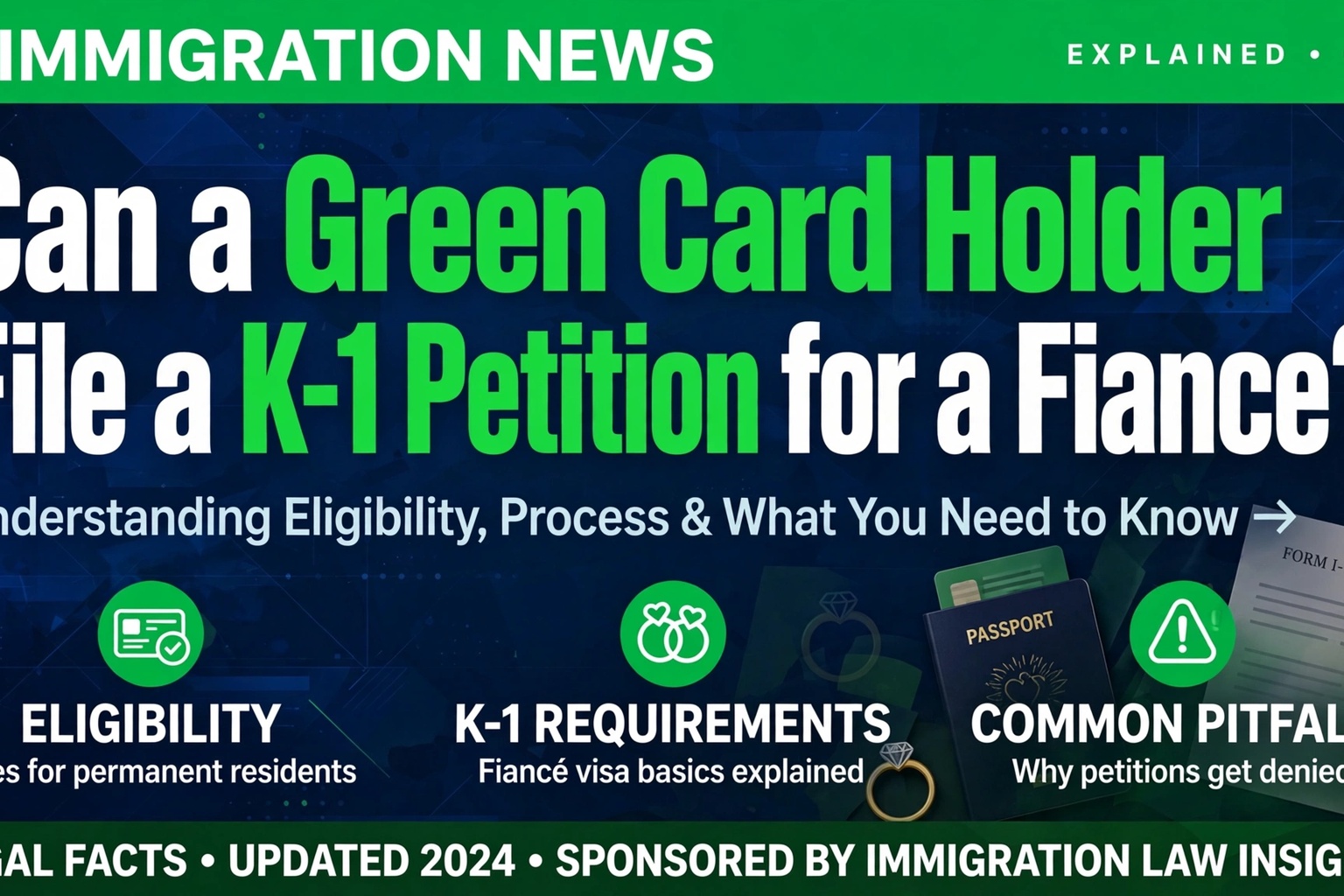
It is one of the most common misunderstandings in family immigration: a lawful permanent resident falls in love with someone abroad and assumes the K-1 fiance(e) visa is available to bring them over for the wedding. It is not. The K-1 category is reserved by statute for the fiance(e)s of U.S. citizens, and no exception, waiver, or creative filing opens it to green card holders.
The citizenship requirement
Form I-129F, the petition that starts every K-1 case, may only be filed by a U.S. citizen. A lawful permanent resident who files it will have it denied — losing the $675 filing fee and months of waiting for an answer that was predetermined. USCIS is explicit on this point, and it is one of the few K-1 eligibility rules with no gray area and no workaround.
What a green card holder can actually do
The realistic path is marriage first, then sponsorship. After the wedding, the permanent resident files Form I-130, Petition for Alien Relative, for the spouse. Spouses of green card holders fall into the family second preference category (F2A), which — unlike spouses of U.S. citizens — is subject to annual numerical limits. That means a visa queue: the priority date (the date USCIS receives the I-130) must become “current” under the State Department’s monthly Visa Bulletin before the spouse can apply for the immigrant visa. The wait has varied enormously over the years, from months to years, and the Visa Bulletin is the only source that matters.
The naturalization shortcut
Many permanent residents in this situation weigh naturalization seriously. A permanent resident who becomes a U.S. citizen gains two advantages at once: the ability to file an I-129F for a fiance(e), or — if already married — an I-130 for a spouse in the “immediate relative” category, which is not subject to numerical limits and is typically far faster than the F2A queue. The trade-off is the time naturalization itself takes, including the continuous residence and physical presence requirements. For someone already close to eligibility, it is often the fastest overall route to living together in the United States.
Avoiding the expensive mistake
The worst outcome is filing the wrong petition and learning the rule a year later. Before choosing a path, confirm the petitioner’s exact status, check the current Visa Bulletin for F2A movement, and realistically assess naturalization timing. Because the F2A backlog shifts and individual circumstances — prior immigration history, criminal records, previous marriages — change the analysis, this is a situation where consulting an immigration attorney before filing is genuinely worthwhile. Informational only.
There is one more wrinkle worth knowing. If the permanent resident’s spouse is already in the United States in another lawful status when the F2A priority date becomes current, adjustment of status inside the U.S. may be possible — but lawful status must have been maintained throughout, since overstays generally bar adjustment in preference categories. And the petitioner’s own naturalization, once eligible, upgrades any pending I-130 to the immediate-relative category upon proof of citizenship. Timing these moving pieces is exactly where professional advice pays off.
Sources: https://www.uscis.gov/i-130 https://www.uscis.gov/family/family-of-us-citizens/visas-for-fiancees-of-us-citizens
Disclosure: The stories on Love Lies Abroad are based on publicly reported accounts. We are not stating these as facts — this is what was reported. If you are featured in a story and believe it is inaccurate, contact us and we will review it, correct it, or take it down.
Submit a correction, documentation, context, or a response for private editorial review. Contact the editorial desk.
Join the conversation
Load Facebook comments to read and reply using your Facebook account.