
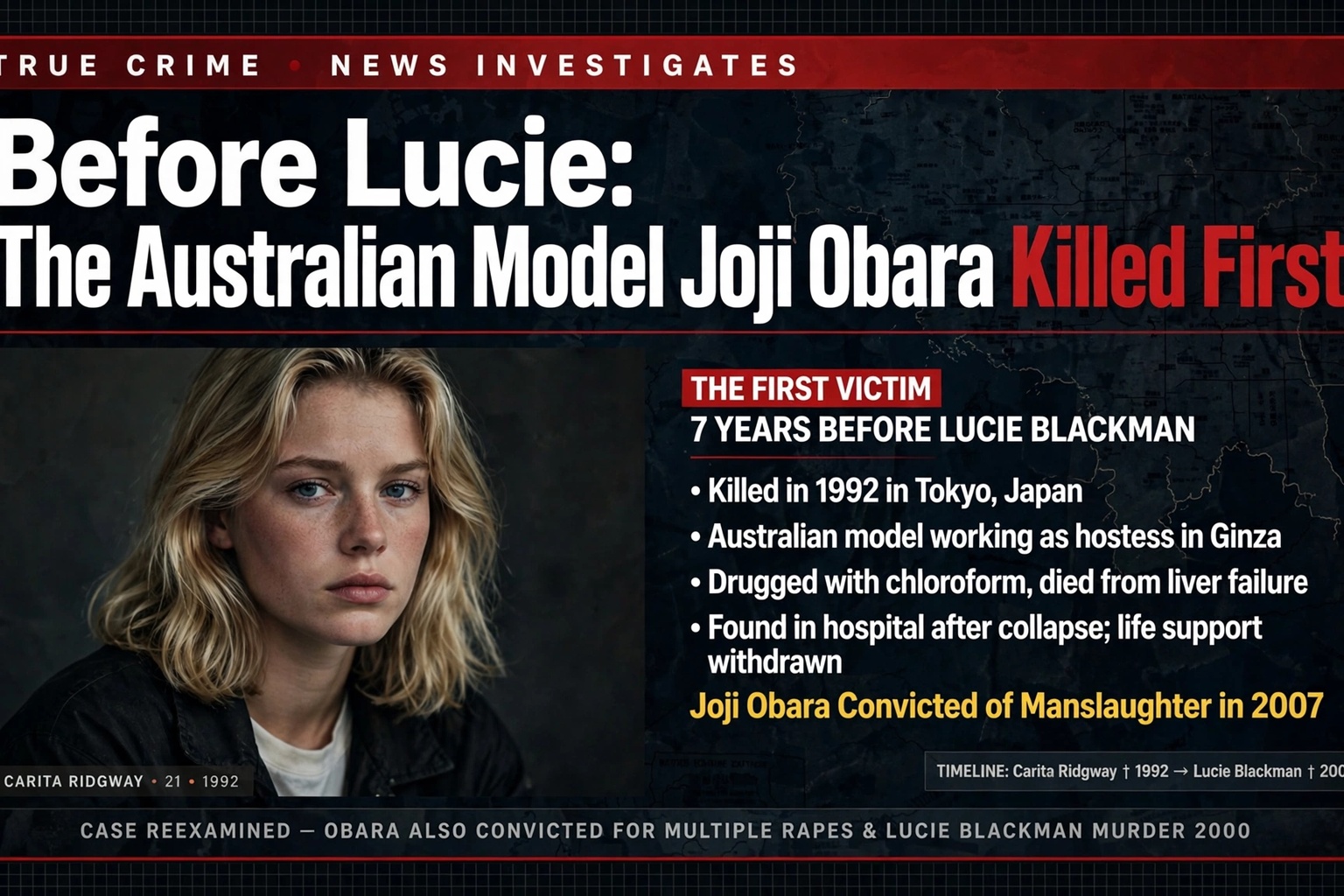
Years before Lucie Blackman’s disappearance made headlines around the world, Carita Ridgway — a 21-year-old Australian model working as a hostess in Japan — accepted a lift home from work from Joji Obara in 1992. He drugged her with chloroform. She died of liver failure and brain death after he dumped her at a Tokyo hospital under a false name, claiming she was having a bad reaction to shellfish.
At the time, her death did not trigger the investigation it deserved. Her file gathered dust while Obara refined his methods. By the time police finally searched his homes, they would recover hundreds of tapes and a stockpile of sedatives and chloroform — the toolkit of a man who had learned, from Carita, exactly how much was too much. It was recorded as a medical tragedy — at one point attributed to Hepatitis E — and the file was closed. Obara walked away clean, and for nearly a decade he kept operating: the videotapes later found in his properties would document assaults on as many as 150 to 400 women between 1992 and 2000.
It was only the massive Blackman investigation that finally tied Obara to Ridgway. When police searched his properties in 2000, they found a videotape of the assault on Carita — and a diary entry in his own hand that read, in essence: “Carita Ridgway, too much chloroform.” An autopsy re-examination found traces of chloroform in her liver, and investigators built a paper trail showing Obara had been the one to deliver her to the hospital that night.
The evidence told a story of casual, practiced cruelty. Obara had a routine: drinks laced with sedatives, assaults recorded on video, and if a victim stirred, a chloroform-soaked rag to put her under again. With Carita, he misjudged the dose. Instead of calling for help, he invented a story about bad shellfish and left her at the hospital to die.
In April 2007, Obara was convicted of the rape and manslaughter of Carita Ridgway, alongside multiple rape charges involving other women, and sentenced to life in prison. Her family finally had a verdict — and with it, a bitter accounting of the 1992 investigation that had let her killer go free to claim more victims, including Lucie Blackman eight years later. They had waited fifteen years for a court to say what they had always known: their daughter did not die of hepatitis, and the man who carried her into that hospital was the reason she never woke up.
Ridgway’s case is the quieter half of the Obara story — no international manhunt, no Netflix documentary, no headlines. Just a young Australian woman whose death was misread for years while her killer continued to operate. Her conviction came only because investigators, digging into Obara for Blackman, refused to let the older file stay closed.
Together, the Blackman and Ridgway cases form a two-part warning about the vulnerabilities of young Western women working in Japan’s nightlife economy in that era — and about how killers who are not caught keep killing.
Disclosure: The stories on Love Lies Abroad are based on publicly reported accounts. We are not stating these as facts — this is what was reported. If you are featured in a story and believe it is inaccurate, contact us and we will review it, correct it, or take it down.
Submit a correction, documentation, context, or a response for private editorial review. Contact the editorial desk.
Join the conversation
Load Facebook comments to read and reply using your Facebook account.