
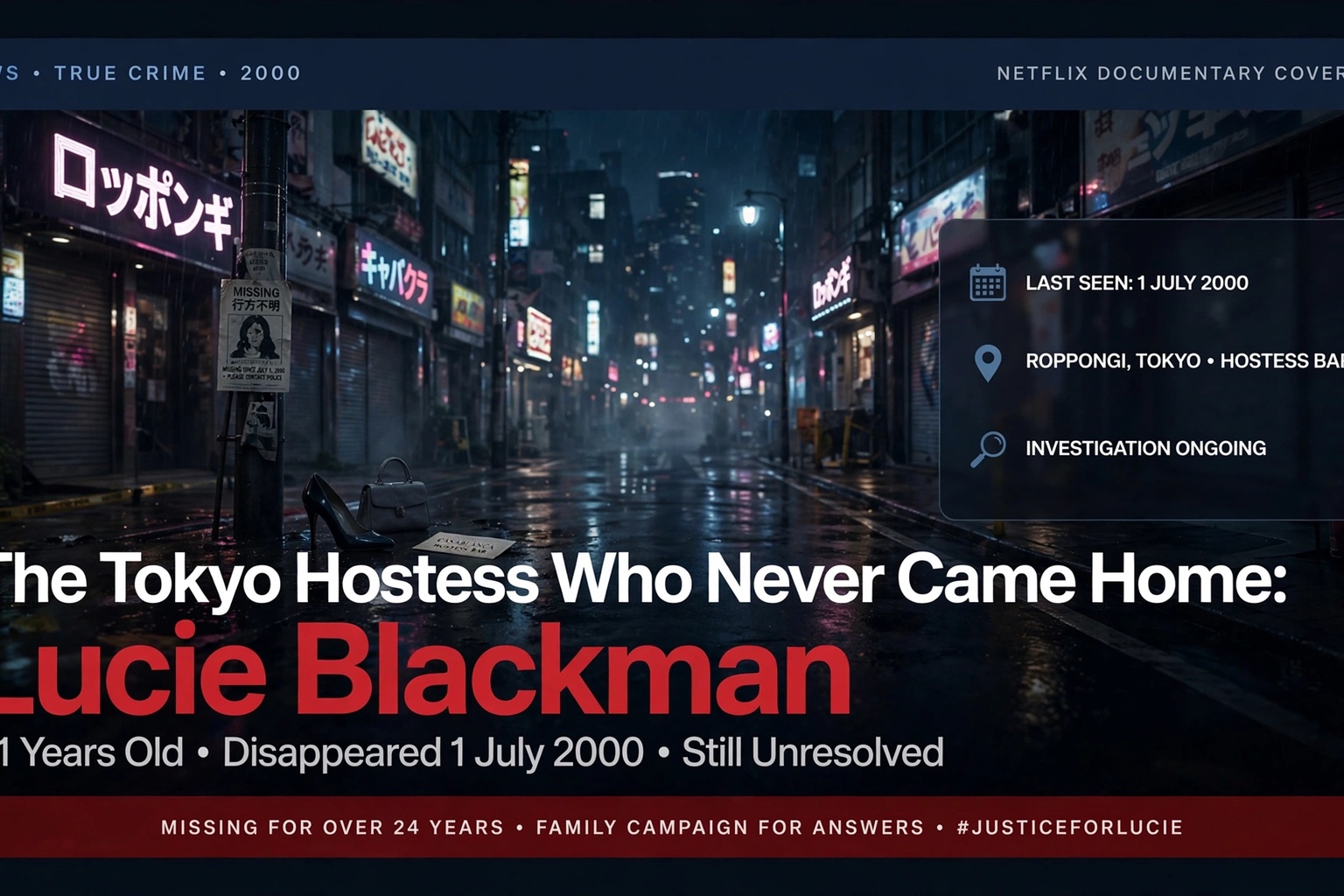
Lucie Blackman, a 21-year-old former British Airways flight attendant from Sevenoaks, Kent, had gone to Japan in May 2000 seeking adventure. She was working as a hostess at the Casablanca nightclub in Tokyo’s Roppongi district — a job where paid dates with customers were part of the arrangement — when she agreed to have dinner with a wealthy client, Joji Obara, on July 1, 2000. She never came home.
Her disappearance triggered a massive international search. Her father, Tim Blackman, flew to Japan and campaigned relentlessly, and the case drew intense media coverage in Britain. But investigators were slow to treat it as a serious criminal case — critics later said police hesitated partly because Lucie was working in a job from which young women often simply vanish without notice. Precious months passed.
Obara was arrested in October 2000 on assault accusations from other women, and the net began to close. Police searching his properties found roughly 400 videotapes documenting assaults on unconscious women, along with receipts for a chainsaw, cement, and a portable tent. Witnesses who had survived nights in his bed came forward describing waking up sore and sick with no memory of what had happened.
What investigators eventually uncovered was horrifying: Blackman had been drugged, assaulted, and killed. Her dismembered body was found on February 9, 2001 — 223 days after she vanished — her head encased in concrete, buried in a seaside cave at Aburatsubo, near one of Obara’s coastal properties. The remains were in such poor condition that a cause of death could never be determined.
Obara, a wealthy property developer who had amassed a fortune in Japan’s bubble economy, maintained his innocence through one of Japan’s longest criminal prosecutions. When the verdict came in April 2007, it stunned the family: he was acquitted of Lucie’s rape and murder for lack of direct evidence, but convicted of multiple rapes and of the manslaughter of Australian woman Carita Ridgway — and sentenced to life in prison.
The prosecution appealed, and in December 2008 the Tokyo High Court went further: it found Obara guilty of the abduction, dismemberment, and disposal of Lucie Blackman’s body, cementing the life sentence. Japan’s Supreme Court rejected his final appeal, and he remains in prison. The legal path was complex — he was never convicted of murdering Lucie — and the reporting must reflect what the courts actually found, not what investigators believed.
The case also tore the family apart in public. During the trial, an associate of Obara offered both parents a Japanese “condolence payment” of 100 million yen each. Tim Blackman accepted; Lucie’s mother, Jane Steare, refused her offer and called the money blood money, a betrayal. Her sister Sophie said only that what mattered was that Obara was finally being held responsible.
The case became one of the most high-profile crimes involving a foreigner in Japan and was later the subject of the Netflix documentary “Missing: The Lucie Blackman Case.” It also exposed a second victim — Carita Ridgway, an Australian woman killed by Obara years earlier, whose case was only solved because of the Blackman investigation. Together the two cases form a grim record of a predator who operated for nearly a decade because the first death was never properly investigated.
Disclosure: The stories on Love Lies Abroad are based on publicly reported accounts. We are not stating these as facts — this is what was reported. If you are featured in a story and believe it is inaccurate, contact us and we will review it, correct it, or take it down.
Submit a correction, documentation, context, or a response for private editorial review. Contact the editorial desk.
Join the conversation
Load Facebook comments to read and reply using your Facebook account.