
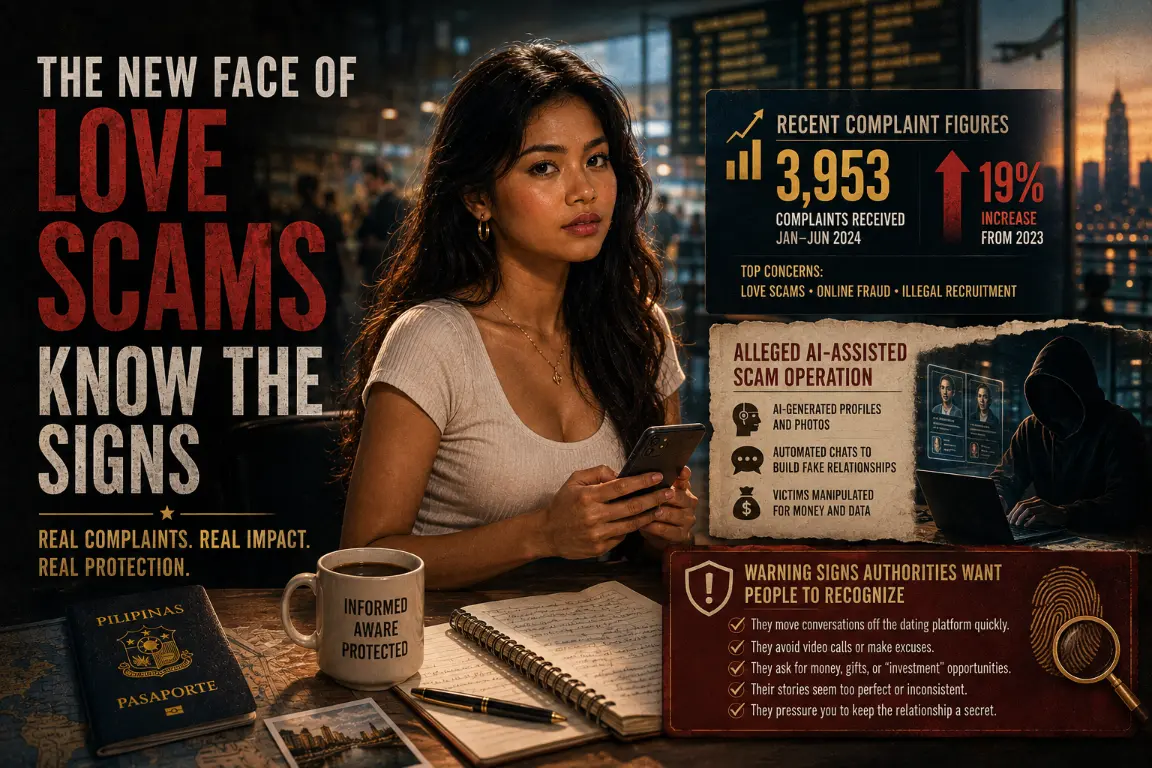
Evidence note: National totals below are attributed to Philippine authorities. The people arrested in a May 2026 operation are accused, not convicted, and this article makes no finding about their guilt.
Romance scams turn trust into leverage. The approach may begin with a dating profile, a social-media message, or a wrong-number text. The requests often come later: emergency expenses, travel money, an investment opportunity, customs fees, or access to an account.
What recent figures show
The Philippine News Agency reported figures attributed to the Philippine National Police Anti-Cybercrime Group showing 75 recorded love-scam cases in 2024, 54 in 2025, and six from January 1 through February 5, 2026. A separate PNA report said the Cybercrime Investigation and Coordinating Center received 123 formal love-scam complaints in 2025.
Those figures describe recorded cases and complaints, not the full scale of harm. People may stay silent because they are embarrassed, fear family judgment, or believe the money cannot be recovered.
Technology can make the deception harder to spot
In May 2026, the National Bureau of Investigation announced the arrest of 17 people after an operation in Parañaque. The NBI alleged that the group used fabricated identities, artificial-intelligence tools, and scripted romantic conversations to target victims abroad. Those are law-enforcement allegations at the arrest stage; the release does not establish a conviction.
The fake-parcel pattern
The Bureau of Customs warns about a recurring scheme in which an online contact claims to have sent a valuable package. A supposed courier or customs representative then demands payment for duties, taxes, clearance, or a penalty. Real customs transactions should be verified through official channels, not a number or payment link supplied by the romantic contact.
Warning signs
- The relationship becomes intense before identities and everyday details can be verified.
- The person repeatedly avoids live, unscripted video or gives explanations that cannot be checked.
- A crisis, parcel, travel plan, or investment suddenly requires money.
- Payment is requested through cryptocurrency, gift cards, money mules, or an account in someone else’s name.
- The contact asks for identification documents, intimate images, banking access, or one-time security codes.
What to do
Stop sending money and preserve the conversation, profile links, receipts, account details, and phone numbers. Contact the bank or payment service quickly. Report the account to the platform and make a report through the appropriate Philippine cybercrime or law-enforcement channel. If intimate images are involved, do not pay a blackmail demand; preserve evidence and seek help.
A sincere cross-border relationship can withstand verification. Asking for time, documentation, independent contact details, and a live conversation is not distrust—it is basic safety.
Disclosure: The stories on Love Lies Abroad are based on publicly reported accounts. We are not stating these as facts — this is what was reported. If you are featured in a story and believe it is inaccurate, contact us and we will review it, correct it, or take it down.
Sources
- Philippine News Agency — PNP love-scam case figures reported in 2026 — Attributes annual and early-2026 case counts to the PNP Anti-Cybercrime Group.
- Philippine News Agency — CICC complaint figures and scam patterns — Attributes 2025 formal complaint total to CICC.
- National Bureau of Investigation — NBI operation involving alleged AI-assisted love scams — Official arrest-stage allegations; no conviction asserted.
- Bureau of Customs — Online love scam advisory — Official warning about fake parcels and customs-payment demands.
Submit a correction, documentation, context, or a response for private editorial review. Contact the editorial desk.
Join the conversation
Load Facebook comments to read and reply using your Facebook account.